

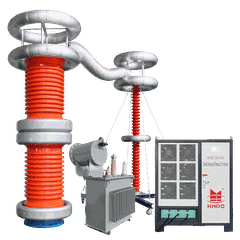


How to Identify Resonance Points in a Variable Frequency Series Resonance Test Device?
Variable frequency series resonance test devices are widely used in the inspection and verification of high-voltage equipment. Their primary function is to achieve resonance by adjusting frequency, thereby testing equipment performance and insulation characteristics. The occurrence of resonance is intrinsically linked to the interaction between circuit components. A thorough understanding of its principles is crucial for effectively utilizing this device.

I. Fundamental Principles of Resonance
Resonance occurs when the reactive forces of inductive and capacitive components in a circuit cancel each other out at a specific frequency. When inductance (L) and capacitance (C) are connected in series, their resonant frequency (f₀) can be calculated using the formula:

At the resonance point, the circuit impedance reaches its minimum value while the current reaches its maximum value. This characteristic makes the circuit highly sensitive to external power sources at the resonance frequency.
II. Process of Variable Frequency Scanning to Locate Resonance Points
The device's variable frequency power supply continuously outputs a frequency sweep within a preset range (typically ascending or descending).
During the sweep, the control system continuously monitors the loop current, reactor voltage, and test specimen voltage.
When the loop current reaches its peak and the voltage across the test specimen (test voltage) simultaneously peaks, the corresponding power supply frequency is identified as the resonant frequency of the test circuit.
Note:
- The resonance point's position is closely related to the test specimen's equivalent capacitance: different specimens possess varying capacitances C, resulting in distinct resonance frequencies
 .
- During testing, if the specimen's insulation performance degrades or breaks down, its equivalent capacitance undergoes sudden change. This disrupts the circuit's resonant state, causing abrupt fluctuations in current and voltage. The device can thus detect insulation defects in the test specimen.


