

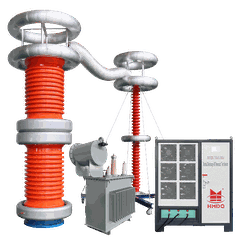




I. Working principle of the device
The core technology of the non-localized series resonant device lies in the deep combination of series resonance (LC circuit) and frequency conversion technology, and its working principle can be expanded from the following two aspects:
1. The realization mechanism of series resonance (LC circuit)
The device forms an LC series circuit using the inductor (L) of the reactor and the capacitance (C) of the test specimen. When the frequency output by the variable frequency power supply meets the resonant condition ωL = 1/ωC (where ω is the angular frequency, and ω = 2πf), the circuit reaches series resonance. At this point, the circuit impedance is at its minimum (only resistive R), the current is maximized, and the voltage amplitudes across the inductor and capacitor are equal but opposite in phase, with energy being mutually compensated between the magnetic field of the inductor and the electric field of the capacitor. Due to the extremely low resistance R of the test circuit (usually composed of wires and contact resistance), the quality factor Q (Q= ωL/R) can exceed 50, making the voltage on the test specimen Q times the excitation voltage. This allows for high-voltage output at low input power, solving the problem of requiring large-capacity power supplies in traditional withstand voltage tests.
2. Synergistic effect of frequency conversion technology
Frequency conversion technology is key to achieving resonant regulation. The device uses a frequency converter to transform the fixed-frequency (50Hz) industrial power supply into a sine wave with adjustable amplitude and frequency (frequency range 30-300Hz), matching the resonant frequency requirements of different test specimens. In resonance, the circuit exhibits low impedance to the fundamental wave and high impedance to higher harmonics, thus outputting a well-shaped sine voltage and avoiding harmonic interference that could affect partial discharge testing. Additionally, frequency conversion technology supports precise frequency adjustment (a combination of coarse and fine adjustments), ensuring the system quickly locks onto the resonant point, enhancing testing efficiency.
(As shown in the figure, the working flow chart of the series resonant device without partial discharge is clearly marked with the resonant condition ωL=1/ωC)

Quality factor Q is a key indicator for measuring the energy conversion efficiency of series resonant circuits. Its calculation formula is Q= ωL/R (where ω is angular frequency, L is inductance, and R is circuit resistance) or Q = Ucx/Ulx (where Ucx is the terminal voltage of the test specimen, and Ulx is the excitation voltage). In non-biphasic series resonant devices, due to the extremely low resistance R of the test loop (mainly composed of wire and contact resistance), the quality factor Q of the loop can typically exceed 50.
The technical characteristics of high Q values bring significant advantages: Firstly, the output voltage is Q times the excitation voltage, allowing the device to achieve high-voltage output with lower input power, effectively addressing the issue of insufficient capacity in traditional AC withstand voltage tests. For example, if the excitation voltage is 1kV and Q = 50, the test specimen terminal voltage can reach 50 kV, significantly reducing the requirement for power supply capacity. Secondly, under resonant conditions, the loop exhibits low impedance (only R) to the fundamental wave and high impedance to higher harmonics, thus producing a well-shaped sinusoidal voltage, avoiding the impact of harmonic interference on partial discharge testing. Thirdly, a high Q value means minimal energy loss in the loop; all reactive power required by the test specimen is supplied by the reactor, while the power source only needs to provide active power loss in the loop, significantly enhancing testing efficiency and energy utilization.
In addition, the characteristic of Q≥50 also enhances the safety of the device. When the test specimen is discharged or broken down, the resonant condition is destroyed, the loop impedance increases, the voltage drops rapidly, and the short circuit current supplied by the power supply is reduced by the restriction of the reactance, effectively limiting the damage degree of the tested equipment.
The safety protection mechanism of the non-localized series resonant device is the core design to ensure the safety of equipment and personnel during the test. It effectively deals with the abnormal working conditions that may occur during the test through the synergistic action of multiple protection measures. The specific protection mechanism is as follows:
1. Overvoltage protection
The device is equipped with an overvoltage protection module, which can set the overvoltage protection threshold according to testing requirements (usually 1.1 times the rated voltage). When the terminal voltage of the test specimen exceeds the set value due to resonance abnormalities or external interference, the system immediately cuts off power output to prevent insulation breakdown or damage caused by excessively high voltage. For example, the ZXWXZ series devices can operate continuously for 60 seconds at 1.1 times the rated voltage without flashover or insulation damage, and the overvoltage protection will activate quickly if the voltage exceeds this limit.
2. Overcurrent protection
Overcurrent protection monitors the loop current in real time. When the current exceeds the rated value (such as due to a short circuit in the test specimen or an abnormal decrease in loop impedance causing a surge in current), it triggers the protection mechanism to cut off the power supply. This protection prevents overheating or damage to core components like frequency converters and reactors caused by overcurrent, while also avoiding secondary damage to the tested equipment.
3. Flashover protection
Flashover protection is a specialized safeguard against insulation breakdown or partial discharge flashovers in test specimens. When a specimen experiences flashover, the resonant condition is disrupted (the equivalent capacitance is short-circuited), causing a sudden drop in loop voltage. The system quickly identifies the flashover event through voltage surge detection, immediately stops voltage output, and records the voltage value at the time of flashover, providing data support for subsequent fault analysis. For example, some devices retain the flashover voltage value after the flashover protection activates, facilitating the assessment of the specimen's insulation performance by test personnel.
4. Other auxiliary protection
In addition to the above core protection, the device is also equipped with multiple auxiliary protection measures, including:
Power loss protection: when the power supply is interrupted accidentally, the current test data is automatically saved and the system is reset to avoid confusion of parameters after restart;
Out-of-tune protection: When the system is out of tune due to frequency shift or capacitance/inductance parameter changes, the protection is triggered and prompted to re-tune to ensure that the test is carried out in a resonant state;
Cooling fan linkage protection: monitor the temperature of frequency converter power supply and reactor, when the temperature exceeds the safety threshold, force start the cooling fan and limit the power output to prevent overheating of equipment due to poor heat dissipation;
Short circuit protection: when the circuit is short circuit, the power supply is quickly cut off to limit the impact of short circuit current on the equipment.
Through the above multi-level and multi-dimensional security protection mechanism, the no-burden series resonance device can effectively reduce the risk of equipment damage in the high-voltage test scenario, ensure the safety of test personnel, and improve the reliability and data accuracy of the test process.
2. Analysis of environmental emission causes
The aging of insulating materials is one of the core causes of environmental partial discharge, which is particularly affected by temperature and humidity. The specific mechanism is as follows:
1. Accelerated aging effect of temperature on insulating materials
During the long-term operation of electrical equipment, insulating materials (such as cables and transformer windings) can experience thermal aging due to increased ambient temperature or heat generated by the equipment itself (such as Joule heating). Increased temperatures can damage the molecular structure of insulating materials, leading to the breaking of polymer chains and a decrease in crosslink density. The material gradually loses its elasticity and becomes brittle, significantly reducing insulation performance (such as breakdown strength and volume resistivity). For example, when cable insulation materials are exposed to sustained high temperatures (such as exceeding their rated temperature rating), molecular thermal motion intensifies, and internal defects (such as micro-pores and impurities) gradually expand, forming localized electric field distortion points, ultimately triggering partial discharges.
2. The influence of humidity on the deterioration of insulation materials
Increased humidity can accelerate the aging of insulating materials through two pathways: First, water penetrates the interior of the insulation, reducing its dielectric strength and forming localized conductive channels, which increase leakage current and eventually lead to thermal breakdown. Second, water reacts with chemical additives in the insulation material (such as antioxidants and plasticizers) to produce corrosive substances (like acids), which corrode the insulation layer and generate bubbles. These bubbles are prone to ionization under the influence of an electric field, becoming the starting point for partial discharges. For example, when cables operate in humid environments, water seeps through micro-pores in the insulation layer and combines with polar groups in the insulation material to form a "water tree" structure. The concentrated electric field at the tips of these water trees can directly trigger partial discharges.
3. The synergistic effect of temperature and humidity aggravates aging
The synergistic effect of temperature and humidity can further accelerate the degradation of insulating materials. For example, in high-temperature environments, the water absorption rate of insulating materials increases, while rising humidity reduces thermal stability, creating a vicious cycle of "temperature-humidity-thermal aging." Additionally, drastic changes in temperature and humidity due to day-night temperature differences or seasonal transitions can cause thermal expansion and contraction in insulating materials, leading to internal stress and micro-cracks. These cracks are prone to accumulate charge under the influence of an electric field, eventually developing into partial discharge channels.
In conclusion, temperature and humidity significantly accelerate the aging of insulation materials by directly destroying molecular structure, promoting water intrusion and synergistic stress, which is an important cause of environmental partial discharge.
Mechanical damage and electric field distortion are two key causes of environmental partial discharge, which often work together to lead to the occurrence and development of partial discharge. The specific mechanism is as follows:
1. Direct effects of mechanical damage
Electrical equipment is prone to mechanical damage to its insulation layer during installation, operation, or transportation due to external forces (such as bending, stretching, squeezing, and bumping), leading to micro-cracks, damage, or structural deformation. For example, if cable installation techniques are improper, excessive bending can cause micro-gap formation within the insulation layer; during transportation, collisions with GIS equipment may trigger displacement or collision of internal floating structures, resulting in metal particles or sharp burrs. These mechanical damages can compromise the integrity of insulating materials, reduce local insulation performance, and turn the damaged area into a weak point where electric fields concentrate, providing initial conditions for partial discharges.
2. Trigger mechanism of electric field distortion
The presence of mechanical damage or defects in equipment manufacturing processes (such as burrs and edges on the conductor surface, dust and impurities on the insulation component surface, uneven welds on the inner surface of the shell) can lead to non-uniform local electric field distribution, forming electric field distortion zones. For example, burrs on the conductor surface can cause the local electric field strength to be significantly higher than the average field strength (up to several times or even tens of times). When this field strength exceeds the breakdown voltage of the insulating material, the air or insulating medium at the tip of the burr can ionize, triggering partial discharge. Additionally, micro-pores or impurities (such as water and gases) within the insulation layer can concentrate the electric field due to differences in dielectric constant under the influence of the electric field. The gas molecules within these pores are ionized, forming discharge channels.
3. Synergistic effect of mechanical damage and electric field distortion
Mechanical damage and electric field distortion do not act independently but rather exacerbate each other. For example, micro-cracks in the cable insulation (mechanical damage) can expose burrs on the internal conductor (a source of electric field distortion). The high electric field at the tip of these burrs further tears the cracks, expanding the area of damage. At the same time, moisture or gas that intrudes into the cracks (due to reduced sealing caused by mechanical damage) lowers the local dielectric strength, making discharges more likely in areas with electric field distortion. This vicious cycle ultimately leads to partial discharges evolving from occasional, weak events to continuous, intense discharges, accelerating the degradation of equipment insulation and potentially causing insulation breakdown or equipment failure.
Industrial pollution is one of the important inducers of environmental discharge. It accelerates the deterioration of insulating media significantly through pollutant deposition, chemical corrosion and electric field distortion. The specific mechanism is as follows:
1. The deposition of pollutants leads to the decrease of surface insulation strength
In industrial environments, there is often a large amount of dust, particulate matter, and oil contamination. These substances tend to adhere to the surface of insulating layers in electrical equipment (such as cables, GIS equipment, and ring main units), forming conductive or semi-conductive pollution layers. For example, when dust on the surface of cable insulation combines with moisture, it can create localized conductive pathways, leading to increased leakage current; when oil contamination mixes with dust on the surface of insulators in ring main units, it may reduce the surface breakdown voltage, causing surface discharge even at normal operating voltages.
2. Chemical degradation caused by corrosive gases
Corrosive gases emitted by industrial processes (such as sulfur dioxide, nitrogen oxides, and hydrogen sulfide) can chemically react with insulating materials (like epoxy resin and silicone rubber), disrupting their molecular structure. For example, sulfur dioxide dissolves in water to form sulfurous acid, which corrodes the cross-linked polyethylene (XLPE) material in cable insulation layers, causing molecular chain breaks and reduced crystallinity, significantly degrading insulation properties (such as volume resistivity and breakdown strength). Additionally, corrosive gases accelerate the oxidation of metal components (such as conductors and casings), forming sharp burrs or rough surfaces, leading to localized electric field distortions and further triggering partial discharges.
3. Metal particle pollution aggravates the distortion of electric field
Metal particles generated during industrial production (such as machining swarf and wear particles) may enter the interior of equipment (like GIS chambers and cable joints), becoming charged and moving under the influence of an electric field. These particles can deposit on the surface of insulators or embed themselves within the insulation layer, forming localized high-electric-field regions [6]. For example, free metal particles inside GIS equipment can be polarized in an electric field, with their tip electric field strength reaching several times the average field strength. When this exceeds the breakdown field strength of the gas (such as SF6), the surrounding gas can ionize, triggering partial discharge.
4. Synergistic effects of multiple pollutants accelerate deterioration
Various pollutants in industrial pollution (such as dust, corrosive gases, and metal particles) often act synergistically, further exacerbating the degradation of media. For example, dust combined with corrosive gases forms acidic deposits, which not only reduce the strength of insulating surfaces but also corrode the interior of insulating layers; metal particles interacting with acidic deposits both damage the insulation structure and create electric field distortion points, causing partial discharges to become continuous, ultimately potentially leading to insulation breakdown or equipment failure.
To sum up, industrial pollution significantly reduces the performance of insulating media through multiple mechanisms such as pollutant deposition, chemical corrosion and electric field distortion, which is one of the key causes of environmental partial discharge.
3. Solution implementation
The selection of a non-localized series resonant device should strictly follow the electrical parameters of the test object and the test requirements, among which the setting of rated voltage is one of the core standards. The specific selection basis is as follows:
1. Setting principle of rated voltage multiplier
According to the search results, the test voltage of the non-locally placed series resonant test device should be determined according to the rated voltage and insulation grade of the test item, usually 1.5 to 2 times the rated voltage. The selection of this multiple is based on the following considerations:
Insulation performance verification: by applying the test voltage higher than the rated voltage (1.5-2 times), the insulation tolerance of the specimen under overvoltage condition can be effectively detected, and potential insulation defects (such as microcracks, impurities, etc.) can be exposed;
Standard compliance: the international/standard national standards (such as IEC, GB) for voltage withstand test of power equipment generally stipulate that the AC withstand test voltage is 1.5-2 times of the rated voltage to ensure the comparability and authority of the test results;
Safety margin: The multiple setting should take into account the test effectiveness and equipment safety. Too high voltage may lead to insulation breakdown, too low voltage can not fully expose defects. The range of 1.5-2 times is a balance between the two.
2. The output voltage range of the device matches
The output voltage range of the device must cover the testing requirements of the specimen. Search results show that the output voltage of a non-buried series resonant device typically ranges from 10kV to 1000kV (specifically depending on the equipment design). When selecting a device, choose one with the appropriate voltage rating based on the rated voltage of the specimen. For example, when testing cables with a rated voltage of 35kV, a device with an output voltage range covering 52.5kV (35kV × 1.5) to 70kV (35kV × 2) should be selected to ensure that the test voltage meets the requirements.
3. No partial discharge characteristics are required
The partial discharge quantity of the device is a key indicator for selection. According to technical parameters, the partial discharge quantity of a non-discharging series resonant device at rated voltage must be ≤5pC (special orders can be as low as 2pC) to avoid interference from the device's own discharge on test results. When selecting, it is necessary to verify the partial discharge test report of the device to ensure that its partial discharge quantity at rated voltage meets the testing accuracy requirements of the tested equipment (for example, transformers and GIS, which are sensitive to partial discharge, should choose a custom device with a partial discharge quantity ≤2pC).
4. Frequency range and resonance matching
The frequency adjustment range of the device (30-300Hz) must match the resonant frequency of the test object. By adjusting the frequency using variable frequency technology, the circuit can reach a resonant state, thereby achieving high voltage output at low input power. When selecting the device, calculate the resonant frequency (f=1/2π√LC) based on the capacitance value (C) of the test object and the inductance value (L) of the device's reactor, ensuring that the device's frequency range covers this value to guarantee testing efficiency and voltage stability.
5. Environmental adaptability and safety protection
The environmental adaptability of the device (such as operating temperature range-10°C to +40°C) and safety protection functions (such as overvoltage, overcurrent, and flashover protection) are also important considerations when selecting a model. For example, when testing in outdoor environments or with significant temperature differences, a device with a wide temperature range should be chosen; for high-voltage testing scenarios, priority should be given to devices with multiple protection mechanisms (such as an overvoltage protection threshold that can be set at 1.1 times the rated voltage) to ensure the safety of the testing process.
Through the comprehensive consideration of the above standards, it can ensure that the test requirements of the non-discharge series resonant device and the test object are accurately matched, and improve the accuracy and reliability of the test results.

The 30 minutes to 1 hour test process of the non-localized series resonant device should strictly follow standardized operations to ensure the safety and accuracy of the test. The specific steps are as follows (taking the typical power cable withstand voltage test as an example):
1. Preparations (5-10 minutes)
Equipment connection: the test specimen (such as cable) is reliably connected to the high voltage reactor, capacitor divider and other components of the device to ensure that the wiring is not loose or contact is poor. Armored cables should be connected with special connectors to avoid mechanical damage affecting insulation performance.
Parameter Settings: Enter parameters such as the rated voltage and insulation class of the test specimen through the human-machine interface. Set the test voltage (usually 1.5 to 2 times the rated voltage) and test duration (30 to 60 minutes). Additionally, set the protection threshold (for example, overvoltage protection is 1.1 times the test voltage, and overcurrent protection is 1.2 times the rated current).
Environmental confirmation: check whether the environmental temperature (-10°C to +40°C) and humidity meet the requirements of the device, clean the debris around the equipment to ensure that there is no interference from conductive pollutants or corrosive gases.
2. Automatic tuning and boosting (10-15 minutes)
Frequency regulation: Start the automatic tuning function, and the device adjusts the output frequency (30-300Hz) through the variable frequency power supply to make the LC series circuit reach the resonant state (ωL=1/ωC). During the tuning process, the frequency, voltage and current parameters are monitored in real time to ensure that the resonant point is locked (usually 1-3 minutes).
Voltage boost: After tuning is completed, the voltage is gradually increased to the test value through the boost button (the boost rate is about 1kV/s). During the boost process, the device automatically maintains the resonant state to ensure that the voltage stability is less than or equal to 1% (for example, when the rated voltage is 100kV, the voltage fluctuation does not exceed ±1kV).
3. Stabilization test phase (30 minutes)
Real-time monitoring: Continuous operation for 30 minutes at the test voltage, real-time monitoring of the partial discharge quantity (≤5pC), voltage stability and current changes of the specimen through the partial discharge detector, voltmeter and ammeter. If the partial discharge quantity is abnormal (e.g., ≥10pC) or the voltage fluctuation exceeds 1%, the device triggers an alarm and records the abnormal data.
Data recording: The voltage-time (U/T), current-time (I/T) curve and partial discharge pulse spectrum are automatically recorded by the data acquisition system during the test process to provide a basis for subsequent insulation performance analysis.
4. Pressure reduction and test end (5-10 minutes)
Slow voltage reduction: after the test is completed, the voltage is gradually reduced to zero through the voltage reduction button (the voltage reduction rate is less than the voltage increase rate) to avoid the impact of voltage drop on the insulation of the test object.
Equipment reset: disconnect the power supply, remove the test connection, and clean up the test site. The device automatically saves the test data (including maximum partial discharge, voltage stability, resonant frequency, etc.), and generates a test report for reference.
(As shown in the figure, the voltage stability performance of the series resonant device without partial discharge is a folded line graph under the environment of-10°C to +40°C, which clearly shows the voltage fluctuation at different frequencies (30Hz, 150Hz, 300Hz) and the technical index Q=50.)

This process combines automated control (such as automatic tuning and data recording) with manual monitoring to ensure that the test is completed efficiently within 30-60 minutes, while ensuring the safety of equipment and personnel, and the data accuracy meets the requirements of power equipment insulation performance evaluation.
The non-localized series resonant device has significant adaptability in the wide temperature environment of-10°C to +40°C. Its design is optimized through multi-dimensional technology to ensure stable operation under different temperature scenarios, as follows:
1. Temperature tolerance
The core components of the device (such as frequency converters, reactors, and capacitive voltage dividers) are made from heat-resistant materials and optimized for structural design, allowing them to operate normally within an environmental temperature range of-10°C to +40°C. For example, the internal structure of the reactor is designed for both vibration resistance and temperature stability, ensuring that insulating materials do not become brittle at low temperatures or soften at high temperatures, thus maintaining the stability of inductive parameters; the electronic components of the frequency converter are selected as wide-temperature devices (such as industrial-grade IGBT modules) to prevent frequency drift or power output fluctuations caused by temperature changes.
2. Heat dissipation and anti-freezing design
For high-temperature environments (+40°C), the device is equipped with a cooling fan interlock protection mechanism: when the reactor or frequency converter power supply temperature exceeds the safety threshold (such as 60°C), the system automatically activates the cooling fans to accelerate heat dissipation and limits power output to prevent overheating; meanwhile, the reactor uses an epoxy resin-insulated cylinder shell, combined with the high thermal conductivity of aluminum alloy top and bottom cover plates, enhancing heat dissipation efficiency. For low-temperature environments (-10°C), the insulation materials (such as epoxy resin and silicone rubber) have low-temperature flexibility, preventing micro-cracks caused by low-temperature shrinkage; the armored metal casing is treated for rust prevention and corrosion resistance (such as powder coating or electroplating) to avoid mechanical damage due to metal embrittlement at low temperatures.
3. Environmental adaptability verification
In practical applications, the non-buried series resonant device has demonstrated reliable temperature adaptability in complex environments such as outdoor substations and cable tunnels. For example, during cable withstand voltage testing in northern winters (-10°C), the device quickly reaches a stable state through its preheating function (the variable frequency power supply automatically adjusts the output power to warm up the core components after startup). In southern summers (+40°C), during GIS equipment testing, the cooling fan interlock protection effectively controls the reactor temperature, ensuring that the resonant frequency and voltage stability (≤1%) meet the requirements during testing.
(As shown in the figure, the temperature-voltage stability test curve of the series resonant device without partial discharge is shown under the environment of-10°C to +40°C, showing that the voltage fluctuation at different temperature points is less than 1%.)
4. Application effect verification
Through multi-dimensional technical optimization, the partial discharge series resonant device successfully reduces the partial discharge amount to less than or equal to 5pC (customized to less than 2pC according to special requirements), effectively avoids the interference of the device's own discharge to the test results, and ensures the accuracy of insulation performance evaluation. The core implementation mechanism is as follows:
1. Design of electric field uniformity
The device optimizes the electrodes and insulation structure to reduce electric field distortion. For example, high-voltage reactors use epoxy resin-insulated cylinder casings, with non-magnetic materials like aluminum alloy for the top and bottom covers and flanges, avoiding eddy current losses and localized electric field concentration in metal components; the voltage equalization hood is formed from aluminum plates processed using specialized molds, ensuring a smooth surface without burrs, which guarantees uniform electric field distribution and reduces the risk of partial discharge at its source.
2. Application of high performance insulation materials
The device uses high-purity, low-dielectric-loss insulating materials (such as epoxy resin and silicone rubber) and eliminates internal micro-voids and impurities through vacuum casting. For example, the insulation cylinder of the non-discharge compensation reactor is made of glass fiber-wound epoxy resin, with a volume resistivity of ≥10¹⁴Ω·cm and a breakdown field strength of ≥30kV/mm, effectively suppressing local discharges within the insulation.
3. No partial discharge structure isolation technology
The frequency conversion power supply of the device is connected to the control box and voltage divider via optical fiber, completely isolating the high-voltage circuit from the low-voltage control circuit to prevent interference with control signals caused by high-voltage discharges; the excitation transformer serves as an isolation transformer, further blocking the transmission of partial discharge signals from the power side to the test circuit, ensuring that the partial discharge amount within the device itself originates only from the minor losses in the test circuit.
4. Real-time monitoring and verification of partial discharge
The device is equipped with a high-precision partial discharge detector to monitor the partial discharge amount in real-time at rated voltage. According to technical parameters, the partial discharge amount of the series resonant device without partial discharge at rated voltage is ≤5pC (can be as low as 2pC with special customization), and it has passed the national product certification, ensuring that the partial discharge of the device itself does not mask the true emission signals of the test specimen during testing.
In practical applications, the device performs excellently in testing equipment sensitive to partial discharges, such as transformers, GIS, and cables. For example, when performing a withstand voltage test on a cable with a rated voltage of 35kV, the device's own partial discharge level is only 3pC, while the partial discharge caused by insulation aging (such as 15pC) can be clearly identified, effectively assessing the degree of cable insulation degradation.
The voltage stability of the non-buried series resonant device is ≤1%, which is one of its core performance indicators. This means that during continuous operation at rated voltage, the fluctuation range of the output voltage does not exceed 1% of the rated voltage. This characteristic is achieved through multi-dimensional technical design, ensuring precise control and stability of the voltage during testing. Specifically, it is demonstrated as follows:
1. Technical implementation mechanism
Precise regulation of frequency conversion technology: The device finely adjusts the output frequency through the frequency converter (combining coarse and fine adjustment) to ensure that the LC series circuit is always in a resonant state. In the resonant state, the circuit impedance is minimal and stable (only resistance R), and the current and voltage are in phase, effectively suppressing voltage fluctuations.
Closed-loop control and real-time monitoring: The device is equipped with high-precision voltage sensor and feedback control system to monitor the output voltage in real time and compare it with the set value. When the voltage fluctuation exceeds 0.5%, the system automatically adjusts the output amplitude of the frequency converter power supply to stabilize the voltage within ±1% range of the rated value.
Stability of high Q value resonant circuit: Since the quality factor Q of the test circuit is greater than or equal to 50 (Q=ωL/R), the circuit presents low impedance to the fundamental wave and high impedance to the higher harmonics in the resonant state, so as to output good sine voltage and reduce the voltage fluctuation caused by harmonic interference.
2. Practical application performance
In a test scenario where the device operates continuously for 60 minutes at rated voltage and rated current (customizable for longer periods if required), the voltage stability of the device remains within ≤1%. For example, when performing a withstand voltage test on a cable with a rated voltage of 100kV, the output voltage fluctuation of the device is always kept within ±1kV, ensuring the accuracy of insulation performance evaluation.
3. Impact on test results
The characteristic of voltage stability ≤1% directly affects the reliability of insulation performance testing. A stable voltage output can prevent misjudgments due to local discharge caused by voltage fluctuations (such as false discharge signals triggered by sudden voltage spikes), while ensuring that the test specimen is subjected to a constant high voltage for thorough evaluation, accurately exposing insulation defects (such as micro-cracks and impurities).
In summary, the non-discharge series resonant device realizes the technical index of voltage stability less than 1% through the synergistic action of frequency conversion technology, closed-loop control and high Q value resonant circuit, which provides a reliable voltage environment for the insulation performance test of power equipment.
The resonant frequency adjustment range of the non-localized series resonant device covers 30-300Hz. This characteristic is realized by frequency conversion technology, which is the core design to adapt to different test requirements of the test objects. The specific performance is as follows:
1. Frequency adjustable technology implementation
The device uses a frequency converter to transform the fixed-frequency (50Hz) industrial power supply into a sine wave with adjustable amplitude and frequency, with a frequency adjustment range of 30-300Hz. The frequency power supply is equipped with coarse and fine adjustment buttons, supporting precise frequency regulation (such as a coarse adjustment step of 1Hz and a fine adjustment step of 0.1Hz), ensuring the system quickly locks onto the resonant frequency of the test specimen.
2. Adapt to the needs of multiple types of specimens
The capacitance value of different electrical equipment varies significantly, and its resonant frequency (f=1/2π√LC) also changes accordingly. For example:
Cable: large capacitance (usually 0.1-1μF/km), low resonant frequency (about 30-100Hz);
Transformer: small capacitance (usually 100-1000pF), high resonant frequency (about 100-300Hz);
GIS equipment: the capacitance is between the cable and the transformer, and the resonant frequency is mostly concentrated in 50-200Hz.
The frequency range of 30-300Hz can cover the resonant frequency requirements of the above types of equipment, ensuring that the device can carry out withstand voltage tests on transformers, cables, switchgear and other test items.
3. Optimize the effect of testing
The adjustable resonant frequency not only improves the applicability of the device, but also optimizes the test effect through the following mechanisms:
High voltage output stability: in the resonant state, the loop presents low impedance to the fundamental wave (only resistance R), and high impedance to the higher harmonics, so as to output good sine voltage waveform (harmonic distortion rate is less than 1%), avoiding the influence of harmonic interference on partial discharge test;
Low input power demand: by adjusting the frequency to make the circuit reach the resonant state, the terminal voltage of the test piece is Q times of the excitation voltage (Q≥50), so as to achieve high voltage output under low input power, solving the problem of insufficient power supply capacity in traditional withstand voltage test;
Rapid lock resonance point: frequency conversion technology supports rapid scanning and adjustment of frequency (automatic tuning usually takes 1-3 minutes), significantly improving test efficiency.
To sum up, the adjustable characteristic of 30-300Hz resonant frequency enables the non-discharge series resonant device to flexibly adapt to the test requirements of different specimens, and at the same time ensures the efficiency, accuracy and safety of the test.
V. Conclusion
The technical advantages of the non-localized series resonant device can be summarized as follows from three aspects: principle innovation, performance optimization and function expansion:
1. Core principle innovation: low power and high voltage output
The device is based on the deep integration of series resonance (LC circuit) and frequency conversion technology. It forms an LC series circuit through the reactor inductor (L) and the test specimen capacitor (C). By adjusting the frequency of the variable frequency power supply to the resonant point (ωL=1/ωC), the quality factor Q of the circuit is made to be greater than or equal to 50 (Q=ωL/R). At this point, the voltage at the test specimen end is Q times the excitation voltage (for example, when the excitation voltage is 1kV, the test specimen voltage can reach 50kV). This achieves high-voltage output with low input power, effectively addressing the issue of insufficient capacity in traditional AC withstand voltage tests.
2. No partial discharge characteristics: guarantee of accurate testing
Through the design of electric field uniformity (such as aluminum alloy voltage equalization hoods, non-magnetic enclosures), high-performance insulating materials (epoxy resin vacuum casting, volume resistivity ≥ 10¹⁴Ω·cm), and optical fiber isolation technology (thorough isolation between high-voltage and low-voltage circuits), the partial discharge level of the device is strictly controlled to be ≤ 5pC at rated voltage (≤ 2pC for special orders). This prevents interference from the device's discharge on the partial discharge signals of the test specimen, ensuring the accuracy of insulation performance evaluation.
3. Frequency conversion technology: wide frequency adaptation and efficient regulation
The variable frequency power supply supports frequency adjustment from 30 to 300Hz (coarse adjustment step size of 1 Hz, fine adjustment step size of 0.1 Hz), allowing precise matching of resonance frequency requirements for different test items (such as cables, transformers, GIS). The cable resonance frequency ranges from 30 to 100 Hz, and the transformer resonance frequency ranges from 100 to 300 Hz. The automatic tuning function locks onto the resonance point within 1 to 3 minutes, combined with closed-loop control (voltage stability ≤ 1%), ensuring an efficient and stable testing process.
4. Security protection: multiple mechanisms to ensure test security
The device is equipped with overvoltage (1.1 times the rated voltage threshold), overcurrent (1.2 times the rated current threshold), flashover (records flashover voltage values), and power loss (saves data and resets) among more than ten protection functions. For example, when a specimen flashes over, the resonant condition is disrupted causing a sudden drop in voltage. The system cuts off power within 0.1 seconds to limit the damage caused by short-circuit currents to the equipment.
5. Environmental adaptation: stable operation in wide temperature scenarios
Through temperature-resistant materials (industrial-grade IGBT modules, low-temperature tough epoxy resin), heat dissipation design (cooling fan interlock protection), and anti-freeze structure (armorized rust-proof casing), the device can operate stably in environments ranging from-10°C to +40°C. For example, at high temperatures (+40°C), the fan automatically cools down; at low temperatures (-10°C), the insulation material does not become brittle, ensuring reliable testing under various conditions.
6. Function expansion: multi-scenario adaptation and data support
The device supports testing of various types of test specimens, including transformers, cables, and switchgear (test voltage ranges from 10kV to 1000kV). It is equipped with a data acquisition system that records U/T and I/T curves as well as partial discharge pulse spectra in real time, generating standardized reports. Additionally, the PLC control system enables automated testing (fully automatic, semi-automatic, or manual mode), reducing human intervention and enhancing testing efficiency.
In the future, the improvement of the non-discharge series resonant device in the direction of intelligent monitoring can be carried out around the following core directions to further improve the test efficiency, data value and equipment life cycle management capability:
1. Intelligent recognition and classification of partial discharge signals based on AI
The current device can monitor partial discharge signals, but the identification of partial discharge types (such as tree discharge, water tree discharge, and air gap discharge) still relies on human experience. In the future, deep learning algorithms (such as convolutional neural networks and recurrent neural networks) can be introduced, combined with historical partial discharge databases (including features like discharge amplitude, phase distribution, and pulse waveforms) for model training, to achieve automatic recognition and classification of partial discharge signals. For example, by analyzing the time-domain and frequency-domain characteristics of discharge pulses, intelligent judgment can be made on the type of partial discharge source (such as internal insulation defects, surface contamination, or mechanical damage), and its development trend (such as stability, slow growth, or rapid deterioration) can be assessed, providing precise guidance for equipment maintenance.
2. Multi-source data fusion and full life cycle evaluation
The current data acquisition of existing devices primarily focuses on electrical parameters such as voltage, current, and partial discharge levels. In the future, this can be expanded to include environmental parameters (temperature, humidity, air pressure), equipment status parameters (such as SF6 gas density in GIS and transformer oil chromatography data), and equipment inventory information (commissioning time, historical fault records). By integrating multi-source data fusion technologies (such as federated learning and graph neural networks), a comprehensive evaluation model for equipment insulation status can be established. For example, combining the operating temperature and humidity data of cables with partial discharge test results, the impact weight of temperature and humidity on partial discharge development can be analyzed, predicting the remaining life of cable insulation, thus achieving an upgrade from "single-point testing" to "full lifecycle management."
3. Remote real-time monitoring and intelligent early warning
The current testing process of the device requires on-site operation, with data viewing relying on local storage. In the future, 5G/Internet of Things technology can be used to connect the device to the power IoT platform, enabling remote real-time monitoring and parameter settings during the testing process. For example, testers can use mobile APPs or large screens in the monitoring center to view key parameters such as test voltage, current, and partial discharge levels in real time. When the partial discharge level exceeds the threshold (e.g., ≥10 pC) or voltage fluctuation is abnormal (>1%), the system will automatically trigger an alert and send it to relevant personnel, while recording waveform data at the moment of anomaly for subsequent analysis. Additionally, remote control functions can support experts in adjusting test parameters (such as frequency and voltage) via the cloud, addressing the issue of insufficient technical resources at the site.
4. Adaptive test parameter optimization
The current frequency adjustment and voltage boosting rate of the device require manual settings, which may affect test efficiency or result accuracy due to improper parameters. In the future, adaptive control algorithms can be introduced to automatically optimize parameters such as test frequency and boosting rate based on the type of specimen (such as cables, transformers), environmental conditions (such as temperature, humidity), and historical test data. For example, in low-temperature environments where cable capacitance increases, the system can automatically adjust the resonant frequency to a lower range (such as 30-50 Hz) to ensure rapid resonance locking; in high-humidity environments, it can automatically extend the boosting time (such as from 1 kV/s to 0.5 kV/s) to avoid misjudgment caused by excessive surface leakage current, thereby enhancing the reliability of test results.
5. Digital twin and virtual test verification
Combining digital twin technology, construct virtual models of the non-discharge series resonant device and the test specimen to simulate partial discharge behavior under various testing scenarios (such as different voltage levels, environmental temperature and humidity, and equipment aging). Virtual testing validates the feasibility of actual testing plans, optimizes test parameters, and predicts potential anomalies (such as sudden increases in partial discharges or resonance point shifts), providing rehearsal support for on-site testing, reducing testing risks, and improving efficiency.
Through the improvement of the above intelligent monitoring direction, the non-discharge series resonance device will be upgraded from a "single test tool" to an "intelligent diagnosis platform", which will significantly improve the accuracy, efficiency and intelligence level of the insulation performance evaluation of power equipment, and provide more powerful technical support for the safe and stable operation of the power grid.