

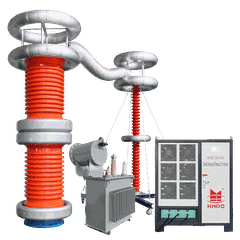


Lightning Impulse Voltage Generator
The Professional Impulse Voltage Generator Manufacturer
Our company has specialized in the production and manufacturing of high-voltage testing equipment for 20 years, with a modern intelligent factory covering an area of over 10000 square meters, staffed by 51 professional technicians, and hold CE certification. 35 patents, 10+ software copyrights,Currently, we have over 150 stable distributors worldwide and established more than 10 service offices overseas.
Core Concept: The "Lightning Simulator"
An Impulse Voltage Generator is a specialized high-voltage apparatus designed to generate very short, high-amplitude electrical pulses that simulate lightning strikes and switching surges(transient overvoltages) that occur in power systems. A Lightning Impulse Voltage Generatoris a specialized high-voltage apparatus designed to generate a specific type of electrical pulse that accurately simulates the voltage surge from a natural lightning strike hitting a power line or electrical system.


Our Advantages
- Professional Consultation – Respond technical enquiries within one hours;
- Detailed Documentation – Dispatch requested technical materials within one hour;
- Competitive Quotation – Provide a reasonable quotation within two hours.
- Certificated By CE, lSO9001,SGS, BV,TUV.
- Trust And RecognitionFrom 180 Countries And Regions
- High-Level Professional Factory With Over 45.000 m
- Product demonstration videos
- Strict contract requirements
- Timely production progress updates synchronization
- On-time delivery
- 12-month warranty
- Overseas training support
- Regular follow-ups by professionals
- Extended warranty (optional)
- Factory testing available
- CE certification
- 35 patents
- 10+ software copyrights
- Customization available
- Professional after-sales Team
- Product Innovation
- Quality Control
- Authorized calibration (optional)
- Authorized as a National-Level “High-Tech Enterprise”
- Wuhan Technology Innovation "Gazelle" Enterprise.


Impulse Voltage Generator -Components
The Impulse Voltage Generator is the heart of the entire test apparatus, serving to generate standard impulse voltage waveforms:
1. Marx Generator
2. Waveform Shaping Circuit
01
3. DC Charging Supply
4. High Voltage Divider
02
5. Digital Recorder/Oscilloscope
6. Measurement&Control System
03
7. Test Object
8. Test Hall or Shielded Room
04
9. Grounding System
10. Safety&Protection Equipment
05
Working principle and process of impulse voltage generator
The Impulse voltage generator operates on the fundamental principle of ‘parallel charging and series discharging of capacitors’. Through the conversion between charging and discharging of capacitor banks, it achieves the transformation of energy from ‘low voltage, high current’ to ‘high voltage, low current’, thereby generating surge waveforms compliant with testing standards.
The operational sequence of the surge voltage generator comprises four distinct phases: charging, triggering, discharge and waveform generation,and recovery.
These form a complete ‘charge-discharge-recovery’ cycle:
1. Charging phase (energy storage): Activate the DC high-voltage power supply and adjust its output to the preset charging voltage (U₀).
2. Triggering phase (state transition): The control system issues a trigger signal (typically a high-voltage pulse) to the first-stage ball-gap switch (G₁) closest to the power supply.
3. Discharge and waveform generation phase (output surge voltage).
4. Recovery phase (preparation for the next cycle).


Impulse Voltage Generator--Four core reasons

The impulse voltage test mainly simulates the two most serious overvoltage situations that power equipment may encounter in reality, namely lightning overvoltage and switching overvoltage.
1.Verify the insulation strength to prevent power outages and ensure power supply continuity.
2.Ensure grid security and reliability, ensure grid stability, and maintain public safety.
3.Comply with international standards and regulations, and meet regulatory requirements.
4. Design Validation&R&D to establish market trust.
Common Types of Pulse Generators
Standard Marx Pulse Generator
The classic mainstay design in most high-voltage laboratories. It employs a simple spark gap as the switching element. When the voltage across its terminals exceeds its breakdown rating, the spark gap naturally breaks down.
Triggered Marx Generator (Marx-Wesendorf)
A modern, high-precision iteration of the standard Marx generator. It employs a triggered pressurised spark gap structure, wherein the initial spark gap is precisely ignited by an external trigger signal (such as a laser or pulse transformer), subsequently initiating a controlled cascade discharge.
Lightning Pulse Generator
Essentially a Marx-type generator tuned for specific output waveforms, rather than defined by circuit architecture. It can generate a standard 1.2/50 microsecond waveform (front time = 1.2 microseconds, tail time = 50 microseconds).
Switching Pulse Generator
Similarly defined by its waveform, this is a Marx generator tuned to produce slower, longer pulses. It generates a standard 250/2500 microsecond waveform (or similar).


1. High voltage, high current, short duration
2. Standard and adjustable waveform outputs:
Standard Lightning Impulse: 1.2/50 µs waveform
Standard Switching Impulse: 250/2500 µs waveform
Tunability: Flexible adjustment of waveform parameters via external front-end resistor (Rf) and tail-end resistor (Rt).
3. Efficient architecture based on Marx generator, featuring parallel charging and series discharging, scalability, spark gap switching.
4. Integrated measurement system, automated control, safety assurance.
The application of impulse voltage generators
Power System: Dielectric Type Tests
It can be applied to equipment such as power transformers, high-voltage cables, gas-insulated switchgear (GIS), power capacitors and reactors, surge arresters, insulators and bushings, power capacitors and instrument transformers, and surge protection devices (SPD).
Quality Control and Routine Testing
Ensuring each unit meets design standards and safety specifications prior to dispatch.
On-site Acceptance and Maintenance
Verifying insulation integrity post-installation or upon completion of operational cycles.
Research and Development Domains
Specialising in insulation materials science, transient overvoltage simulation, and pulsed power technology.
Aerospace & Aviation
Ensuring electromagnetic compatibility (EMC) and safety standards.
Specialized Industrial Applications
Electrostatic precipitators (ESP),Medical device testing, Automotive high-voltage systems, and related fields.
Procedure for operating the impulse voltage generator: First conduct safety checks, then configure parameters; Next perform no-load commissioning, followed by load testing; Subsequently discharge via grounding, and finally access the equipment.
1. Preliminary Preparation and Safety Verification
Environmental Inspection: Establish safety cordon zones; ambient humidity ≤85%, temperature 10–35°C. Inspect for flammable or explosive materials; lay insulating rubber mats on the floor.
Personal Protection: Operators must wear insulating gloves and be equipped with insulated operating rods, discharge rods, etc.
2. Wiring and Parameter Configuration
Wiring must comply with specifications; reverse connections are strictly prohibited. Configure parameters according to test standards (e.g., lightning impulse 1.2/50μs, switching impulse 250/2500μs).
3. No-Load Commissioning and Load Testing
No-load commissioning: Disconnect test specimen, charge and trigger.
Load testing: After discharge, connect test specimen; repeat charge-trigger cycle.
4.Post-Test Procedures: After power disconnection, fully discharge capacitors, cables, and test specimens using a discharge rod (≥30 seconds, at least twice).

Alternative name: Impulse voltage generator
Marx Generator
Impulse Generator
Multistage Impulse Generator
Dielectric Withstand Tester
Insulation Strength Tester
High-Voltage Impulse Tester
Lightning Impulse Generator
Switching Impulse Generator
Surge Generator
Lightning Impulse current Generator
Our Factory
The Professional Impulse Voltage Generator Manufacturer!


FAQ
Q: 1. What is an impulse voltage generator? What is its function?
A: It is a high-voltage device capable of generating standard lightning waveforms (1.2/50μs) and operating waveforms (250/2500μs). Its core function is to simulate lightning strikes or switching overvoltages, thereby testing the withstand voltage (BIL) of electrical equipment such as transformers and insulators.
Q: 2. How does it operate?
A: It operates on the Marx generator principle: ‘parallel charging, series discharging’. Multiple capacitors are first charged in parallel, then instantaneously connected in series via spark gap switches. This superimposes voltages to generate extremely high pulse voltages.
Q: 3. What is the standard lightning impulse waveform (1.2/50μs)?
A: This is the internationally standardised waveform. 1.2μs denotes the rise time (time taken for voltage to rise from zero to peak), while 50μs denotes the fall time (time taken for voltage to decay from peak to half-value). It simulates the impulse characteristics of natural lightning.
Q: 4. Can lightning and operating waves be generated by the same apparatus?
A: Yes. Modern surge generators typically produce both standard waveforms flexibly by changing the front/tail resistors. Operating waves require higher resistor values to slow the waveform.
Q: 5. How should the generator's rated voltage and energy be selected?
A: The voltage depends on the insulation level (BIL) of the test specimen and the applicable test standard. Energy (Joules) depends on the equivalent capacitance of the test specimen; greater capacitance (e.g., long cables, large transformers) requires higher energy. This can be estimated using the formula E=0.5CU².
Q: 6. What is the fundamental testing procedure?
A: Preparation: Disconnect, discharge, and ground the test specimen.
Wiring: Correctly connect the generator, divider, and test specimen.
Setup: Configure waveform parameters (e.g., 1.2/50μs) and voltage levels.
Charge: Charge the generator to the target voltage.
Trigger: Initiate discharge to apply the impulse wave.
Measurement: Record waveforms using the voltage divider and oscilloscope.
Discharge: Fully discharge the test specimen and generator.
Q: 7. What equipment is it primarily used to test?
A: Primarily used to test the insulation strength of equipment such as power transformers, instrument transformers, high-voltage cables, insulators, GIS (Gas Insulated Switchgear), and surge arresters.
Q: 8. What are the most critical safety precautions?
A: The ‘de-energise – discharge – earth’ procedure must be strictly adhered to, with safety barriers and warning signs erected. Thorough discharge must be performed using an earthing rod.
Q: 9.Is training provided?
A: Yes. Given the high-voltage hazards and complex operations involved, responsible suppliers provide comprehensive training in safe operation, waveform configuration, and fault diagnosis.
Wuhan Goldhome Hipot Electrical Co., Ltd. is one of the most professional lightning impulse voltage generator manufacturers and suppliers in China, featured by quality products and good price. Welcome to buy lightning impulse voltage generator in stock here and get pricelist from our factory. Contact us for customized service.
600kV 30kJ Lightning Impulse Voltage Generator, 1800kV 180kJ Lightning Impulse Voltage Generator, 300kV 20kJ Lightning Impulse Voltage Generator