

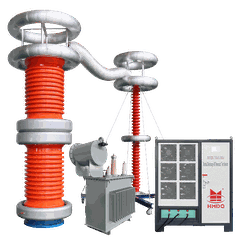



PD Free High Voltage Test System
China Manufacture Price for PD Free High Voltage Test System

20+
years
Goldhome has specialized in the production and manufacturing of PD Free High Voltage Test System for over 20 years
35
patents
With 35 patents, Goldhome keeps innovating and providing advanced, reliable power testing equipment.
14
Service offices overseas.
Singapore, Malaysia,UAE, Saudi Arabia, South Africa, Nigeria, Germany, Poland, Brazil,the USA,India,the UK, Switzerland, Russia.


A PD-Free High-Voltage Test System is a high-voltage testing device capable of generating extremely low levels of partial discharge (PD), or none at all. The system is designed to provide a clean high-voltage testing environment for the equipment under test, free from background noise interference, thereby enabling an accurate assessment of its insulation performance and reliability.
PD (Partial Discharge): A minute discharge caused by concentrated electric fields within the insulation of high-voltage equipment. It is an early sign of insulation aging and, over time, can lead to insulation breakdown and equipment failure.
PD-Free: The system itself does not generate measurable partial discharges at the maximum test voltage (background noise ≤ 5 pC; high-quality systems can achieve ≤ 1 pC), ensuring that the measured partial discharges originate solely from the test specimen and are not masked by power supply interference.
Working Principle
Overall Operating Logic:
- The frequency conversion control unit outputs a low-voltage, pure sine wave signal at an adjustable frequency;
- This signal is stepped up by a partial discharge-free excitation transformer and enters into series resonance with the high-voltage reactor and the test specimen’s capacitance;
- The resonance generates high-amplitude, low-distortion, partial-discharge-free power-frequency/variable-frequency high voltage applied to the test specimen;
- Partial-discharge pulse signals are acquired via coupling capacitors and detection impedances;
- The partial-discharge analyzer filters out noise, identifies discharge magnitude and phase characteristics, and determines whether the insulation has defects.
1. Variable-frequency power supply with stable voltage and frequency output
Utilizes SPWM frequency conversion technology to output a continuously adjustable standard sine wave from 20 to 300 Hz with extremely low waveform distortion. Function: Adjusts the system resonance frequency to match the capacitance of different test specimens (cables, GIS, transformers), enabling the generation of extremely high test voltages using a low-power power supply.
2. Partial Discharge-Free Boost Unit for Isolation and Voltage Boost
The excitation transformer and high-voltage reactor utilize:
Specialized low-partial-discharge insulating oil / epoxy resin insulation
Electric field equalization shielding structure and fully metal shielded enclosure. Principle: Optimizes electric field distribution, eliminates internal air gaps, and prevents corona discharge. This hardware design ensures the equipment itself does not generate partial discharges, achieving a PD-free baseline.
3. Series Resonance Boost Principle (Core)
The test specimen is equivalent to a capacitor Cx, and the high-voltage reactor is equivalent to an inductor L. When the power supply frequency is adjusted to
f=12πLC the circuit enters series resonance. The reactance of the reactor and the capacitance of the test specimen complement each other in terms of reactive power, allowing a high voltage several times that of the excitation voltage to be obtained across the specimen without requiring a high-power supply. Features: Pure waveform, low harmonics, smooth voltage boost, and no superimposed interference noise, making it suitable for partial discharge measurement.
4. PD-Free High-Voltage Output and Shielded Isolation
The entire high-voltage assembly employs equipotential shielding, double-layer shielding, and SF₆/hermetically sealed insulation:
Prevents air ionization, surface discharge, and floating potential discharge
External electromagnetic interference is shielded and isolated, ensuring the high-voltage circuit remains PD-free throughout and does not contaminate the test background.
5. Partial Discharge Signal Acquisition and Analysis
Coupling capacitors + detection impedance capture high-frequency discharge pulses from within the test specimen’s insulation
Signal filtering, amplification, and noise reduction
Display of discharge quantity (pC), discharge phase, and repetition rate
Principle: The system itself has no PD background; all PD signals captured by the instrument genuinely originate from defects within the test specimen’s insulation, such as air gaps, cracks, contamination, and insulation aging.
Core Features
Ultra-low background partial discharge
- The entire system exhibits extremely low intrinsic partial discharge, with background noise as low as ≤1 pC to 5 pC
- No interference from intrinsic discharge at the maximum test voltage; only the actual insulation partial discharge of the test specimen is detected
- Complies with IEC and GB standards for partial discharge testing of high-voltage equipment
Variable-frequency series resonance voltage-boosting technology
- Adjustable frequency: 20–300 Hz, continuously adjustable
- Automatically tracks the resonance point, suitable for various capacitive test specimens such as cables, GIS, current transformers, and transformers
- Delivers ultra-high test voltages with a small-capacity power supply; low power consumption, compact size, and lightweight
Excellent High-Voltage Waveform Quality
- Output sine wave distortion rate ≤0.5%, extremely low harmonics
- Stable voltage output with low ripple and no spike interference
- Suitable for precision partial discharge detection and long-duration withstand voltage tests
Professional Low-Partial-Discharge Insulation and Shielding Structure
- High-voltage reactors and excitation transformers utilize specially formulated low-partial-discharge insulation media + electric field equalization design
- Fully enclosed, metal-shielded, and equipped with equalizing rings to optimize the electric field, eliminating discharges at tips, air gaps, and floating potentials
- Resistant to external electromagnetic interference; suitable for complex laboratory and field conditions
Integrated Withstand Voltage + Partial Discharge Testing
- Simultaneously performs power frequency / variable frequency withstand voltage tests + partial discharge detection
- Real-time display of discharge quantity (pC), discharge phase, repetition rate, and trend graphs
- Accurately identifies early-stage defects such as insulation voids, cracks, contamination, and aging
Intelligent Fully Automatic Control
- Automatic voltage regulation, automatic resonance frequency search, automatic voltage ramp-up/ramp-down
- Equipped with multiple intelligent protections against overvoltage, overcurrent, flashover, and short circuits
- Automatic data storage, report generation, and exportable test reports
Wide Application Range and High Versatility
- Compatible with: high-voltage cables, GIS switchgear, power transformers, CTs/PTs, insulators, bushings, etc.
- Customizable for different voltage levels and capacities; supports laboratory type testing, factory testing, and on-site pre-commissioning tests
Safe, Reliable, and Easy to Operate and Maintain
- Zero resonance overshoot, ensuring no damage to the insulation of the test specimen
- Modular design for simple wiring, easy portability, and low failure rate

Core Functions
Partial Discharge-Free Variable-Frequency Withstand Voltage Test
Outputs pure, partial-discharge-free high voltage, supporting both power-frequency and variable-frequency AC withstand voltage tests. The system generates no interference-induced partial discharges throughout the entire process, ensuring no damage to the test specimen’s insulation.
Precise Partial Discharge Detection and Analysis
Real-time acquisition and measurement of partial discharge charge (pC), discharge phase, and discharge repetition rate, with automatic analysis of internal air gaps, cracks, aging, and tip defects in the insulation.
Automatic Variable-Frequency Series Resonance Voltage Boosting
Automatically scans frequencies and tracks resonance points, adapting to capacitive test specimens such as cables, GIS, transformers, CTs/PTs, insulators, and bushings of varying capacities.
Steady-State Long-Duration Withstand Voltage Testing
Capable of sustained operation at a constant voltage, meeting the long-duration withstand voltage requirements for type testing, factory testing, acceptance testing, and preventive maintenance testing.
Real-time Monitoring of High-Voltage Parameters
Real-time display of output high voltage, test current, frequency, partial discharge (PD) values, and resonance status, with full process visualization.
Fully Automatic Voltage Regulation and Intelligent Control
One-button automatic voltage ramp-up, voltage stabilization, timing, and voltage ramp-down; configurable test duration and step-up voltage modes for unattended operation.
Comprehensive Safety Protection Features
Equipped with automatic trip protection against overvoltage, overcurrent, flashover, breakdown, short circuit, and overheating, as well as emergency shutdown and dual hardware interlocks.
Test Data Storage and Report Generation
Automatically saves test curves, partial discharge spectra, and test data; allows playback of historical records and export of standard test reports, with support for printing and archiving.
Interference-Resistant On-Site Testing
Fully shielded, partial discharge-free design suppresses on-site electromagnetic interference, enabling precise partial discharge and withstand voltage testing in both laboratory and outdoor environments.
Multifunctional Compatibility
Flexibly supports multiple scenarios including type testing, factory sampling inspections, on-site installation handover, and pre-operation maintenance testing—one device for multiple applications.
PD-Free High-Voltage Test System Operating Procedures
I. Pre-Test Preparation
Clear the test area and ensure proper grounding: The system host, reactor, voltage divider, and test specimen must each be independently grounded, and the grounding resistance must meet specifications.
Inspect the equipment’s exterior, terminal blocks, and high-voltage leads to ensure there are no damages, burrs, or loose metal particles.
Confirm the environment: Ensure there is no strong electromagnetic interference, no dust or water mist, and that the high-voltage safety barrier is properly secured; unauthorized personnel are prohibited from entering the test area.
Verify the test specimen parameters: model, capacitance, test voltage, withstand time, and standard partial discharge limits.
Connect the wiring correctly according to the manual: Variable-frequency power supply → Excitation transformer → High-voltage reactor → Coupling capacitor → Voltage divider → Test specimen; ensure the partial discharge detection unit is properly connected.
II. Pre-Startup Settings
Turn on the main power supply, start the control system, and enter the main test interface.
Select test mode: Variable-frequency withstand voltage + partial discharge detection mode.
Preset parameters:
- Target test voltage
- Withstand voltage hold time
- Overvoltage/overcurrent protection thresholds
- Frequency scan range (typically 20–300 Hz)
Activate the PD acquisition system. First, measure the background noise to confirm that the system’s background PD is ≤5 pC, achieving a PD-Free state.
III. Automatic Resonance Frequency Search
Click “Automatic Frequency Sweep / Resonance Search.”
The system automatically scans frequencies to locate the series resonance point and locks onto the resonance frequency.
Observe the resonance status on the interface, as well as the phase matching of current and voltage, ensuring no abnormal alarms are triggered.
IV. Voltage Rise Test Procedure
Select the automatic voltage rise mode; the system will increase the voltage uniformly and gradually.
Real-time monitoring: high-voltage value, test current, frequency, and real-time PD (pC) value.
After reaching the preset test voltage, the system will automatically stabilize the voltage and start timing.
During voltage stabilization, continuously observe the PD spectrum and changes in discharge levels:
Stable PD with no sudden spikes → Insulation is qualified.
Sudden surge in partial discharge or appearance of pulse clusters → Insulation defect, internal discharge.
V. Withstand Voltage Holding and Observation
- Maintain steady-state withstand voltage for the set duration (e.g., 1 min, 5 min, 30 min).
- Record PD waveforms, discharge volume, and voltage-current curves throughout the process.
- If flashover, breakdown, or overcurrent tripping occurs, the system immediately and automatically reduces voltage and shuts down, recording fault data.
VI. Voltage Reduction and Shutdown at Test Completion
Upon completion of the timer, the system automatically and gradually reduces the voltage to zero.
Turn off the high-voltage output and disconnect the excitation circuit.
Wait for the high voltage to discharge completely (through natural decay and forced discharge using a discharge rod), and confirm that no residual voltage remains.
Save the test data and PD spectra, and automatically generate/export the test report.
Turn off the control power supply, disconnect the wiring, organize the equipment, and remove the safety barriers.
VII. Key Safety Precautions
Never connect or disconnect wiring while the system is energized; never touch high-voltage components before they have been fully discharged.
High-voltage leads must not drag on the ground or come into contact with metal structures on walls.
Do not conduct tests during thunderstorms, high winds, or in extremely humid conditions.
Never force the system to increase voltage beyond its rated voltage or capacity.
Main Types of PD-Free High-Voltage Test Systems
I. Classification by Test Frequency
1. Variable-frequency series resonance PD-Free system (most commonly used)
Frequency: Adjustable from 20 to 300 Hz
Applications: High-voltage cables, GIS, current transformers, transformers, bushings
Features: Compact, low power consumption, suitable for on-site acceptance testing and laboratory type testing
2. Fixed 50 Hz Power Frequency PD-Free System
Fixed 50 Hz pure power frequency output
Applications: High-voltage laboratories, routine PD testing on production lines
Features: Standard waveforms, extremely low background partial discharge; suitable for standard IEC power frequency testing
II. Classification by Structural Configuration
1. Split-Type PD-Free High-Voltage Test System
- Frequency converter, excitation transformer, high-voltage reactor, and coupling capacitor housed in separate cabinets
- Advantages: Easy to transport, flexible combination of capacity and voltage, suitable for construction sites
- Applications: Construction sites, outdoor substations, long cable testing
2. Integrated Container/Modular PD-Free System
All high-voltage units are integrated within a standard container or modular unit
- Advantages: Fixed wiring, excellent shielding, even lower background partial discharge, and immunity to on-site environmental interference
- Applications: Third-party testing stations, permanent factory testing laboratories
III. Classification by Output Voltage Level
- Medium-Voltage Type: 50 kV–150 kV
- Used for PD withstand testing of 10kV/35kV transformers, insulators, and small switches
- High-Voltage Type: 200kV–500kV
- PD testing of 110kV/220kV cables, GIS, and main transformers
- Ultra-High-Voltage Type: 600kV–1000kV
- Type testing of UHV equipment; exclusively for authoritative testing institutions
IV. Classification by Applicable Test Object
- PD-Free Testing System for Cables
- Suitable for long-distance high-voltage power cables; features a wide resonance range and extended-duration withstand voltage capability
- PD-Free System for GIS/Switchgear
- Optimized electric field shielding and strong anti-interference performance; suitable for PD testing of SF6 equipment
- PD Withstand Voltage System for Transformers
- Extremely low waveform distortion; meets national and IEC PD type test standards for transformers
- Dedicated Desktop PD System for Current Transformers (CT) and Potential Transformers (PT)
- Compact size, suitable for batch testing on workshop assembly lines
V. Classification by Measurement Function
- Pure PD-Free Withstand Voltage Type
- Performs only AC withstand voltage testing without PD; does not include a high-precision PD analyzer
- Integrated Withstand Voltage + PD Type
- Built-in multi-channel PD detection unit capable of real-time measurement of pC, phase spectra, and defect analysis
Leading Brands in PD-Free High-Voltage Test Systems

Domestic Brands
1.Goldhome (HMDQ)
Core Advantages: 20 years of industry experience; National High-Tech Enterprise; acquired Wuhan Sangao Electric in 2021 (30 years of accumulated expertise in UHV PD-free technology). Partial discharge levels as low as **≤1 pC**; product lines cover 50 kV to 1,200 kV, including variable-frequency series resonance, power-frequency gas-insulated (SF6), and GIS-specific series; application cases in over 100 countries worldwide.
2.Huatian Electric
Features: Outstanding automated control and intelligent diagnostics, comprehensive software workflow guidance, suitable for efficient on-site testing.
3. Siyuan Electric
Features: Strong system integration capabilities for ultra-high voltage (UHV) and extra-high voltage (EHV) systems, suitable for type testing of large power grids and high-end equipment.
II. International Brands
- Haefely (Switzerland, AMETEK Group)
A global benchmark with numerous patents for nanosecond-level partial discharge detection. Integrates AC, DC, impulse, and partial discharge testing modes, suitable for critical equipment such as GIS and transformers.
- Hipotronics (USA, Hubbell Group)
A leading authority on oil-immersed partial discharge-free technology, offering high reference accuracy. Primarily used in arbitration, certification, and research scenarios.
Alternative Name
· PD Free High Voltage Test System
· Partial Discharge Free HV Test System
· Partial Discharge High Voltage Test System
· PD Free AC High Voltage Test System
· PD Free HV Test System
· PD Free High Voltage Testing System
· Partial Discharge Testing System
· HV Partial Discharge Test System
· PD Free Series Resonant Test System
· Variable Frequency PD Free Resonant Test System
· VF Partial Discharge Resonance Test System
· GIS Partial Discharge Test System
· Transformer PD Free High Voltage Tester
· HV Cable Partial Discharge Test Equipment
· CT PT Partial Discharge Test System
· PD Free High Voltage Tester
· Partial Discharge Test Equipment
· High Voltage Partial Discharge Detector
· No Partial Discharge High Voltage Test System
· PD Free High Voltage Test System For Transformer GIS Cable
· Variable Frequency PD Free Series Resonant Test System
· Partial Discharge Free AC HV Withstand Voltage Test System
· UHV PD-Free Withstand Voltage Test System
· Partial Discharge-Free High Voltage Test System
· No Partial Discharge High Voltage Test System
· Non-PD High Voltage Test System
· PD Free HV Test System
·PD Free AC Withstand Voltage Test System
·PD Free DC Withstand Voltage Test System
·PD Free Series Resonant Test System
·Inflation-Free Non-Partial Discharge Test System
·Partial Discharge Free Series Resonant Test System

FAQ
Q1: What is a PD-Free high-voltage test system?
It is a professional high-voltage test device with extremely low background partial discharge (≤1 pC to 5 pC). It generates a pure sine-wave high voltage for AC withstand voltage testing and partial discharge detection of high-voltage equipment, and does not generate any interfering partial discharge signals itself, ensuring accurate test results.
Q2: What exactly does “PD Free” mean?
It means that under rated test voltage, the entire system generates virtually no partial discharges of its own. All detected partial discharge signals originate from the test specimen (such as transformers, GIS, etc.), rather than the test equipment itself, thereby preventing interference with the test results.
Q3: What is the working principle of this system?
It employs variable-frequency series resonance technology. By adjusting the output frequency to match the resonance point between the reactor and the test specimen, it generates high-amplitude high voltage with low input power. Simultaneously, through optimized electric field shielding design and special insulating materials, the system achieves a PD-free background, enabling precise capture of partial discharge signals generated by insulation defects in the test specimen.
Q4: In which scenarios is it primarily used?
It is widely used for factory acceptance testing, on-site handover testing, and preventive insulation testing of high-voltage equipment such as transformers, GIS switchgear, high-voltage cables, CT/PT transformers, insulators, and bushings, covering industries including power, chemical, and rail transit.
Q5: What are the standard requirements for the system’s partial discharge background level?
The standard requirement is ≤5 pC (compliant with IEC and GB standards); High-end laboratory models can achieve ≤1 pC, suitable for high-precision type testing and research applications.
Q6: What is the supported frequency range?
Standard models support continuously adjustable frequencies from 20 Hz to 300 Hz, accommodating various capacitive test specimens; fixed 50 Hz power-frequency models can also be customized to meet standard power-frequency testing requirements.
Q7: Can withstand voltage testing and partial discharge detection be performed simultaneously?
Yes. The system integrates AC withstand voltage testing with partial discharge detection and analysis functions into a single unit. No additional equipment is required, allowing both tests to be completed simultaneously and improving testing efficiency.
Q8: Is it suitable for outdoor field testing?
Yes. The split, portable design facilitates easy transport, and the system features a robust anti-interference design that effectively suppresses on-site electromagnetic interference. It is suitable for both fixed laboratory testing and outdoor field operations at substations, construction sites, and other locations.
Q9: What safety protection features does the system have?
It features multiple protection functions, including overvoltage, overcurrent, flashover, breakdown, and overheat protection. Equipped with an emergency stop button and hardware interlock design, it automatically reduces voltage and shuts down in the event of test abnormalities, ensuring the safety of the equipment, test specimens, and operators.
Q10: What types of this system are available?
It is primarily categorized as follows:
- By frequency: Variable-frequency resonance type, 50Hz power-frequency type
- By structure: Split-type portable, integrated container/modular type
- By voltage: Medium voltage (50kV–150kV), high voltage (200kV–500kV), extra-high voltage (600kV–1200kV)
- By application: Dedicated models for cables, GIS, transformers, and CT/PT
Q11: Can the voltage and capacity be customized?
Yes. We can customize models with different voltage levels (50kV–1200kV) and capacities according to customer requirements to accommodate various special test specimens and testing scenarios.
Q12: Is Guodian Huamei a well-known brand for this equipment?
Yes. Guodian Huamei (Wuhan Guodian Huamei Electrical Equipment Co., Ltd.) is a renowned professional brand in China for partial discharge-free high-voltage testing systems. With 20 years of industry experience, our product line covers all voltage levels, and we have application cases in over 100 countries worldwide, demonstrating strong technical capabilities.
Q13: Why do partial discharge values suddenly increase during the test?
There are two main possibilities: 1. Defects in the test specimen’s insulation (such as internal air gaps, cracks, or aging) cause partial discharge after voltage application; 2. Interference discharges caused by burrs, suspended metal objects, or poor grounding in the test wiring. In such cases, the wiring and grounding should be inspected, and the test repeated.
Q14: What should be noted regarding routine system maintenance?
1. Regularly inspect high-voltage leads and terminal blocks to prevent damage and oxidation; 2. Keep the equipment clean and away from dust, water vapor, and strong electromagnetic interference; 3. Calibrate the partial discharge detection unit regularly to ensure accuracy; 4. Discharge the system promptly after testing and store the equipment properly.
Q15: What is the key difference between this system and a standard high-voltage testing system?
The key difference lies in the “PD-free” capability—standard high-voltage testing systems have high inherent partial discharge levels (>50 pC) and can only perform withstand voltage tests, unable to accurately detect partial discharge; in contrast, the PD-Free system has an extremely low background partial discharge level, enabling simultaneous withstand voltage and partial discharge testing. It can accurately detect early-stage insulation defects in test specimens, providing more reliable data.
Q16: How should you address situations where the voltage cannot be increased or fails to rise?
Step-by-step troubleshooting: Check if the power supply voltage is normal → Check if the control circuit wiring is loose → Check if the protective devices have tripped.
Focus on troubleshooting the resonance system: For series resonance devices, if the frequency has been adjusted to the resonance point but the voltage remains low, it is usually due to a low circuit quality factor (Q-factor). Check for overheating at the connection points (which increases losses) and inspect the reactor for abnormalities.
Q17: What should be done if partial discharge levels suddenly surge during testing?
Immediate response: Immediately reduce the voltage and shut off the high-voltage output.
Safety confirmation: Disconnect the input power supply. After the equipment has fully discharged, check for visible breakdown points, smoke, or a burning odor.
Q18: How can you determine whether the test specimen has actually broken down or if it was a false alarm?
Determine this through waveform analysis and insulation resistance testing:
Observe the waveform: In the case of a true breakdown, the voltage waveform will collapse instantly, and the loop current will rise sharply.
Check the insulation resistance: After the system has fully discharged and the connections have been removed, perform an insulation resistance test on the test specimen. If the resistance value is extremely low, the test specimen is damaged.
As one of the most professional pd free high voltage test system manufacturers in China, we're featured by quality products and good price. Welcome to buy pd free high voltage test system in stock here and get pricelist from our factory. Contact us for customized service.