



Sweep Frequency Response Analyzer
3-Phase Automatic Sweep Frequency Response Analyzer (SFRA) Manufacturer
Goldhome has evolved from a specialized technical team focused on power testing equipment R&D into a high-tech enterprise engaged in the R&D, production, sales, and service of high-voltage testing equipment. Our product portfolio encompasses: Resonant test systems, High-voltage testers, Transformer testers, Circuit breaker testers, Relay protection testers, Cable testers, Transformer oil testers, DC battery testers, Primary Current Injection Tester, Lightning impulse voltage generators, Sweep frequency response analyzer and other power testing equipment. These solutions are widely applied across power engineering, transportation, power plant construction, railway infrastructure, petrochemical, metallurgical, and coal mining industries.


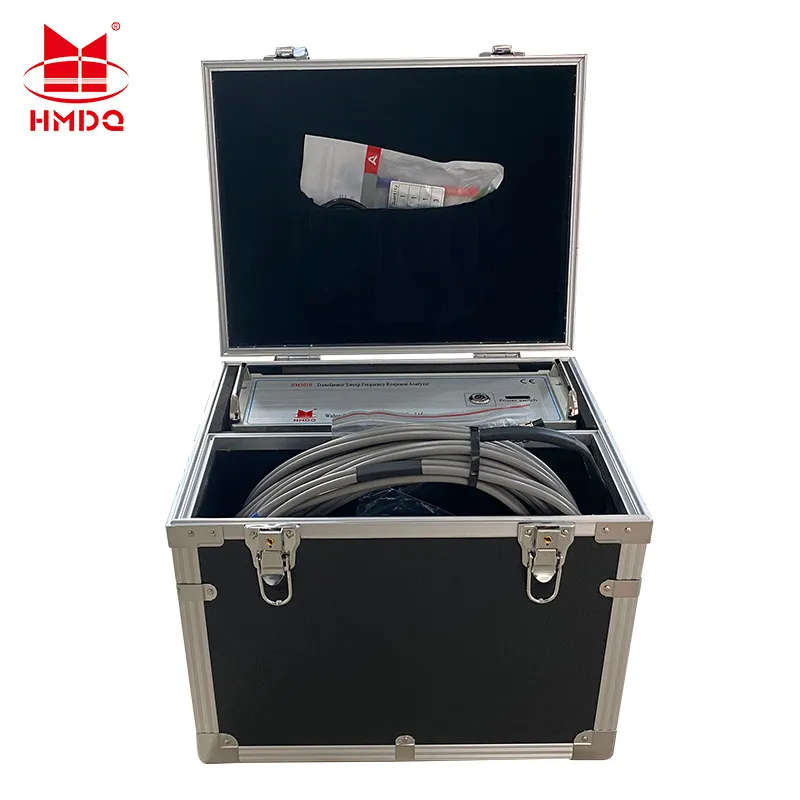
A Sweep Frequency Response Analyzer (SFRA) is a precision instrument used to measure and analyze changes in the amplitude and phase response of systems, circuits, or devices when excited by signals of varying frequencies. Its primary function is to obtain the frequency response curve (or “fingerprint”) of the device under test and to diagnose its condition or verify its performance by comparing these curves.
Click News:Learning Transformer Sweep Frequency Response Analysis (SFRA) Testing
Working Principle
The core operating principle of a sweep response analyzer can be summarized as a comparative analysis of “excitation and response.” It injects a sweep signal with a continuously varying frequency into the device under test (DUT), then precisely measures and compares the differences between the input and output signals at each frequency point, thereby mapping out the device’s complete frequency response characteristics.
1. Generating the Sweep Excitation Signal
This is the starting point of the analysis. The instrument’s internal signal generator creates a pure sine wave. The frequency of this sine wave is not fixed but varies gradually and continuously from the starting frequency to the ending frequency according to preset rules (such as linear or logarithmic scanning). This signal serves as the “probe” applied to the device under test.
2. Applying the Signal and Synchronized Data Acquisition
The sweep signal is split into two paths: one is fed directly into the instrument’s reference channel (Channel A) to serve as a baseline; the other is applied to the input of the device under test. The output response signal generated by the device under test is then fed into the instrument’s test channel (Channel B). Data acquisition in both channels is strictly synchronized, which is the foundation for accurately measuring phase differences.
3. Core Calculations: Narrowband Reception and Fourier Analysis
This is the key technology that distinguishes the instrument from ordinary oscilloscopes. The acquired signal passes through a narrowband bandpass filter or undergoes a direct Fast Fourier Transform (FFT).
Core Objective: Focus exclusively on signal components matching the current sweep frequency.
Major Advantage: This technology extremely effectively filters out noise, harmonics, and other interference. Since the frequencies of interfering signals differ from the instrument’s current sweep frequency, they are excluded by the filter or FFT algorithm. This gives the sweep response analyzer an extremely high dynamic range and excellent immunity to interference.
4. Comparative Calculations: Gain and Phase
For each frequency point, the instrument compares the measurement results of the reference channel (A) and the test channel (B):
Amplitude Ratio (Gain/Attenuation): Calculated as |V_B| / |V_A|. If the output is greater than the input, it is gain; otherwise, it is attenuation. The result is typically expressed in decibels (dB).
Phase Difference (Δφ): Calculates the time lead or lag of the output signal relative to the input signal; the result is expressed in degrees.
5. Generating a Bode Plot
The instrument repeats the above calculation process thousands or even tens of thousands of times (covering every swept frequency point), and finally integrates the results from all frequency points to plot a complete Bode plot:
Amplitude-Frequency Curve: The horizontal axis represents frequency (logarithmic scale), and the vertical axis represents gain/attenuation (dB). It shows how the signal’s amplitude varies with frequency after passing through the device.
Phase-Frequency Curve: The horizontal axis represents frequency (logarithmic scale), and the vertical axis represents phase difference (degrees). It shows how the signal’s phase varies with frequency after passing through the device.

Click News:Transformer Sweep Frequency Response Analysis (SFRA) | Complete Technical Guide
Core Features of the SFRA
Wide Frequency Scan Range
Typically covering a range from a few Hz to tens of MHz, it can reflect low-frequency inductive characteristics while capturing high-frequency capacitive resonance, fully covering the frequency bands sensitive to transformer winding faults.
High Measurement Accuracy and Wide Dynamic Range
The dynamic range typically exceeds 100 dB, enabling the detection of extremely small amplitude changes and sensitive identification of even minor winding deformations.
Small-Signal, Non-Destructive Testing
Utilizes low-voltage, small-signal excitation that does not cause breakdown or damage to transformer insulation, making it a safe, offline diagnostic method.
Strong Interference Immunity
Incorporates built-in hardware filtering and digital signal processing (DSP) to suppress on-site electromagnetic interference, ensuring stable and repeatable waveforms even in complex environments.
High-Resolution Frequency Step
With dense frequency points and fine-grained steps, it clearly displays the positions of resonance peaks and troughs, preventing the oversight of minor deformations.
Unique “Fingerprint” and Comparability
The frequency response curve of a normal transformer is highly unique, enabling:
Comparison among the three windings
Comparison with historical data
Comparison with equipment of the same model
This serves as the core basis for determining winding deformation.
Fully Automatic Sweep and Data Processing
Completes frequency sweeping, data acquisition, calculation, and plotting with a single button press. Automatically generates amplitude-frequency and phase-frequency curves, and supports data storage, export, and report printing.
High Sensitivity for Early Detection of Hidden Defects
Highly sensitive to structural abnormalities such as winding displacement, twisting, loosening, and turn-to-turn short circuits, outperforming traditional methods like DC resistance and turns ratio tests.
Compact Size and Easy Operation, Ideal for On-Site Use
Features a portable design, flexible power supply, and simple wiring, allowing a single person to complete testing on-site.
Intuitive Results and Reliable Diagnostics
Displays curve differences visually via Bode plots, eliminating the need for complex calculations and enabling engineers to quickly assess equipment condition.
Main Types
1. By Application Area
1. SFRA (Transformer Winding Deformation Analyzer) for the Power Industry
Purpose: Specifically designed for diagnosing the mechanical condition of windings in power transformers, reactors, and current/voltage transformers.
Frequency: 0.1 Hz to 25 MHz (covering the entire RLC resonance frequency range of transformers).
Features: High interference immunity, high dynamic range (>100 dB), supports three-phase comparison, and fingerprint curve analysis.
Representative Models: Megger FRAX series, Goldhome
2. General-Purpose Electronic FRA (Frequency Response Analyzer)
Purpose: Electronic/RF R&D; measures amplitude-frequency and phase-frequency characteristics of filters, amplifiers, and antennas.
Frequency: Audio to RF (typically 1 Hz to 100 MHz/1 GHz).
Features: High precision, S-parameter measurement, laboratory-grade accuracy.
Representative Models: General-purpose instruments from Keysight Technologies, Wenshi Electronics, etc.
3. Analog Sweep Type
Analog circuit frequency sweeping, analog detection / phase detection.
Advantages: Low cost, simple; Disadvantages: Low accuracy, narrow dynamic range, no data storage.
4. Digital DDS Type
- DDS (Direct Digital Frequency Synthesis) + high-speed ADC + DSP digital processing.
- Advantages: High frequency accuracy, fine resolution, wide dynamic range, stable response curves, and data storage capability.
- Almost all power SFRA instruments are of the DDS digital type.
5. Portable / Handheld
- Compact size, lithium-ion battery powered, suitable for outdoor and on-site testing at substations.
- Representative models: Megger FRAX99/FRAX101
6. Benchtop / All-in-One
- Built-in screen and computer, AC-powered, for laboratory or fixed-site use.
- Representative models: FRAX150, domestic all-in-one touchscreen units.
7. Split-System (Main Unit + Computer)
- The main unit handles frequency sweeping and measurement, while an external laptop is used for analysis, data storage, and report generation.
- Advantages: High cost-effectiveness, flexible software upgrades.
8. Single-Channel SFRA
Measures one phase or one port at a time, suitable for routine testing.
9. Multi-Channel / Three-Phase Synchronous SFRA
- Measures all three phases simultaneously, enabling more efficient phase-to-phase comparisons and stronger interference resistance.
- Suitable for rapid on-site testing of large power transformers.
10. By Frequency Range
- Ultra-Low Frequency SFRA: <1 kHz (focuses on inductance, core, and loose components)
- Medium Frequency SFRA: 1 kHz–1 MHz (sensitive to overall winding deformation)
- High Frequency SFRA: 1 MHz–25 MHz (turn-to-turn/layer-to-layer capacitance, local deformation)
- Broadband General-Purpose FRA: Covers audio to radio frequency (electronic circuits)
Operation Steps
1. Calibration and Preparation
- Warm-up: After turning on the instrument, allow it to warm up for a period of time to reach thermal equilibrium.
- Perform Calibration: Follow the instrument’s prompts to perform calibration, which typically involves open-circuit, short-circuit, or connecting a standard load to eliminate errors caused by test cables and fixtures.
- Hardware Connection: Connect the device under test to the analyzer using appropriate cables and interfaces. When connecting, follow the signal flow to avoid introducing additional interference.
2. Parameter Configuration (Setting Up)
This is a critical step that determines test accuracy and primarily involves the following parameters:
Frequency Span: Set the start and end frequencies for the scan. The range should cover all key frequency points of the system under test; for example, power loop tests are typically set to 10 Hz to 15 MHz.
Number of Points: Determines the smoothness of the curve and the test duration. A higher number of points results in a more detailed curve but also extends the test time.
Stimulus Level: Set this high enough to achieve a good signal-to-noise ratio, while ensuring the system under test operates within its linear range. For example, in power loop testing, the stimulus signal is typically a small sine wave of several tens of millivolts.
3. Executing the Test
Once the test is started, the analyzer automatically performs a frequency sweep and plots the gain (amplitude)-frequency and phase-frequency curves in real time, typically presented as a Bode plot.
4. Analyzing Data
- Once the test is complete, the curves can be analyzed using the instrument’s cursor functions or accompanying software. Key operations include:
- Data Marking: Use cursors to mark the amplitude and phase at specific frequency points.
- Automatic Measurement: Use the instrument’s automatic measurement function to quickly read key parameters such as gain margin and phase margin.
- Data Export: Export data to a common format for further analysis or report generation.

Typical Application Scenarios
I. Power Transformer Applications
1. Post-Short-Circuit Fault Diagnosis
After a transformer experiences an output short circuit, quickly determine whether the windings have undergone deformation, displacement, twisting, or bulging.
2. Factory and Type Testing
Establish baseline fingerprint curves as part of the transformer’s factory quality acceptance process.
3. Handover Acceptance Testing
Before commissioning a new transformer, compare the measured curves with the factory curves to confirm that no damage occurred during transportation.
4. Periodic Condition-Based Maintenance
Incorporate into preventive testing to track long-term curve changes and detect potential issues early.
5. Pre- and Post-Overhaul Comparison
Determine the location of faults before maintenance and verify the effectiveness of repairs after maintenance.
6. Reactor and Instrument Transformer Testing
Also applicable for detecting structural abnormalities in dry-type reactors and oil-immersed CT/PT windings.
7. Health Assessment of Aging Transformers
Conduct condition evaluations on equipment that has been in operation for many years to determine whether to continue operation or decommission the equipment.
1. Other Applications in Power Systems
2. Switchgear and Busbar Circuit Testing
Detect loose connections, poor contacts, and localized defects in circuits.
3. Generator Stator Winding Testing
Diagnose loose or displaced stator winding ends and abnormalities in the insulation structure.
III. Electronics, RF, and Industrial Control Fields (General-Purpose FRA)
1. Filter Characteristic Testing
Amplitude-frequency, phase-frequency, bandwidth, and insertion loss testing for low-pass, high-pass, band-pass, and band-stop filters.
2. Amplifier Frequency Characteristic Analysis
Gain flatness and phase linearity of audio power amplifiers, operational amplifiers, and RF amplifiers.
3. Antenna and RF Module Testing
Antenna frequency response, impedance matching, and resonance point testing.
4. Open-Loop/Closed-Loop Characteristics of Control Loops
Bandwidth, stability, and phase margin analysis of servo systems and PID control loops.
5. Audio Equipment and Acoustic Testing
Frequency response curve testing for loudspeakers, microphones, and headphones.
IV. Research and Teaching Applications
1. Teaching of circuit and control theory in university laboratories
2. Research on the characteristics of new materials, coils, and magnetic components
3. Analysis of resonant circuits and RLC network characteristics

Famous Brands
International Brands
1. Megger (UK)
Representative Models: FRAX99 / FRAX101 / FRAX150
Features: Global industry standard; 0.1 Hz to 25 MHz; wide dynamic range; high immunity to interference; compliant with IEC 60076-18.
2. Doble (USA)
Representative Models: M5400 / M5500
Features: 10 Hz–25 MHz, 150 dB+ dynamic range, industry-recognized high precision.
3. ABB (Switzerland)
Representative: TM.FRA Series
Features: Combines transformer manufacturing expertise with mature diagnostic algorithms and high stability.
Domestic Brands
1. Goldhome (Wuhan)
Model: HM Series Transformer Winding Deformation Tester (SFRA)
Features: Leading domestic brand; compliant with DL/T911 and IEC 60076-18; frequency accuracy of 0.001%; 5000V isolation; three-phase automatic testing; built-in diagnostic software.
2. Huazheng Electric
Model: FRA100
Features: 1 Hz–20 MHz, fast measurement, amplitude-frequency + phase-frequency analysis, compliant with national standards.
3. Ceyear
Features: Military-grade / high-end testing, wide frequency range, high precision, multi-purpose (general-purpose FRA + power SFRA).

Alternative Name
- Sweep Frequency Response Analyzer
- SFRA Analyzer
- Transformer Winding Deformation Tester
- FRA Analyzer / Frequency Response Analyzer
- Transformer SFRA Test Set
- Power Transformer Diagnostic Tester
- Transformer Frequency Response Test Equipment
- Bode Plot Tester
- 3-Phase SFRA Tester
- Portable SFRA Instrument
- Sweep Frequency Response Analyzer (SFRA)
- SFRA Transformer Winding Deformation Tester
- Portable Frequency Response Analyzer for Transformer
- 3-Phase Transformer SFRA Test Equipment
- Gain-Phase Analyzer
- Bode plot + loop response + FRA
- SFRA + transformer winding
- SFRA
- FRA

FAQ
Q: 1. What is an SFRA? What is it used for?
A: SFRA stands for Sweep Frequency Response Analyzer. It is primarily used to test for deformation in transformer windings. By plotting a frequency response “fingerprint curve,” it determines whether the windings have suffered mechanical failures such as deformation, displacement, loosening, or short circuits.
Q: 2. Does SFRA testing require the transformer to be energized?
A: No. Testing can only be performed after power has been shut off, the transformer has been tested for residual voltage, and discharged. It is an offline, non-destructive test.
Q: 3. Does SFRA testing damage the transformer?
A: No. It uses low-voltage, small-signal excitation (ranging from a few volts to several dozen volts), which does not affect insulation and causes no damage to the equipment.
Q: 4. How long does a single test take?
A: Generally 0.5 to 3 minutes per phase, depending on the frequency range and number of test points. A fully automatic three-phase test typically takes 1.5 to 9 minutes to complete.
Q: 5. What is the typical frequency range?
A: The standard range for SFRA dedicated to power transformers is 0.1 Hz to 25 MHz, covering both low-frequency inductive characteristics and high-frequency capacitive resonance, providing a comprehensive reflection of the winding condition.
Q: 6. What faults can SFRA detect?
A: It can effectively detect:
- Winding deformation, bulging, twisting, and displacement
- Turn-to-turn and layer-to-layer short circuits
- Loose windings and loose leads
- Abnormal core structure
- Mechanical damage caused during transportation
Q: 7. How does SFRA compare to DC resistance and turns ratio tests?
A: DC resistance and turns ratio tests can only detect obvious short circuits or severe faults
SFRA is extremely sensitive to minor deformations and early-stage issues, making it an essential test following a short circuit
Q: 8. How do you determine if the test results are normal?
A: By comparing curves:
- Compare the three-phase curves with each other
- Compare them with factory or historical baseline curves
- No significant differences in the position, amplitude, or waveform of the resonance peak = Normal
- Peak-to-valley shifts, amplitude fluctuations, or waveform distortion = Possible winding abnormalities
Q: 9. What should be done if on-site interference is high and the test curves are unstable?
A: Ensure the instrument and transformer are reliably grounded
Use shielded test leads and keep them away from live equipment
Shorten the test lead length and arrange the wiring neatly
Select a model with high interference resistance
Q: 10. Does SFRA require a computer for operation?
A: Depends on the model:
- Portable all-in-one units: Built-in screen; no computer required
- Economy-class units: Must be connected to a computer to run analysis software
- High-end models support offline testing + post-analysis
Q: 11. Can data be saved and exported?
A: Yes. Generally supports:
- Saving amplitude-frequency / phase-frequency curves
- Exporting PDF/Word reports
- Exporting Excel data
- Historical data comparison and printing
Q: 12. What equipment is SFRA suitable for?
A: Primarily suitable for:
- Oil-immersed power transformers
- Dry-type transformers
- Reactors
- Current/voltage transformers (CT/PT)
- Generator stator windings
Q: 13. Does it comply with international/domestic standards?
A: Reputable brands all meet:
- Domestic: DL/T 911
- International: IEC 60076-18
Q: 14. Does the instrument require periodic calibration?
A: We recommend calibrating it once a year to ensure frequency and amplitude accuracy and meet test specification requirements.
Q: 15. What are the advantages of the Goldhome SFRA?
A: Wide frequency range and high accuracy
Strong anti-interference capability and stable on-site curves
Supports three-phase automatic testing
Simple operation, suitable for domestic substation practices
Fast after-sales response and high cost-effectiveness
As one of the most professional sweep frequency response analyzer manufacturers in China, we're featured by quality products and good price. Welcome to buy sweep frequency response analyzer in stock here and get pricelist from our factory. Contact us for customized service.