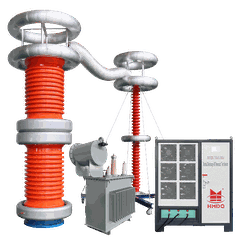
Sweep Frequency Response Analyzer (SFRA) suppliers
Sweep Frequency Response Analyzer (SFRA) factory
Sweep Frequency Response Analyzer (SFRA) best
Sweep Frequency Response Analyzer (SFRA) high quality
Sweep Frequency Response Analyzer (SFRA) price
1/
Sweep Frequency Response Analyzer (SFRA)
The HM5010 tester accurately detects internal transformer faults by measuring characteristic parameters of transformer winding deformation and employing the internal fault frequency response analysis (FRA) method.
Send Inquiry
Description
Technical Parameters
Wuhan Goldhome Hipot Electrical Co., Ltd. is one of the leading manufacturers and suppliers of sweep frequency response analyzer (sfra) in China. With abundant experience, our factory offer high quality customized products made in China with competitive price. Welcome to contact us for quotation.
Products video
HM5010 Winding Resistance Deformation Test Video
Product Overview
The HM5010 tester accurately detects internal transformer faults by measuring characteristic parameters of transformer winding deformation and employing the internal fault frequency response analysis (FRA) method.
product Parameters
1.Two different sweep modes: Linear sweep,Section sweep
Linear sweep:
0.5KHZ-1MHZ interval 0.5KHZ 2000 dots
Section sweep:
50HZ-100HZ interval 2HZ 25 dots
100HZ-1KHZ interval 20HZ 45 dots
1KHZ -10KHZ interval 50HZ 180 dots
10KHZ-100KHZ interval 0.2KHZ 450 dots
100KHZ - 500KHZ interval 0.5KHZ 800 dots
500KHZ - 1000KHZ interval 1KHZ 500 dots
2.Test range:(-100dB) - (+20dB)
3.Test accuracy:0.1dB
4.Frequency accuracy:<0.01%
5.Signal input impedance:>1M Ω
6.Signal output impedance:50 Ω
Maintenance & FAQs
Q: What is a sweep response analyzer?
A: It is a precision instrument that accurately maps a system's frequency characteristics (amplitude and phase) by injecting a sweep signal with continuously varying frequencies into the device under test and measuring its output response.
Q: How does it work?
A: The core principle is "excitation-response" comparative analysis. It actively generates a swept sine wave as the excitation signal while simultaneously capturing both input and output signals. By comparing the amplitude ratio (gain/attenuation) and phase difference between the two signals at each frequency point, it ultimately generates a Bode plot that visually illustrates the system's dynamic characteristics.
Q:What are the main types of sweep frequency response analyzers?
A: They can primarily be classified by implementation technology into analog, digital, and mixed-signal types. By hardware form factor, they can be categorized as benchtop, portable, and modular/PXI. By application field, they are divided into general-purpose and specialized types (such as transformer winding deformation testers and power supply loop analyzers).
Q: What do the English terms FRA, SFRA, Bode plot, and loop response mean?
A: FRA (Frequency Response Analyzer): Frequency response analyzer.
SFRA (Sweep Frequency Response Analyzer): Sweep frequency response analyzer.
Bode plot: A standard graphical representation of frequency response results.
Loop response: Focuses on testing the stability of power supply and control systems.
Q: How is it used to test the loop stability of a switching power supply?
A: Select the injection point: In the power supply's feedback loop, locate the error amplifier output or feedback resistor network and insert an injection resistor (typically 5Ω–50Ω) in series.
Connecting the Equipment: Connect the analyzer's signal source to both ends of the injection resistor via an isolation transformer; connect Channel 1 and Channel 2 to the two ends of the injection resistor, respectively, to measure the excitation and response signals.
Setup and Measurement: Set the sweep range to 10 Hz to 15 MHz, with an excitation amplitude of several tens of millivolts. Start the sweep, and the instrument will automatically calculate and plot the Bode plot.
Analysis Results: Read the phase margin and gain margin directly from the Bode plot. Generally, a system is considered stable if the phase margin is >45° and the gain margin is >10 dB.
Q: How to Perform Transformer Winding Deformation Testing (SFRA)?
A: Safety Precautions: Ensure the transformer is completely de-energized, discharged, and reliably grounded before proceeding. Record parameters such as the tap switch position. Connection and Self-Test: Connect the test leads; the standard method is "injection at the end, detection at the beginning." Before formal measurement, short-circuit the instrument's excitation and detection terminals to perform a self-test, ensuring the curve is a 0 dB straight line. Measurement and Analysis: Measure all three phases sequentially and record the data. Compare the measured frequency response curves with historical data or data from other phases of the same model, either horizontally or vertically. If there is a noticeable shift in resonance points or changes in amplitude, this indicates that the windings may be deformed.
Hot Tags: sweep frequency response analyzer (sfra), China sweep frequency response analyzer (sfra) manufacturers, factory