

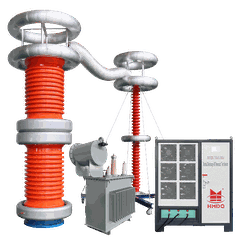



AC Resonance Test System
A Prominent Manufacturer of Series Resonant Tester
Our company has specialized in the production and manufacturing of
Series Resonant Tester for 20 years, with a modern intelligent factory covering an area of over 10000 square meters, staffed by 51 professional technicians, and hold CE certification. 35 patents, 10+ software copyrights,Currently, we have over 150 stable distributors worldwide and established more than 10 service offices overseas.
Series Resonance Test Set is a specialized high-voltage testing device that utilizes the principle of series resonance. By adjusting the output frequency or circuit parameters, it induces resonance between the test specimen (such as cables, transformers, GIS, etc.) and the reactor within the device. This process generates high voltage on the test specimen while significantly reducing the required power supply capacity.


Why Choose Us
Wuhan Goldhome Hipot Electrical Co., Ltd. was established in 2008, located in Economic and Technical Development Zone, working area more than 10000 square meters.We are professional OEM, ODM, OBM Manufacturer which is engaged in the research, development, sale and service of High Voltage Testing Equipment including: Resonant Test System, High Voltage Tester,Transformer Tester ,Primary Current Injection Tester,Circuit Beaker Tester, Relay Protection Tester, Cable Tester, SF6 Test Analyzer,Oil Testing Instruments,etc.


Product Applications
These solutions are widely applied across power engineering, transportation, power plant construction, railway infrastructure, petrochemical, metallurgical, and coal mining industries.
Sales Markets
Cumulative exports have reached Indonesia, India, Pakistan, Vietnam, the Philippines, Saudi Arabia, the United Arab Emirates, Egypt, Turkey, Israel, Brazil, Germany, the United States, Australia, and other countries and regions. With over 150 distributors worldwide and more than 10 overseas service offices, we have successfully opened up global markets.
Honors, patents, certificates
Our production is strictly in accordance with international standards and power industry regulations. Our products are through the national, provincial power authorities testing, as well as CE certification! At present,0ur company has received ISO9001:2015 quality management system certification, ISO14001:2018 occupational health and safety management system certification, and ISO14001:2015 environmental management system certification,and also had got SGS certification. Awarded the title of National High tech Enterprise and Wuhan Science and Technology Innovation "Gazelle" Enterprise.More than 20 patented technologies,such as The utility model patent of a frequency conversion series resonance test device,The utility model patent of Lightning impulse voltage testing equipment,etc.
Our Service
We pledge to treat every client with integrity and equality, regardless of contract size or whether they are domestic or international, new or existing customers, providing professional consultation and advice. Goldhome provides professional installation, commissioning and training for users' workers, ensures that users can get familiar with operation methods and put machines into use as soon as possible.
The Main Product of Series Resonant Devices are as follows:

HMCXZW Partial Discharge-Free Variable Frequency Series Resonance Test Device
HMCXZW(CZ) Vehicle-Mounted Integrated Partial Discharge-Free Variable Frequency Series Resonance Test System


HMCXZ Variable Frequency Series Resonance Test Device
HMCXZW(JZ) Containerized Partial Discharge-Free Series Resonance Test System


HMCXZW Partial Discharge-Free Inductive Withstand Voltage Resonance Test System
HMCXZ Series Resonance Test Device


HMCXZ Variable Frequency Series Resonance Test Device
HMCXZ Cable AC Withstand Voltage Series Resonance Test Device


HMCXL Variable Inductance Power Frequency Series Resonance Test Device
HMCXZ(CVT) Power Frequency Series Resonance Step-Up Device


HMBP Partial Discharge-Free Variable Frequency Power Supply
Key Components of a Series Resonant Tester
A complete series resonant test system is a modular assembly, with components tailored to the test object’s voltage and capacitance. The main parts include:
|
Component |
Function |
|
Variable-Frequency Power Supply |
Provides adjustable AC frequency (30–300Hz) and low-voltage input; controls the test process (voltage, time, etc.). |
|
Adjustable Reactor (Inductor) |
Adjusts inductance (L) to match the DUT’s capacitance (C) and achieve series resonance. Multiple reactors can be connected in series/parallel for different test requirements. |
|
Capacitive Divider |
Measures the high voltage across the DUT (since direct measurement of ultra-high voltage is difficult) and feeds back data to the control system for overvoltage protection. |
|
Control System |
Automates the test process (frequency sweeping, voltage regulation, timing), displays real-time data (voltage, current, frequency), and triggers alarms for faults (overvoltage, overcurrent). |
|
DUT Connection Cables |
High-insulation cables (e.g., silicone rubber cables) to connect the tester to the DUT, ensuring no leakage or breakdown at high voltages. |
Typical Applications of Series Resonant Tester
Series resonant testers are ideal for testing capacitive or large-inductance high-voltage equipment (where traditional high-voltage transformers are inefficient or impractical). Common use cases include:
Power Cables
Testing the insulation performance of high-voltage cross-linked polyethylene (XLPE) cables (e.g., 10kV, 35kV, 110kV cables).
01
Power Transformers
Insulation tests (e.g., induced voltage withstand test) for transformer windings to detect turn-to-turn or phase-to-phase insulation defects.
02
Capacitor Banks
Verifying the insulation and voltage withstand capability of power capacitors (e.g., shunt capacitors in substations).
03
GIS (Gas-Insulated Switchgear)
Testing the insulation of SF₆ gas-insulated switchgear, which has large capacitance and requires high test voltages.
04
High-Voltage Motors
Insulation withstand tests for large AC motors to prevent insulation breakdown during operation.
05


Advantages of Series Resonant Testers
Compared to conventional high-voltage transformers or DC high-voltage generators, series resonant testers offer unique benefits:
•High Efficiency: Uses low input power (e.g., 5kVA input to generate 500kV output via Q-factor amplification), saving energy and reducing equipment size/weight.
•Low Harmonic Distortion: The variable-frequency power supply outputs pure sine-wave voltage, avoiding damage to the DUT’s insulation caused by harmonic currents.
•Safe Operation: At resonance, the circuit impedance is resistive—if the DUT’s insulation breaks down (short circuit), the resonant state is destroyed, and the current is limited by the reactor’s inductance, preventing catastrophic damage to the tester or DUT.
•Flexibility: Modular reactors allow adjustment of inductance to match different DUT capacitances, covering a wide range of test voltages (from tens of kV to thousands of kV).
•Small Input Power, Large Output:Its most significant advantage. It requires only 1-5% of the power needed by a conventional test transformer, making it vastly more efficient.
•Lightweight and Portable:Components are much smaller and lighter, enabling easy transportation to field sites for on-location testing.
•Intrinsic Safety:If the test object fails (insulation breaks down), the resonant condition is immediately lost. The circuit de-tunes, and the large current stops, preventing extensive damage to the test object.
•Pure Sine Wave Output:Produces a clean, sinusoidal voltage waveform that closely mimics real-world operating conditions, providing a superior test.
•Automated and Precise:Modern systems are fully automated, making testing simpler, more repeatable, and safer for the operator.
The Principle of Series Resonance
The system is a practical application of the electrical theory of a series RLC circuit.
•The Setup:The tester creates a circuit where an inductor is connected in series with the capacitor.
•Resonance:At a specific frequency, the inductive reactance of the reactor and the capacitive reactance of the DUT become equal and cancel each other out.
•Result:The total impedance of the circuit becomes very small, essentially just the circuit's resistance.
•The Voltage Boost:This large current flows through both the reactor and the capacitive DUT.


How to Maintain and Use Series Resonance Tester
Safety First: Always assume all equipment is energized. Follow all local safety regulations and use Personal Protective Equipment (PPE) like safety gloves, glasses, and arc-flash clothing. Ensure the test area is clearly marked and guarded.
Pre-Test Preparation:
1.Review the Test Plan:Know the test standard (e.g., IEC, IEEE), the test voltage level, and the duration for the specific equipment under test (e.g., cable, transformer, GIS).
2.Inspect the Equipment:
•Visual Inspection:Check all components (reactors, transformer, HV leads, capacitor divider) for physical damage, cracks, dirt, or moisture.
•Check Connections: Ensure all grounding cables are secure, intact, and connected to a solid earth ground point.Proper grounding is non-negotiable.
•Check Components:Verify that the HV connecting leads are not frayed and that corona rings (if present) are securely attached.
3.Setup the System:
•Position the console (control unit) on a stable, dry surface.
•Place the reactors and excitation transformer on dry insulating mats or platforms, ensuring adequate clearance from grounded objects and people.
•Connect the components with the designated cables as per the manufacturer's wiring diagram. Connections are typically made in this order: Console -> Excitation Transformer -> Reactors -> Capacitive Divider -> Device Under Test (DUT).
4.Calculate and Configure:
•Know the capacitance of your test object (usually available from manufacturer datasheets).
•Use the system's manual to select the appropriate reactor configuration (series/parallel) to ensure the resonant frequency will be within the device's operating range (e.g., 30-300 Hz).
5.Final Safety Check:
•Double-check that the DUT is completely isolated from the live power system. Use visible disconnects and grounds.
•Ensure all personnel are clear of the test area and informed that a high-voltage test is about to begin.
•The test operator should have a clear view of the entire test setup or be in communication with a spotter.
Alternative Names for Series Resonant Test Set
This device also be referred to as:
AC Resonant Test
Series Resonant Test
Series Resonant Set
Series resonant test equipment
AC Resonant Test System
Tuned Resonant Test Set
Resonant Hipot Tester
Cable Resonant Test System
Low-Current AC Test Set
AC /DCTest Set
Cable Resonant Test
Resonant Test Set
AC Resonant Test Set
Variable Frequency Resonant Test Set
Resonant Testing Kit
Resonant Test System
Resonant AC Test System
Portable Resonance Analyzer
High voltage AC Resonant Tester
High voltage withstand resonant device
Hipot resonant test system
Cable voltage withstand test device
Power frequency voltage withstand test device
AC Resonant Test System With PD
Vehicle-mounted AC Resonant Test System
Container Resonant Test System
Inductive Resonant Test System with PD
HV Cable Resonant Device
Inductance Adjustable AC Resonant Test System
CVT for Resonant Test System
Portable Cable AC Voltage Withstand test equipment
Our Succeed Cases
Polish clients conducted on-site inspections of the factory in the Wuhan Gold home Hipot Electrical Co., Ltd. and reached a cooperation agreement.


The HMCXZ Variable Frequency Series Resonance Test device has safely arrived in Poland for on-site installation and debugging.


FAQ
Q: 1. What is a series resonant test system?
A: It is an AC withstand voltage testing apparatus that utilises the principle of series resonance between inductance (L) and capacitance (C) to generate high voltage and large current on capacitive test specimens. By adjusting the power supply frequency, the system induces resonance within the circuit, thereby achieving extremely high output voltage or current on the test specimen with relatively low input power.
Q: 2. What is its operating principle?
A: The core principle is “voltage resonance”.
Q: 3. What are the advantages of series resonance?
A: Four core advantages: compact equipment; safety and reliability; pure waveform; broad test range.
Q: 4. What are the main components of the system?
A: Four core components: frequency converter power supply; excitation transformer; reactor; capacitive voltage divider.
Q: 5. How do I select the appropriate model for my test specimen?
A: Selection depends on two key parameters:
Specimen capacitance (C_x): Requires estimation or consultation (e.g., cable length, transformer specifications).
Maximum test voltage (U_test): Calculate the required system's rated capacity using the formula: P = ω × C_x × U_test².
Q: 6. Why are reactors combined in series and parallel?
A: Series and parallel combinations alter total inductance (L) and rated voltage/current to accommodate different test specimens:
Series: Increases rated voltage for high-voltage, low-current tests (e.g., cable withstand voltage).
Parallel: Increases rated current for high-current, low-voltage tests (e.g., generator withstand voltage, GIS testing).
Q: 7. What equipment does it primarily test?
A: High-voltage equipment with large capacitance: power cables; gas-insulated switchgear (GIS), switchgear; large generators, motors; insulators, bushings.
Q: 8. What distinguishes automatic tuning from manual tuning?
A: Automatic tuning: Automatically scans frequency points to locate and lock onto the resonance point (F0), offering simple operation and high efficiency.
Manual tuning: Requires manual frequency adjustment whilst observing voltage/current changes to locate the resonance point. Demands high technical proficiency and is gradually being phased out.
Q: 9. What should be done if the system fails to resonate or the output voltage is insufficient?
A: Common causes: Wiring errors; parameter mismatches; damaged insulation in the test specimen or system.
As one of the most professional ac resonance test system manufacturers in China, we're featured by quality products and good price. Welcome to buy ac resonance test system in stock here and get pricelist from our factory. Contact us for customized service.
high voltage calibration equipment, high voltage testing system, ac resonance subsystem testing instrument for ac resonance detection