




Oil Flash Point Tester
China Goldhome Supply Manufacture Price for Oil Flash Point Tester
Our company has specialized in the production and manufacturing of Oil Flash Point Tester for 20 years, with a modern intelligent factory covering an area of over 10000 square meters, staffed by 51 professional technicians, and hold CE certification. 35 patents, 10+ software copyrights,Currently, we have over 150 stable distributors worldwide and established more than 10 service offices overseas.

35+
National patents
20+
Years Experience
51
Technical Staff
20872
Active Members


A flash point tester, also known as a flash point determinator, is a laboratory and industrial testing instrument specifically designed to determine the flash point of liquid (or solid) substances. The flash point is a key safety indicator for assessing a substance’s flammability, volatility, and fire hazard; it is directly used to classify hazardous materials and to guide safe storage and transportation.
Why Use a Flash Point Tester?
1. Assessing the Fire and Explosion Hazards of Liquids
The flash point is a key safety indicator for determining the flammability of petroleum products and chemical liquids. By testing the flash point, one can accurately determine the temperature at which a liquid forms a flammable mixture that will flash ignite upon contact with an open flame, thereby assessing the risk of fire and explosion.
2. Classifying Hazardous Materials and Guiding Safe Storage and Transportation
Based on the flash point, liquids can be classified into extremely flammable, flammable, and combustible categories to determine:
- Whether warehouses require explosion-proof design
- Whether transport vehicles require hazardous materials certification
- Storage temperatures and safety distances
- Without flash point data, legal storage and transportation are not permitted, and safety inspections cannot be passed.
3. Ensuring the Safe Operation of Electrical Equipment
For insulating media such as transformer oil, insulating oil, and capacitor oil:
A significant decrease in flash point indicates that the oil has undergone high-temperature decomposition, has aged and deteriorated, or has been adulterated with lighter oils.
Continued use can lead to reduced insulation, overheating, fire, or even equipment explosions.
Therefore, flash point testing is a mandatory requirement in electrical oil testing.
4. Ensuring Product Quality and Preventing Adulteration and Non-Compliance
For products such as diesel, lubricating oil, solvents, and coatings, failure to meet the flash point standard constitutes non-compliance.
Flash point testing helps:
- Prevent substandard raw materials and adulterated products from entering the supply chain
- Ensure that shipped products comply with national and industry standards
- Avoid quality incidents and post-sales risks
5. Meet mandatory regulatory and standard requirements
Flash point testing is a mandatory requirement under GB, IEC, ASTM, UN Dangerous Goods Regulations, and maritime and air transport regulations.
- Product exports, incoming material inspections, safety assessments, and fire safety inspections
- all require the submission of a flash point test report
The absence of test data is considered non-compliance.
Working Principle
Basic Principle
1. Heating the sample: The instrument heats the sample at the rate specified in the standard.
2. Vapor generation: As the temperature rises, combustible vapors are released from the sample’s surface and mix with the air inside the cup to form a gas mixture.
3. Introduction of an ignition source: When the preset temperature range is reached, the instrument automatically introduces an ignition source (such as an electric spark or a small flame).
4. Flash point detection: As soon as a momentary flash combustion (i.e., “flash point”) occurs, built-in sensors (such as an ionization ring or a photoelectric sensor) immediately detect the signal.
5. Recording results: The instrument then records the temperature at which the flash point occurs, which is the sample’s flash point, and automatically saves and prints the data.
Principle of the Closed Cup Flash Point Tester
- The sample is heated in a sealed cup; vapors cannot escape.
- When the set temperature is reached, the sample is stirred, and the ignition port is opened for a set duration.
- A flame is introduced into the cup to detect whether a flash fire occurs.
- This method more closely simulates the actual risks in a sealed container, resulting in lower readings that indicate greater safety.
Principle of the Open Cup Flash Point Tester
- The sample is heated in an open cup; vapors diffuse freely upward.
- The ignition source is slowly swept across the surface of the liquid
- The test detects whether the vapor-air mixture at the surface flashes
- Simulates open-air and leakage scenarios; results are higher than those of the closed-cup method
Principle of Automatic Detection
- Precise temperature measurement via platinum resistance thermometers
- Temperature control and heating via electric heating modules
- Flash detection via ionization sensors or photoelectric sensors
- Temperature is immediately locked and heating stops upon detection of a flash
- Flash point values are automatically calculated, displayed, and printed

Click News:Fully Automatic Closed Cup Flash Point Tester - Principles, Applications & Benefits
Basic Structure
Main Unit Housing
The outer casing and base support all components
Dust-proof, anti-static, and slip-resistant design
Built-in cooling and airflow channels
Test Cup Assembly (Core)
Oil Cup: Standard stainless steel test cup for holding samples
Cup Lid (for closed-top use): Features ignition and stirring ports for sealed heating
Lifting/Positioning Mechanism: Ensures precise positioning of the oil cup
Heating and Temperature Control System
Heating Module: Electric heating wire / infrared heating, for uniform temperature rise
Temperature Sensor: High-precision PT100 platinum resistance thermometer
Temperature Control Unit: Automatically controls temperature at standard rates (1–6°C/min)
Ignition System
Igniter: Electronic high-voltage ignition (Safer with no open flame)
Ignition Flame: Small gas flame or arc ignition
Ignition Mechanism: Periodically sweeps across the liquid surface or extends into the cup
Flash Point Detection System
Ionization flame detector / Photoelectric sensor
Automatically detects instantaneous flash-point signals
Locks the flash-point temperature immediately upon detection
Control and Display Section
Touchscreen / Keypad
Microcontroller main control board
Data storage, printing, USB / Bluetooth data upload
Safety Protection Features
Automatic power cutoff upon overheating
Automatic flame extinguishing if flame is too large (dry quenching / air cooling)
Heating stops when lid is opened; dry-burn protection

Core Features
1. Fully Automatic One-Button Testing
Automatic heating, stirring, ignition, detection, temperature locking, and printing—no manual supervision required throughout the entire process, ensuring objective and consistent results.
Accurate Temperature Measurement with Excellent Repeatability
Utilizes high-precision PT100 platinum resistance temperature sensors for stable temperature control; the repeatability and reproducibility of flash point testing meet national standards.
2. Intelligent Flash Ignition Detection
Ionization flame sensors and photoelectric detection provide sensitive recognition of instantaneous flash ignition, ensuring no false positives or false negatives and eliminating human error.
3. Strictly Compliant Heating Rates
Heating rates are controlled in accordance with GB/T 261, GB/T 3536, and ASTM D92/D93 standards, ensuring authoritative and reliable results.
4. Multiple Safety Protections
Features include automatic power cutoff for overheating, dry-burn protection, abnormal flame-out protection, and an overheating extinguishing mechanism, ensuring safer operation.
5. Simple Operation and User-Friendly Interface
Large-screen Chinese touchscreen with preset parameters allows even beginners to get started quickly without professional training.
6. Convenient Data Storage and Upload
Supports historical data storage, USB export, and print output for easy test record-keeping and traceability.
7. Wide Range of Applications
Can test various liquid samples, including transformer oil, diesel, lubricating oil, solvents, coatings, and chemical reagents.

Key Applications
Assessing Fire Hazards
The flash point is the internationally recognized key indicator for measuring the flammability of liquids. The lower the flash point, the more flammable the liquid and the greater the fire risk. Classifying fire hazards: Liquids can be categorized into hazard classes based on their flash points (as specified in China’s *Code for Fire Protection Design of Buildings*, for example). For instance:
- Flash point < 28°C: Class A flammable liquids (e.g., gasoline), requiring the strictest explosion-proof and anti-static measures.
- 28°C ≤ flash point < 60°C: Class B flammable liquids (e.g., kerosene).
- Flash point ≥ 60°C: Class C flammable liquids (e.g., lubricating oil).
Guiding Safe Operation and Storage: Based on flash point data, safe operating temperatures can be established, compliant storage containers and firefighting equipment can be selected, and environmental control requirements during transportation can be determined.
Monitoring Oil Quality and Contamination to Ensure Equipment Safety
In the petroleum, power generation, and industrial lubricant sectors, the flash point is a key indicator for assessing oil quality and determining whether the oil has deteriorated or been contaminated.
- Assessing Oil Purity: For example, new transformer oil has specific flash point requirements (typically no less than 140°C). If the flash point measured during equipment operation drops significantly, it usually indicates that more volatile light fractions (such as gasoline or solvents) have been mixed into the oil, suggesting a possible equipment leak or the addition of the wrong oil.
- Monitoring Oil Aging: For engine oils and lubricants, the flash point decreases with use. Regular monitoring can determine whether the oil has become severely oxidized or diluted by fuel, thereby helping to decide if a replacement is necessary to protect equipment from abnormal wear or accidents.
Meeting Compliance and Certification Requirements, Providing Legal Basis
Flash point testing is a mandatory requirement in numerous regulations, standards, and contracts.
- Product Quality Inspection Before Shipment: All petroleum products, coatings, solvents, and similar items must undergo flash point testing in accordance with national standards (GB) and international standards (ISO, ASTM) prior to shipment to ensure compliance with quality specifications.
- Safety Data Sheets (SDS): The flash point is a mandatory entry in Section 9 (Physical and Chemical Properties) of the SDS and serves as the foundation for conveying safety information to downstream users.
- Environmental and Transportation Compliance: When declaring the transport of dangerous goods, the flash point serves as the core basis for determining the transport category (e.g., whether the substance is classified as a flammable liquid) and the packaging group, directly impacting transport permits and safety management.
Main Categories
These devices are divided into two main categories based on testing methods, simulating fire risks in different scenarios:
1. Closed Cup Tester
- Principle: The sample is heated in a sealed, lidded cup, and vapors accumulate inside the cup; when the flash point is approached, the lid is opened at a predetermined time and ignited to detect internal flash ignition.
- Standards: GB/T 261, ASTM D93 (Pensky-Martens Method).
- Characteristics: Results tend to be lower, simulating risks within enclosed containers (storage tanks, pipelines, oil tanks).
- Applications: Gasoline, diesel, kerosene, transformer oil, solvents, paints, etc.
2. Open-Cup Flash Point Tester
- Principle: The sample is heated in an open cup, allowing vapors to diffuse freely; an ignition source is swept across the liquid surface to detect surface flash.
- Standards: GB/T 3536, ASTM D92 (Cleveland Method).
- Features: Results tend to be higher, simulating risks in open environments (leaks, open drums, work involving open flames).
- Applications: Lubricating oils, heavy oils, asphalt, and high-flash-point oils.
Main Applications
Flash point testers have a wide range of applications, primarily including:
- Petrochemicals: This is the core application area. These devices are used to determine the flash point of various petroleum products, such as crude oil, gasoline, diesel, lubricating oil, and jet fuel, to assess their fire hazard potential and provide a basis for production process control, product quality inspection before shipment, and safe storage and transportation.
- Electric Power Industry: Flash point testing of electrical oils, such as transformer oil and insulating oil, serves as a critical preventive test for monitoring their degree of aging and identifying potential failure risks.
- Coatings and Paints Industry: Determining the flash points of paints, coatings, solvents, and other products guides formulation design and ensures safety during production and application.
- Fragrance and Flavor Industry: Many fragrances and flavorings are volatile organic liquids, and flash point testing is a mandatory safety inspection item in this industry both domestically and internationally.
- Third-Party Testing: Flash point testing is also an essential service offered by third-party testing agencies and research institutes, used to provide authoritative safety performance evaluation reports for various enterprises.

How to Choose a Flash Point Tester?
Select Closed-Cup or Open-Cup Based on Sample Type
- Transformer oil, diesel, solvents, low-flash-point liquids → Choose a closed-cup flash point tester
- Lubricating oil, heavy oil, asphalt, high-flash-point oils → Choose an open-cup flash point tester
- Priority for the Power Industry: Fully Automatic Closed-Cup Flash Point Tester
Select Based on Applicable Standards
- Domestic Power and Petrochemical Industries: Compliant with GB/T 261, GB/T 3536
- Export / International Trade: Supports ASTM D93, ASTM D92, and IEC Standards
Prioritize Fully Automatic Models
- Automatic heating, stirring, ignition, detection, calculation, and printing
- Eliminates human error and ensures good result reproducibility
- Suitable for laboratories, on-site testing, and quality inspection agencies
Consider testing accuracy and stability
- Temperature sensor: PT100 platinum resistance thermometer
- Flash point repeatability of ≤ ±1°C is ideal
- Reliable ignition and sensitive flash detection without false positives
Safety and operational convenience
Large-screen Chinese touchscreen with one-button testing
Over-temperature protection, dry-burn protection, automatic flame extinguishing
Supports data storage, USB export, and printing
Budget and Brand After-Sales Service
- Imported brands offer high accuracy but are expensive
- Domestic brands offer high cost-effectiveness, fast after-sales service, and are suitable for bulk purchases
Maintenance of Flash Point Testers
Clean the oil cup after each test.
- Wipe the oil cup, lid, and stirrer with anhydrous ethanol or petroleum ether.
- Avoid oil residue that could affect future results.
- Never heat the unit directly while it contains oil.
Inspect the ignition system regularly.
- Check that the size of the ignition flame is normal.
- Clean carbon deposits from the ignition needle.
- For gas-powered models, monitor the gas cylinder pressure; for electronic ignition models, inspect the high-voltage module.
Maintenance of Temperature Sensors
- Keep the PT100 probe clean, free of oil residue, and undamaged.
- Send the instrument for calibration annually or as required by metrological standards to ensure accuracy.
Maintenance of Control and Display Components
- Keep the touchscreen clean; do not use corrosive cleaning agents.
- Prevent dust and water from entering the interior of the housing.
- When not in use for extended periods, disconnect the power supply and store in a dust-free environment.
Environmental and Usage Guidelines
- Place on a well-ventilated, vibration-free surface away from open flames
- Avoid direct sunlight, humidity, and dusty environments
- Strictly adhere to standard sample volumes; do not use too much or too little
Precautions for Long-Term Storage
- Thoroughly clean the entire unit
- Unplug the power cord and cover with a dust cover
- Periodically power on the unit to prevent moisture damage to electronic components
Famous Brands
Internationally Renowned Brands
1. Anton Paar (Austria): A globally renowned brand of precision instruments. Its flash point testers feature a dual ignition system (gas + electronic) and are compatible with micro-cup testing, offering extremely high repeatability. Representative products include the PMA closed-cup and CLA Cleveland open-cup models, which are compatible with the full range of standards including ASTM D93, ISO 2719, IP 34, and domestic standards such as GB/T 261 and GB/T 3536, and other standards, making them suitable for applications requiring extremely high testing accuracy.
2. Grabner Instruments (Austria): Specializes in petrochemical testing instruments. Its fully automatic closed-cup/open-cup flash point testers offer rapid heating capabilities, are suitable for testing low-volatility samples, provide strong data traceability, and are fully compatible with international standards such as ASTM, ISO, and IEC, making them ideal for high-frequency, high-demand industrial testing.
3. PAC (USA/Germany): A benchmark brand in industrial-grade testing instruments, PAC’s flash point testers emphasize durability and explosion-proof design, meeting the high-frequency testing demands of industrial sites. They comply with standards such as ASTM D92, ASTM D93, and GB/T 3536, and are widely used on the front lines of petrochemical production.
4. Thermo Fisher (USA): A globally leading scientific instrument brand. Its laboratory-grade flash point analyzers feature high-precision temperature control, support multi-language interfaces, and are compatible with LIMS systems. They meet the full range of standards including ASTM, ISO, and GB, making them suitable for research and high-end quality control applications.
5. Mettler Toledo (Switzerland): A renowned brand in the field of precision measurement. Its automatic flash point analyzers feature high detection sensitivity, support micro-sample analysis, and offer exceptional data stability. They are compatible with international standards such as ASTM, ISO, and IEC, making them suitable for precise laboratory testing.
Mainstream Domestic Brands
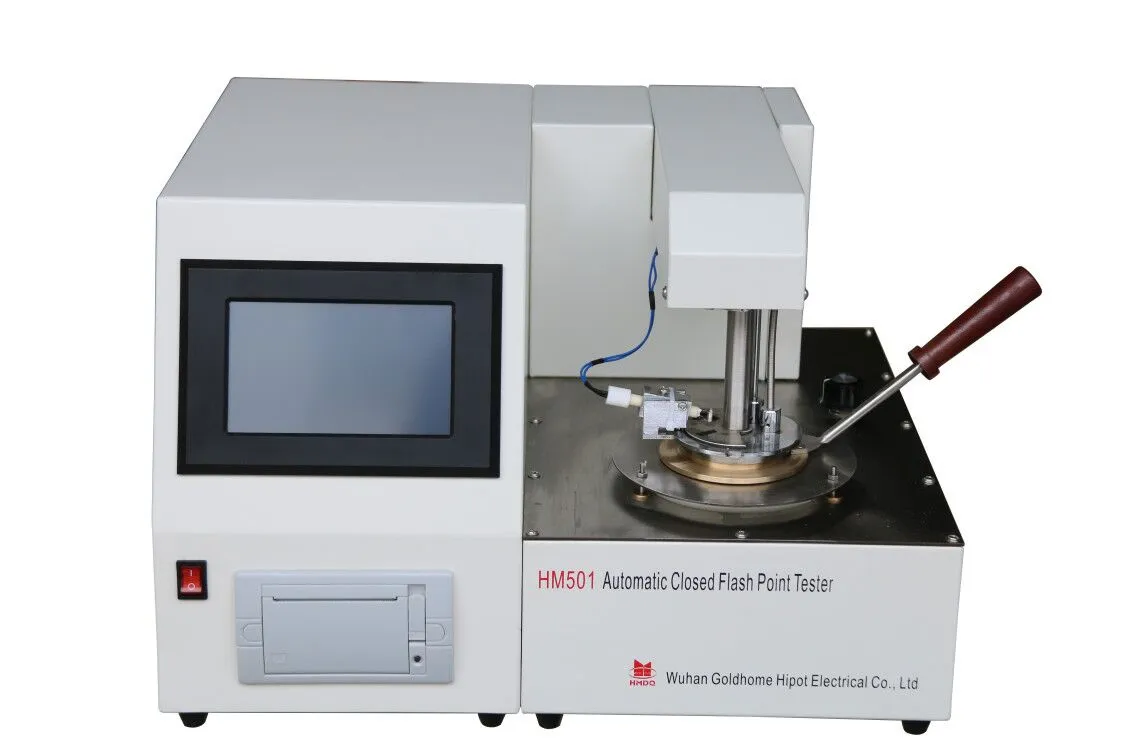
1. Goldhome (Wuhan, China): A well-known domestic brand of power testing instruments, specializing in the power and petrochemical sectors. Its flash point testers feature fully automatic operation and high-precision detection, meeting domestic national standards. Core products include the HM501 fully automatic closed-cup flash point tester and the HM-KS fully automatic open-cup flash point tester. Specifically, the HM501 has a measurement range of room temperature to 350°C, with repeatability meeting national standards (≤110°C ±1°C, >110°C ±2°C). It utilizes a PT100 platinum resistance temperature sensor and supports automatic ignition, result locking, printing, and automatic atmospheric pressure correction. Designed specifically for testing low-flash-point liquids such as transformer oil, diesel, and solvents, it is the preferred model in the power industry; The HM-KS Fully Automatic Open Cup Flash Point Tester has a measurement range of room temperature to 400°C, with a temperature detection accuracy of 0.1°C. It features electronic ignition and forced air cooling, enabling dual-function operation (flash point + fire point). It supports storage of 1,000 data sets and includes a self-test function. Suitable for testing high-flash-point liquids such as lubricating oil, heavy oil, and asphalt, it is widely used in petrochemical and quality inspection applications. Goldhome’s overall strengths lie in its user-friendly operation, compliance with domestic standards, and rapid after-sales response (24-hour response from the Wuhan headquarters). It offers far better value for money than imported brands and is suitable for bulk purchases.
2. Delite (Beijing): With 25 years of industry experience, its flagship flash point testers include the A1190 Closed Cup Flash Point Tester and the A1020 Open Cup Flash Point Tester. These devices offer a detection resolution of 0.1°C and repeatability of ≤2°C, with rapid after-sales support. They are suitable for various applications including power generation, petrochemicals, aviation, and commodity inspection, and enjoy a strong reputation in China’s industrial testing sector.
3. YYP (Shandong): Focusing on smart testing, its smart closed/open cup flash point testers feature six-step self-diagnostic functions, electronic ignition design, and support for cloud data synchronization. Suitable for production line quality control, new energy materials, electronics manufacturing, and petrochemical applications, they offer user-friendly operation and meet modern testing requirements.
4.Yuntang (Shandong): Specializing in multifunctional testing instruments, its YT-KS dual-mode flash point tester employs adaptive PID temperature control, can store 20,000 data sets, and supports RS485/LIMS integration. It is suitable for various scenarios including laboratories, on-site testing, and agricultural testing, offering outstanding value for money.
5.Jiuzhang Instruments (Shandong): Emphasizing intelligent operation, its fully automatic flash point tester features an Android touchscreen interface that displays real-time temperature curves. It supports data export and cloud platform integration, making it suitable for high-frequency testing, research institutions, and large-scale enterprise laboratories.
Aternative Name
- Aternative Name
- Fash point tester
- Fash point anayzer
- Automatic fash point tester
- Cosed cup fash point tester
- Open cup fash point tester
- Pensky-Martens fash point tester
- Ceveand Open Cup Fash Point Apparatus
- Ceveand Open Cup Tester
- Fash point test equipment
- High precision fash point tester
- Semi-automatic Fash Point Tester
- Digita fash point tester
- Fash point tester temperature range
- Portabe fash point tester
- Fash point tester for transformer oi
- ASTM D93 fash point tester
- ASTM D92 fash point test
- ISO 2719 fash point tester
- GB/T 261 fash point tester
- Anton Paar fash point tester
- Metter Toedo fash point anayzer
- PAC fash point tester
- Godhome fash point tester
- Fash point tester price
- Fash point tester manufacturer
- Industria fash point tester
- aboratory fash point anayzer
- Fash point tester for diese oi
- Fash Point Apparatus
- Benchtop Fash Point Tester
- Transformer Oi Fash Point Tester
- Fash Point Measuring Instrument
- Tag Cosed Cup Fash Point Tester
- Continuousy Cosed Cup Fash Point Tester
- Rapid Equiibrium Cosed Cup Tester
FAQ
Q: 1. What is a flash point tester?
A: A flash point tester is a specialized instrument designed to measure the flash point of liquid substances. Its primary function is to assess the flammability and explosiveness risks of liquids, making it an essential piece of testing equipment in the petroleum, chemical, power, and quality inspection industries. The standard English term for this device is “flash point tester,” which is also the most frequently searched product keyword among customers.
Q: 2. Is there a difference between a flash point tester and a flash point analyzer?
A: There is no fundamental difference between the two; they are essentially the same type of equipment. The term “flash point analyzer” is commonly used in English and emphasizes precise laboratory analysis scenarios. In everyday procurement and technical discussions, the two terms are interchangeable, as their functions and testing principles are identical.
Q: 3. What are the advantages of a fully automatic flash point tester?
A: The fully automatic flash point tester (Automatic Flash Point Tester) is the most popular model among customers. It requires no manual supervision throughout the entire process and can automatically complete heating, stirring, ignition, flash detection, temperature locking, data storage, and printing. This significantly reduces human error, ensuring accurate and highly repeatable test results, as well as simpler operation.
Q: 4. Are “flash point test equipment” and “flash point tester” the same product?
A: Yes, “flash point test equipment” is a general term often used in bulk purchasing and manufacturer procurement scenarios. It refers to the same category of products as “flash point tester,” encompassing the full range of models, including closed-cup, open-cup, fully automatic, and portable types.
Q: 5. How to Choose Between a Closed-Cup Flash Point Tester and an Open-Cup Flash Point Tester?
A: Closed-Cup Flash Point Tester: The sample is tested in a sealed cup, simulating the accumulation of vapors in a sealed container. The results tend to be lower and more conservative, making it suitable for low-flash-point liquids such as transformer oil, diesel, and solvents. It is the preferred choice in the power industry.
Open-cup flash point tester: The sample is tested in an open cup, simulating open-air or leakage scenarios. The results tend to be higher. It is suitable for high-flash-point oils such as lubricating oils, heavy oils, and asphalt, and is widely used in industrial applications.
Q: 6. What is a Pensky-Martens Flash Point Tester?
A: The Pensky-Martens Flash Point Tester is the standard model for closed-cup flash point testing. It complies with major national and international standards and is a commonly used device for testing oils and fuel oils, making it a frequently selected piece of equipment.
Q: 7. What is the Cleveland open cup flash point test?
A: The Cleveland open cup flash point is the standard test method for open cup flash points. It is specifically designed for high-flash-point oils, and the test results comply with industry standards, aligning with the standard testing procedures for open cup flash point testers.
Q: 8. What is the key difference between the closed-cup flash point and the open-cup flash point?
A: The closed-cup flash point is the lowest temperature at which the vapor of a liquid ignites upon contact with a flame in a sealed environment, while the open-cup flash point is the lowest temperature at which the vapor at the surface of a liquid ignites upon contact with a flame in an open environment. The two differ in testing scenarios and numerical values, addressing distinct safety risk assessment requirements.
Q: 9. What are the features of a high-precision flash point tester?
A: High-precision flash point testers utilize high-precision temperature sensors, ensuring stable temperature control and excellent test repeatability. Their measurement accuracy meets national standards, making them suitable for applications requiring high precision, such as laboratories, third-party quality inspections, and product certification.
Q: 10. What is a digital flash point tester?
A: Digital flash point testers are equipped with digital displays, typically featuring a Chinese touchscreen interface. They display temperature curves and test data in real time, support automatic calculations, data storage, and export, and offer intuitive operation, replacing traditional manual dial-type devices.
Q: 11. What is the typical temperature range of a flash point tester?
A: The temperature range of a flash point tester is a core parameter. For closed-cup models, the common range is room temperature to 350°C, while for open-cup models, it is room temperature to 400°C. Different models are designed to meet the testing requirements of various oil products and can be customized based on the sample.
Q: 12. What scenarios are portable flash point testers suitable for?
A: Portable flash point testers are compact and lightweight, with some models supporting battery power. They are suitable for scenarios where fixed laboratory testing is not feasible, such as on-site testing, field operations, substation inspections, and logistics spot checks.
Q: 13. What are the requirements for a flash point tester specifically designed for transformer oil?
A: A flash point tester for transformer oil must be a fully automatic closed-cup model that complies with power industry standards. It should offer high precision and stability to accurately determine whether transformer oil has aged or deteriorated, thereby ensuring the safety of power equipment.
Q: 14. How should one select a flash point tester specifically designed for diesel oil?
A: When selecting a flash point tester for diesel oil, closed-cup models should be prioritized. These must comply with national testing standards and are used to monitor diesel quality and assess flammability risks, making them essential equipment for quality control in the petrochemical industry and diesel production.
Q: 15. What standards must flash point testers comply with?
A: Domestically, the commonly used standard is GB/T 261 (closed-cup flash point). Internationally, the widely adopted standards are ASTM D93 (closed-cup), ASTM D92 (open-cup), and ISO 2719. For export products and international compliance testing, equipment that meets the corresponding standards must be selected. For domestic quality inspection and the power industry, models compliant with national standards are preferred.
Q: 16. Where are flash point testers compliant with ASTM D93 used?
A: The ASTM D93 flash point tester is the internationally recognized standard for closed-cup flash point testing. It is primarily used for testing petroleum products, lubricants, and liquid fuels, and is suitable for scenarios such as export trade, international compliance certification, and quality inspection at foreign-invested enterprises.
Q: 17. For which samples is the ASTM D92 flash point test applicable?
A: The ASTM D92 flash point test is the international standard for open-cup flash point testing. It is suitable for high-flash-point samples such as lubricating oils, cutting oils, and residual fuel oils, and serves as the core compliance standard for open-cup models.
Q: 18. What are some well-known brands of flash point testers?
A: Internationally renowned brands include Anton Paar, Mettler Toledo, and PAC, which specialize in high-end precision testing. Among domestic brands, Goldome stands out for its high cost-effectiveness, alignment with domestic industry needs, and rapid after-sales response.
Q: 19. What are the advantages of Goldhome flash point testers?
A: Goldhome flash point testers are high-quality domestic models designed specifically for the power and petrochemical industries. They offer a complete range of fully automatic closed-cup and open-cup models that comply with national standards. These devices are easy to operate, affordably priced, and backed by prompt after-sales support, making them ideal for bulk purchases by domestic enterprises and power utilities.
Q: 20. What key factors should be considered when purchasing a flash point tester?
A: First, determine whether you need a closed-cup or open-cup model. Next, select a fully automatic model. Verify the testing accuracy, temperature range, and compliance standards. Choose between a laboratory model or a portable model based on your specific application. Additionally, consider the manufacturer’s credentials, after-sales service, and price (Flash point tester price).
Q: 21. How can one find a reliable flash point tester manufacturer?
A: When selecting a professional flash point tester manufacturer, prioritize evaluating industry experience, product compliance certifications, and customer case studies. For domestic brands, consider manufacturers like Guodian Huamei that specialize in power testing; their quality and after-sales service are more assured.
Q: 22. What is the difference between industrial-grade and laboratory-grade flash point testers?
A: Industrial-grade flash point testers (Industrial flash point tester) are highly durable and suitable for environments requiring frequent, continuous use, such as factories and refineries; laboratory-grade flash point analyzers (Laboratory flash point analyzer) offer higher precision and are suitable for scenarios requiring accurate testing, such as scientific research, quality inspection, and product development.
As one of the most professional oil flash point tester manufacturers in China, we're featured by quality products and good price. Welcome to buy oil flash point tester in stock here and get pricelist from our factory. Contact us for customized service.