

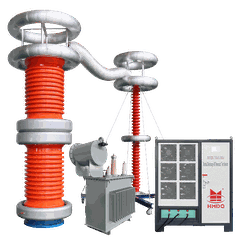



Partial Discharge Test System
Partial Discharge Test Equipment
A Prominent Manufacturer of Partial Discharge Test Equipment in 20 years, Professional Quality Technology, Supply Manufacture Price
Our company has specialized in the production and manufacturing of Partial Discharge Test Equipment for 20 years, with a modern intelligent factory covering an area of over 10000 square meters, staffed by 51 professional technicians, and hold CE certification. 35 patents, 10+ software copyrights,Currently, we have over 150 stable distributors worldwide and established more than 10 service offices overseas.
Partial Discharge Test Equipment comprises non-partial discharge test equipment and partial discharge detection instruments. Non-partial discharge test equipment (providing a “pure” high-voltage environment) generates high voltage and ensures this voltage itself is ‘clean’ (does not generate partial discharge); partial discharge detection instruments (responsible for “capturing and diagnosing” signals).
Partial Discharge Test Apparatus = High-Voltage Generation Unit (Without Partial Discharge Testing Apparatus) + Detection and Analysis Unit (Partial Discharge Detection Instrument)
Only through their combined operation can an effective and accurate insulation performance diagnosis be achieved.
All core components of the partial discharge test apparatus: Partial discharge-free variable frequency power supply; Partial discharge-free excitation transformer; Partial discharge-free reactor; Partial discharge-free capacitive voltage divider; Protection resistor; equalization hood/anti-corona ring; detection impedance; high-frequency current transformer (HFCT); coupling capacitor; acoustic emission (AE) sensor; ultra-high frequency (UHF) sensor; partial discharge detector main unit; shielded room; dedicated connection cables.


Honors, patents, certificates
Our production is strictly in accordance with international standards and power industry regulations. Our products are through the national, provincial power authorities testing, as well as CE certification! At present,0ur company has received ISO9001:2015 quality management system certification, ISO14001:2018 occupational health and safety management system certification, and ISO14001:2015 environmental management system certification,and also had got SGS certification. Awarded the title of National High tech Enterprise and Wuhan Science and Technology Innovation "Gazelle" Enterprise.More than 20 patented technologies,such as The utility model patent of a frequency conversion series resonance test device,The utility model patent of Lightning impulse voltage testing equipment,etc.
Product Applications
These solutions are widely applied across power engineering, transportation, power plant construction, railway infrastructure, petrochemical, metallurgical, and coal mining industries.
Sales Markets
Cumulative exports have reached Indonesia, India, Pakistan, Vietnam, the Philippines, Saudi Arabia, the United Arab Emirates, Egypt, Turkey, Israel, Brazil, Germany, the United States, Australia, and other countries and regions. With over 150 distributors worldwide and more than 10 overseas service offices, we have successfully opened up global markets.
Our Service
We pledge to treat every client with integrity and equality, regardless of contract size or whether they are domestic or international, new or existing customers, providing professional consultation and advice. Goldhome provides professional installation, commissioning and training for users' workers, ensures that users can get familiar with operation methods and put machines into use as soon as possible.
Working Principle and Process of Partial Discharge Test Equipment
1.Partial Discharge-Free Test Equipment (high-voltage test equipment that does not generate partial discharges itself) creates an “absolutely pure” high-voltage environment to ensure that any detected discharge signals originate solely from the device under test, not the test equipment itself.
Optimized Insulation Design:
Utilizes equalization shielding technology (e.g., corona rings), smooth burr-free conductors, and premium insulation materials.
Minimized Background Noise
Comprehensive electromagnetic shielding, proper grounding, and low-noise electronic components.
Purified Voltage Waveforms
Utilizes variable-frequency power supplies and series resonance technology to filter out harmonics.
Absolute System Safety
Incorporates overcurrent/overvoltage rapid protection, safety interlock devices, and reliable grounding.
2. The application and design of partial discharge detection systems adhere to a series of core principles, ensuring the accuracy, reliability, and safety of test results.
Maximising sensitivity and signal-to-noise ratio
Utilising high-sensitivity sensors, electromagnetic shielding, optimised grounding, and digital filtering techniques.
01
Precision in Detection and Diagnosis
We are a solution provider to meet the needs of different customers,widely used in iron ore mining,raw material yard management,coking and sintering,blast furnace ironmaking to steelmaking and rolling,etc. to ensure the safety of power supply.
02
System Integration and Compatibility
Modular design, standardised interfaces, flexible configuration options.
03
Safety and Reliability
Strict adherence to high-voltage safety protocols, overvoltage/overcurrent protection, system self-diagnostic functions.
04
Type of Partial Discharge Test Equipment
The primary types of conventional partial discharge testing equipment include: Series Resonant Test Systems, Partial discharge free power frequency test transformers, DC partial discharge free test power supplies, and Ultra-low frequency test power supplies. Our company primarily Manufactures the following types of No Partial Discharge Testing Equipment: Partial Discharge Free Series Resonant Test Systems, No Partial Discharge Test Transformers, No Partial Discharge Test Simulation Systems, GIS Partial Discharge Fault Simulation Test Systems, and GIL High-Voltage Simulation Test Systems.
Primary Types of Partial Discharge Detection Instruments: High-Frequency Current Transformers, Transient Earth Voltage Sensors, Coupling Capacitor & Impedance Matching Unit, Ultra-high Frequency Sensors, Ultrasonic/Acoustic Emission Sensors, Dissolved Gas Analysis.
The Core Feature Product of Partial Discharge Test Equipment
1. HMCXZW Partial Discharge-Free Variable Frequency Series Resonance Test Device
Overview:
This test system is suitable for:
- Inductive withstand voltage and partial discharge tests on power transformers.
- AC withstand voltage and partial discharge tests on instrument transformers.
- AC withstand voltage tests on power cables.
- AC withstand voltage tests on GIS (Gas Insulated Switchgear) assemblies.
- AC withstand voltage tests on capacitive equipment such as circuit breakers, disconnect switches, insulators, and bushings.
- Power frequency withstand voltage tests on large generator sets.
- Power supply for large ground grid testing.
Features:
1. Excellent test equivalence. Output is a pure sine wave with minimal distortion (distortion rate <3%), eliminating the need for peak measurement.
2. Fiber-optic control ensures complete isolation between high-voltage and low-voltage control circuits.
3. Safe and reliable with integrated multi-level protection. Includes: discharge breakdown protection, overvoltage adjustment protection, output short-circuit protection, power-on zero-position protection, bridge arm amplification circuit protection, and power curve protection.
4. Signal source generated by dedicated chip with microcomputer control, delivering high output frequency stability down to 0.01Hz.
5. Equipped with gas-insulated partial discharge-free reactors, achieving partial discharge levels ≤5pC.

2. HMGTU Power Frequency Partial Discharge-Free High-Voltage Test System
Overview:
The HMGTU Gas-Insulated Partial Discharge-Free Switchgear Test System, also known as the GIS High-Voltage Switchgear AC Withstand Voltage and Partial Discharge Detection System or GIL Cable AC Withstand Voltage and Partial Discharge Test System, is suitable for insulation withstand voltage testing, partial discharge testing, and accuracy testing of GIS transformers for high-voltage, high-capacity GIS and GIL power equipment. It is an essential apparatus for preventive testing and factory acceptance testing at GIS substations, manufacturers of GIS/GIL power equipment, and producers of bowl-type insulators and insulating structural components.
Adding a high-voltage bushing interface to this equipment enables high-voltage extraction, allowing various high-voltage tests on traditional high-voltage equipment.By adding a high-voltage bushing interface to this equipment, high voltage can be drawn off to perform various high-voltage tests on traditional high-voltage equipment.
Features:
1. High voltage fully enclosed within a shielded chamber ensures safe and reliable testing
2. Overall partial discharge level controllable within 1-3 pc
3. Compact size minimizes space requirements; lightweight components
4.Built-in high-voltage disconnect switch enables multi-functional operation
5. Direct connection to test specimens facilitates testing convenience
6. Rugged construction withstands long-distance transportation
7. Reduced system power supply capacity requirements

3.1 HMYDJW Oil-immersed Partial Discharge-Free Test Transformer
Currently, there are two types of partial discharge-free test transformers: gas-filled partial discharge-free withstand voltage test units and epoxy-barrel oil-immersed partial discharge-free withstand voltage test units.
Overview:
An oil-immersed partial discharge-free test transformer is a test transformer with no partial discharge or minimal partial discharge. It is suitable for conducting partial discharge tests and power frequency withstand voltage tests on various electrical equipment, electrical components,and insulating materials.Our oil-immersed partial discharge-free test transformer is a partial discharge-free power frequency test device designed, developed, and manufactured by our company through the introduction and adaptation of advanced foreign technology. It is widely used by manufacturers of electrical appliances, cables, motors, transformers, instrument transformers, insulating materials, and related high-voltage components, as well as in high-voltage testing laboratories of power utilities, research institutions, and universities to conduct partial discharge and power frequency withstand voltage tests on their products.
Features:
- Oil-immersed epoxy cylinder structure delivers low partial discharge, minimal losses, lightweight design, and reduced waveform distortion
- Low-impedance voltage performance exceeds national standards
- Multi-layer shielding provides strong anti-interference capability
- High insulation rating with partial discharge ≤5 pC
- Equipped with automatic protection devices for reliable overcurrent and overvoltage protection

3.2 HMYDQW Inflatable Partial Discharge Test Transformer
Overview:
HMYDQW Inflatable Partial Discharge Test Transformer also known as partial discharge test transformer, partial discharge power frequency test transformer, partial discharge high-voltage test transformer, or partial discharge high-voltage test apparatus.
The gas-filled partial discharge-free test transformer is a partial discharge-free power frequency test transformer designed, developed, and manufactured by our company through the introduction and assimilation of advanced foreign technologies. It is widely used in manufacturers of electrical appliances, cables, motors, transformers, instrument transformers, insulating materials, and related high-voltage components, as well as in high-voltage testing laboratories of power utilities, research institutions, and universities. It enables partial discharge and power frequency withstand voltage testing of their products.
Features:
1. Internally filled with SF6 gas of high insulation strength as the insulating medium;
2. Compact size, lightweight, high-grade craftsmanship, aesthetically pleasing design, and easy to transport;
3. Low partial discharge levels due to SF6 gas arc-quenching properties and specialized structural design, with PDP ≤ 5 pC at rated voltage;
4. Simple, intuitive testing process with user-friendly operation;
5. Effectively eliminates power supply noise interference;
6. High automation and strong anti-interference capability through advanced control technology;
7. High reliability achieved with rapid electronic protection devices.

4. HM160 GIS Partial Discharge Fault Simulation Test Device
Overview:
HM160 GIS Partial Discharge Fault Simulation Test Device Also known as the GIS Partial Discharge Signal Generator or GIS Insulation Defect Simulation Test Device. Primarily used to simulate various discharge phenomena within GIS systems, suitable for research on live partial discharge detection in GIS and instrument evaluation.
Features:
1. High Fidelity: Designed based on actual GIS structures to realistically simulate various partial discharge faults within GIS.
2. Integrated Design: High-voltage equipment including step-up transformers and coupling capacitors are built into the GIS.
Fault Simulation: Capable of simulating GIS discharge types such as corona, air gap, particle, and tracking discharges, with multiple discharge phenomena capable of occurring simultaneously.
3. Controllable Discharges: Allows selection of discharge types and control over the starting voltage, extinction voltage, and discharge intensity of each signal.
4. Diverse Detection Capabilities: Provides a testing platform for pulse current, ultra-high frequency (UHF), ultrasonic, high-frequency, and SF6 gas analysis techniques.
5. Metrology Transfer: Incorporates pulse current method-related coupling and calibration units for synchronous testing.
6. High Stability: Reusable discharge modules with consistent discharge characteristics.
7. User-Friendly Operation: Initiation and termination of various faults can be directly controlled externally.
8. Diverse Insulator Types: Bowl-type insulators include fully shielded, bare bowl, and casting port configurations.
9. Visualization: Built-in infrared video probe facilitates internal condition observation and discharge video capture.
10. Integrated Sensors: Built-in UHF sensors enable convenient comparison with tested instruments.

5. The HM85T Transformer Partial Discharge Fault Simulation Test Device
Overview:
The HM85T Transformer Partial Discharge Fault Simulation Test Device is also known as the Transformer Fault Simulation Test Device, Transformer Partial Discharge Defect Simulation Test Equipment, or Transformer Partial Discharge Signal Generator. Using traditional partial discharge testing equipment and wireless sensing partial discharge testing equipment, it tests various discharge types in GIS, including tip, air gap, particle, and tracking discharges. Multiple discharge types can be generated simultaneously, providing testing for pulse current, ultra-high frequency, ultrasonic, high-frequency, and other detection technologies.
The HM85T transformer simulation device employs an innovative manufacturing process with unique dielectric insulation materials, achieving a partial discharge level <3 pC.
Features:
- Compact design occupying minimal space
- Lightweight components
- Robust construction for long-distance transport
- Capable of performing various tests in unshielded environments
- All high-voltage components are fully enclosed in a sealed chamber, ensuring high operator safety
- Wide application range; with additional bushings, it can perform withstand voltage tests on conventional equipment
- Built-in high-voltage measurement and partial discharge coupling capacitor
- The entire system achieves partial discharge levels below 3 pC, guaranteeing the accuracy of test data

6. HM9209S Handheld Partial Discharge Detetor
Overview:
Our company’s partial discharge inspection instrument is a multifunctional handheld device. Based on ground wave, ultrasonic, Ultra-high Frequency and High-Frequency Current Detection methods, it assesses partial discharge conditions in equipment. It displays partial discharge amplitude and spectrum waveforms, offering storage and retrieval capabilities for two-dimensional and three-dimensional spectra. This enables effective evaluation of partial discharge in electrical equipment. The handheld partial discharge detector features TEV, UHF, AA, AE, and HFCT measurement capabilities. The Partial Discharge Inspection Instrument is suitable for partial discharge detection in electrical equipment such as GIS, switchgear, transformers, and power cables.
Features:
The Partial Discharge Inspection Instrument features a completely redesigned appearance and utilises the widely adopted Android operating system for enhanced user-friendliness. It integrates a 5-megapixel camera for convenient inspection documentation; RFID functionality facilitates expansion into IoT applications; and incorporates an internal discharge type library for efficient comparison and verification of discharge conditions.

7. HMJFS-04 High-Voltage Partial Discharge Patrol Instrument
Overview:
The HMJFS-04 High-Voltage Partial Discharge Inspection Instrument employs UHF electromagnetic radiation detectors, AA non-contact ultrasonic detectors, TEV ground wave detectors, AE contact ultrasonic detectors, and HFCT high-frequency current cable detectors. Different detection principles are applied according to the target being inspected, with multiple detection methods utilised simultaneously under special circumstances.
Features:
1. High-Sensitivity Sensors
Standard configuration includes various sensor types. Through hardware optimisation and software algorithms, these sensors achieve high sensitivity, enabling early detection of defects at their initial stages, alongside precise localisation and identification of defect types.
2. Real-time Dynamic Data Waveform Visualisation
Precisely captured data enables comprehensive, real-time dynamic display of signal waveforms, swiftly aiding inspection personnel in confirming equipment fault types. This proves decisive in identifying discharge characteristics.
3. Minimalist Operational Design
To reduce user learning curves, the high-voltage partial discharge inspection instrument employs an extremely simplified operational design. Inspection commences with a single-button mode switch, eliminating complex adjustments and significantly lowering operational complexity.

The Application of Partial Discharge Test Equipment
Power systems
- Generation sector: Hydro/thermal/nuclear power stations: Testing generators, step-up transformers, outgoing circuit breakers, phase-separated enclosed busbars, etc.
- Hydro/thermal/nuclear power stations: Testing generators, step-up transformers, outgoing circuit breakers, phase-separated enclosed busbars, etc.
- Grid Sector:Substations: Testing power transformers, GIS (Gas Insulated Switchgear), high-voltage circuit breakers, instrument transformers, surge arresters, bushings, insulators, etc.
- Distribution Sector: Distribution Networks: Testing distribution transformers, ring main units, switchgear, cable branch boxes, etc.
Industrial Manufacturing Sector
Distribution systems and major production equipment (e.g., high-voltage motor testing, medium-frequency furnaces) within industrial enterprises (such as chemical plants, metallurgical facilities, semiconductor factories) demand exceptionally high power supply reliability. Testing includes high-voltage motors, capacitors, and surge arresters.
Rail Transport Sector
Traction power supply systems for high-speed rail and metro networks (including traction transformers, catenary equipment, and GIS switchgear) constitute key application targets for partial discharge testing.
Petroleum, Chemical, and Metallurgical Industries
Primarily involves explosion-proof motors, reactors, chemical rectifier transformers, and high-voltage switchgear.
Data Centres and Critical Infrastructure
Data centres, hospitals, airports, financial hubs: Testing high-voltage diesel generators, input/output cabinets of UPS (uninterruptible power supply) systems, precision distribution cabinets, dry-type transformers, etc.
Aerospace and Shipbuilding
Aerospace: Used to assess insulation performance in airborne high-voltage electrical systems (e.g., new-generation multi-electric aircraft) and ground support equipment.
Shipbuilding: Particularly for naval vessels, luxury cruise liners, and LNG carriers, testing generators, high-voltage distribution panels, transformers, etc., within integrated electric propulsion systems.
Alternative Names for Partial Discharge Test Device
- Partial Discharge Test Apparatus
- Partial Discharge-Free Test Equipment
- Partial Discharge-Free Series Resonance Test Apparatus
- GTU High-Voltage Partial Discharge-Free Combined Test System
- Oil-Immersed Partial Discharge-Free Test Transformer
- Gas-Insulated Partial Discharge-Free Test Transformer
- Inductive Withstand Voltage Partial Discharge-Free Test Apparatus
- GIS Partial Discharge Fault Simulation Test Apparatus
- GIS High-Voltage Switchgear AC Withstand Voltage and Partial Discharge Detection System
- GIL Cable AC Withstand Voltage and Partial Discharge Test Apparatus
- GIS Insulation Defect Simulation Test Apparatus
- GIS Partial Discharge Signal Generator
- Switchgear Partial Discharge Simulation Test Apparatus
- Transformer Fault Simulation Test Apparatus
- Transformer Partial Discharge Defect Simulation Test Equipment
- Transformer Partial Discharge Signal Generator
- GIL High-Voltage Simulation Test Apparatus
- Partial Discharge Detection Instruments
- Handheld Partial Discharge Detector
- Handheld Multifunctional Partial Discharge Tester
- High-Voltage Partial Discharge Patrol Tester
- Digital Partial Discharge Tester
- Cable Damped Oscillatory Wave Partial Discharge Test System
- Insulation Diagnostic System
- Partial Discharge Detection System
- Ultra-High Frequency Detector
- Acoustic/Ultrasonic Detection System
- UHF PD Detector
- TEV Detector
- Handheld PD Detector
- On-line PD Monitoring System
Our Success Cases
A warm welcome to our Israeli clients for their site visit to Wuhan Gold home Hipot Electrical Co., Ltd.


An Israeli client ordered an HMCXZW partial discharge-free series resonant test apparatus. To provide timely updates on production progress, we captured photographs during manufacturing. The product has now been safely delivered to Israel and is undergoing on-site installation and debugging. The project has been successfully completed, with the client confirming the product's high quality and full compliance with their requirements.
During production:


Installation and commissioning on site in Israel:


A Prominent Manufacturer of Partial Discharge Test Equipment in 20 years, Professional Quality Technology, Supply Manufacture Price
Certificate


FAQ
Q: 1.What exactly is partial discharge testing?
A: It is a non-destructive testing method that detects minute electrical sparks (known as partial discharges) within internal insulation. This enables the early detection of defects such as insulation ageing, cracks, and contaminants, thereby preventing sudden failures.
Q: 2. What equipment is required for partial discharge testing?
A: Two core components are essential:
- Partial discharge-free high-voltage power supply: Such as a series resonant test system, which provides a ‘pure’ high-voltage excitation.
- Partial discharge detection instrumentation: Including sensors (e.g., HFCT, UHF) and a host unit for acquiring and analysing discharge signals.
Q: 3.What are the most critical safety precautions?
A: Absolute priority! The following must be strictly enforced:
1) Power off, tag and lock out;
2) Fully discharge all equipment;
3) Ensure all equipment and personnel are reliably earthed.
Q: 4. How is partial discharge level (in pC) deemed acceptable? Are there standards?
A: Standards exist, though there is no universally agreed ‘pass threshold’. Acceptability must be determined based on equipment type, voltage rating, and reference to relevant international/national standards (e.g., IEC, GB). Trend analysis: An increasing partial discharge level over time constitutes a hazardous indicator.
Q: 5.What should be done if partial discharge is detected? Is shutdown always necessary?
A: Not necessarily. A comprehensive assessment is required:
Minor and stable: Enhanced monitoring may be implemented, incorporating it into planned maintenance.
Severe and increasing: Shutdown for inspection should be carried out promptly to locate and rectify the fault point.
Q: 6.What is the difference between online and offline testing?
A: Offline testing: Conducted after equipment shutdown under specifically applied high voltage.
- Advantages: High sensitivity, accurate results.
- Disadvantages: Requires power disconnection.
Online monitoring: Real-time monitoring via sensors whilst equipment is operational.
- Advantages: No disruption to power supply, real-time alerts.
- Disadvantages: Susceptible to on-site interference, lower sensitivity.
Q: 7.How to Select the Appropriate Partial Discharge Test Instrument?
A: Mainly based on three aspects:
1.Test Object:
UHF for GIS, HFCT for cables/switchgear, ultrasonic for localisation.
2.Test Scenario:
Portable units for routine inspections, online systems for continuous monitoring.
3. Budget and Requirements:
Basic models are suitable for simple diagnostics, while advanced models feature sophisticated analytical capabilities. Options range from handheld entry-level units costing tens of thousands to online monitoring systems priced in the millions. Selection depends on functionality, sensitivity, number of channels, and brand. The key is to choose the most cost-effective solution based on actual requirements.
Q: 8. Is the operation complex? Does it require professional training?
A: Modern instrument operation (connections, button presses) tends towards simplicity, but data interpretation and diagnostics demand specialised knowledge and training.
As one of the most professional partial discharge test system manufacturers in China, we're featured by quality products and good price. Welcome to buy partial discharge test system in stock here and get pricelist from our factory. Contact us for customized service.