

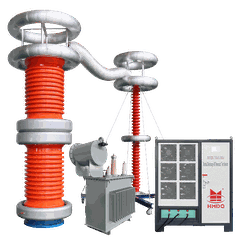

The performance of an AC Test Transformer - Dry Type is a crucial aspect in high - voltage testing applications. As a supplier of AC Test Transformer - Dry Type, I have witnessed firsthand how different load types can significantly influence the performance of these transformers. In this blog, we will explore in detail how the load type affects the performance of a dry - type AC test transformer.
1. Understanding Dry - Type AC Test Transformers
Dry - type AC test transformers are widely used in various industries for high - voltage testing purposes. Unlike their oil - immersed or SF6 gas - type counterparts [AC Test Transformer - SF6 Gas Type](/high - voltage - testing - equipment/ac - dc - hipot - tester/ac - test - transformer - sf6 - gas - type.html) and [AC Test Transformer - Oil Immersed Type](/high - voltage - testing - equipment/ac - dc - hipot - tester/ac - test - transformer - oil - immersed - type.html), dry - type transformers do not use liquid or gas for insulation. Instead, they rely on solid insulation materials, which makes them safer, more environmentally friendly, and easier to maintain.
2. Different Load Types and Their Characteristics
Resistive Loads
Resistive loads are the simplest type of load. They have a linear relationship between voltage and current, following Ohm's law ((V = IR)). In an AC circuit, the current through a resistive load is in phase with the voltage. When a dry - type AC test transformer is connected to a resistive load, the power factor is unity ((PF = 1)). This means that all the electrical power supplied by the transformer is converted into useful work, such as heating or lighting.


The performance of the transformer under a resistive load is relatively straightforward. The voltage regulation is typically good because the load current does not cause significant phase shifts or reactive power flow. The transformer can operate at its rated capacity without much concern for overheating due to reactive components. However, if the resistive load is too large, it may still cause the transformer to overheat due to excessive real power consumption.
Inductive Loads
Inductive loads, such as motors and solenoids, have a magnetic field associated with them. In an AC circuit, the current through an inductive load lags behind the voltage by 90 degrees in an ideal case. This lagging current results in a reactive power component ((Q)) in addition to the real power ((P)). The power factor of an inductive load is less than unity ((0\lt PF\lt1)).
When a dry - type AC test transformer is connected to an inductive load, the reactive power flow can cause several performance issues. First, the transformer has to supply both real and reactive power. The reactive power does not do any useful work but still causes additional current to flow through the transformer windings. This increased current can lead to higher copper losses ((I^{2}R) losses) in the transformer, resulting in increased heating.
Moreover, the voltage regulation of the transformer may deteriorate. The inductive load current causes a voltage drop in the transformer windings, and since the current lags the voltage, the voltage regulation becomes more complex to calculate and control. The transformer may need to be derated when operating with a large inductive load to avoid overheating and ensure proper voltage regulation.
Capacitive Loads
Capacitive loads, like capacitor banks, have a current that leads the voltage by 90 degrees in an ideal AC circuit. Similar to inductive loads, capacitive loads also have a reactive power component. The power factor of a capacitive load is also less than unity, but the reactive power is of the opposite sign compared to an inductive load.
When a dry - type AC test transformer is connected to a capacitive load, the leading current can cause some unique performance effects. The reactive power flow from the capacitive load can partially or fully compensate for the reactive power demand of inductive loads in the same system. However, if the capacitive load is too large, it can cause over - voltage conditions in the transformer. The leading current can also interact with the internal impedance of the transformer, potentially leading to resonance conditions, which can be very dangerous for the transformer and the entire electrical system.
3. Impact on Transformer Efficiency
The load type has a direct impact on the efficiency of a dry - type AC test transformer. Efficiency ((\eta)) is defined as the ratio of output power ((P_{out})) to input power ((P_{in})), i.e., (\eta=\frac{P_{out}}{P_{in}}\times100%).
Under a resistive load, since the power factor is unity, most of the input power is converted into output power, and the efficiency is relatively high. The losses in the transformer mainly consist of copper losses ((I^{2}R) losses in the windings) and core losses (hysteresis and eddy - current losses).
For inductive and capacitive loads, the presence of reactive power increases the input power without a corresponding increase in useful output power. This leads to a decrease in efficiency. The additional current flowing through the transformer due to reactive power also increases the copper losses, further reducing the efficiency.
4. Voltage Regulation
Voltage regulation is another important performance parameter affected by the load type. Voltage regulation is defined as the change in secondary voltage from no - load to full - load conditions, expressed as a percentage of the no - load voltage.
In a resistive load, the voltage regulation is relatively easy to predict and control. The voltage drop in the transformer windings is mainly due to the real current flowing through the resistance of the windings.
For inductive loads, the voltage regulation is more complex. The lagging current causes a voltage drop that is not only due to the resistance but also due to the inductive reactance of the transformer windings. This can result in a larger voltage drop compared to a resistive load at the same load current.
Capacitive loads can have the opposite effect. The leading current can cause the secondary voltage to increase under load conditions, which may require special measures to control the voltage within the acceptable range.
5. Thermal Performance
The load type also significantly affects the thermal performance of a dry - type AC test transformer. As mentioned earlier, inductive and capacitive loads cause additional current flow due to reactive power, which leads to increased copper losses and, consequently, more heat generation.
Excessive heat can damage the insulation materials of the transformer, reducing its lifespan and reliability. Therefore, when operating a dry - type AC test transformer with inductive or capacitive loads, proper thermal management is essential. This may include using fans or other cooling methods to dissipate the heat effectively.
6. Harmonics and Load Type
Some loads, such as non - linear loads (e.g., electronic devices with switching power supplies), can introduce harmonics into the electrical system. Harmonics are multiples of the fundamental frequency of the AC power supply.
Non - linear loads can cause additional losses in the dry - type AC test transformer. The harmonics increase the effective current flowing through the windings, leading to higher copper losses. They can also cause additional core losses due to increased eddy - current and hysteresis effects at the harmonic frequencies.
Moreover, harmonics can distort the voltage waveform, affecting the accuracy of high - voltage testing. When dealing with non - linear loads, it is important to use a dry - type AC test transformer with appropriate harmonic filtering capabilities or to take measures to mitigate the harmonic effects in the electrical system.
7. Conclusion and Call to Action
In conclusion, the load type has a profound impact on the performance of a dry - type AC test transformer. Resistive loads generally result in better performance in terms of efficiency, voltage regulation, and thermal management. Inductive and capacitive loads introduce reactive power, which can cause various performance issues such as reduced efficiency, poor voltage regulation, and increased heat generation. Non - linear loads add the complexity of harmonics to the equation.
As a supplier of AC Test Transformer - Dry Type, we understand the importance of matching the transformer to the specific load requirements. We offer a wide range of dry - type AC test transformers that can be customized to meet the needs of different load types. If you are in the market for a high - quality dry - type AC test transformer, or if you have any questions about how load types affect transformer performance, we encourage you to contact us for a detailed discussion. Our team of experts is ready to assist you in making the right choice for your high - voltage testing applications.
References
- Electric Power Systems by Nagrath and Kothari
- Transformers: Theory, Design, and Application by John McDonald
- High - Voltage Engineering by E. Kuffel, W. S. Zaengl, and J. Kuffel