

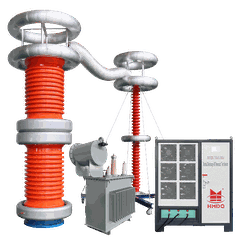

Hey there! As a supplier of Inductive Resonant Test Systems, I often get asked if our system can be used for capacitor testing. Well, let's dive right into this topic and find out.
First off, let's understand what an Inductive Resonant Test System is. It's a powerful piece of equipment that's mainly used in high - voltage testing scenarios. The basic principle behind it is the resonance phenomenon. When an inductor and a capacitor are connected in an electrical circuit, under certain conditions, they can reach a state of resonance where the inductive reactance and capacitive reactance cancel each other out, resulting in a very high current flow at the resonant frequency.
Now, let's talk about capacitor testing. Capacitors are essential components in electrical circuits. They store and release electrical energy, and their proper functioning is crucial for the overall performance and safety of the electrical system. There are several aspects to test in a capacitor, such as its capacitance value, insulation resistance, and dielectric strength.
So, can an Inductive Resonant Test System be used for capacitor testing? The answer is a big yes! And here's how.
Testing Capacitance Value
One of the primary parameters to test in a capacitor is its capacitance value. An Inductive Resonant Test System can be used to measure this accurately. By creating a resonant circuit with the capacitor under test and an inductor in the test system, we can determine the resonant frequency. The relationship between the resonant frequency (f), inductance (L), and capacitance (C) is given by the formula (f=\frac{1}{2\pi\sqrt{LC}}).
Once we measure the resonant frequency of the circuit, we can rearrange the formula to calculate the capacitance value of the capacitor. This method provides a very precise measurement, especially when compared to some traditional capacitance - measuring methods.
Insulation Resistance Testing
Insulation resistance is another critical parameter for capacitors. A good capacitor should have a high insulation resistance to prevent leakage currents. An Inductive Resonant Test System can be used to apply a high - voltage signal to the capacitor. By measuring the current flowing through the capacitor during the test, we can calculate the insulation resistance using Ohm's law ((R = \frac{V}{I})).


If the insulation resistance is lower than the specified value, it indicates that there might be a problem with the capacitor's insulation, such as moisture ingress or dielectric breakdown.
Dielectric Strength Testing
Dielectric strength is the maximum electric field that a dielectric material in the capacitor can withstand without breaking down. An Inductive Resonant Test System can generate high - voltage levels, which are suitable for dielectric strength testing.
We can gradually increase the voltage applied to the capacitor using the test system. If the capacitor can withstand the specified high - voltage level for a certain period without any breakdown or excessive current flow, it means that the dielectric strength of the capacitor meets the requirements.
Now, let's take a look at some of the advantages of using an Inductive Resonant Test System for capacitor testing.
Advantages
- High Precision: As mentioned earlier, the resonant method provides very accurate measurements of capacitance values. This is crucial, especially for applications where precise capacitance is required, such as in electronic filters and power factor correction circuits.
- High - Voltage Capability: The test system can generate high - voltage levels, which are necessary for dielectric strength testing. This allows us to simulate real - world operating conditions and ensure the reliability of the capacitor.
- Efficiency: The resonant circuit in the test system can reduce the power requirements during testing. This not only saves energy but also makes the testing process more cost - effective.
However, there are also some challenges when using an Inductive Resonant Test System for capacitor testing.
Challenges
- Complex Setup: Setting up the resonant circuit requires careful adjustment of the inductance and the test frequency. This might be a bit tricky for inexperienced operators.
- Limited to Certain Capacitor Types: Some types of capacitors, such as electrolytic capacitors, have a relatively low self - resonant frequency. In such cases, the test system might need to be adjusted accordingly to ensure accurate testing.
If you're interested in learning more about the components related to the Inductive Resonant Test System, you can check out these links. The Compensation Capacitor Of Resonant Test Set is an important part of the resonant test system. It helps to optimize the resonant circuit and improve the testing accuracy. The Variable Frequency AC Resonant Test System allows for flexible adjustment of the test frequency, which is very useful for different types of capacitor testing. And the AC Resonant Test Set provides a comprehensive solution for high - voltage testing, including capacitor testing.
In conclusion, an Inductive Resonant Test System is a very effective tool for capacitor testing. It can provide accurate measurements of various capacitor parameters, and its high - voltage capability makes it suitable for different types of capacitor testing scenarios.
If you're in the market for an Inductive Resonant Test System for your capacitor testing needs, don't hesitate to reach out. We're here to provide you with the best - quality test systems and professional technical support. Let's start a conversation about how our products can meet your specific requirements.
References
- Electrical Engineering Handbook, Third Edition
- Power System Testing and Diagnosis by J. C. Das