

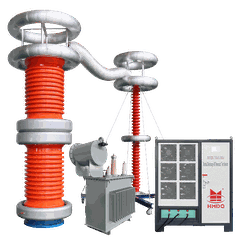

Hey there! As a supplier of Inductive Resonant Test Systems, I often get asked whether these systems can be used for transformer testing. Well, let's dive right into it and explore this topic in detail.
First off, let's understand what an Inductive Resonant Test System is. An Inductive Resonant Test System is a specialized piece of equipment designed to perform high-voltage tests on electrical components. It works on the principle of resonance, where the inductance and capacitance in the test circuit are adjusted to create a resonant condition. This allows for efficient and accurate testing of various electrical devices, including transformers.
Transformers are crucial components in electrical power systems. They are responsible for stepping up or stepping down the voltage levels to ensure efficient transmission and distribution of electricity. Given their importance, it's essential to test transformers regularly to ensure their proper functioning and to detect any potential issues early on.
So, can an Inductive Resonant Test System be used for transformer testing? The answer is a resounding yes! These systems offer several advantages when it comes to testing transformers.
One of the main advantages is the ability to perform high-voltage tests with relatively low power requirements. In a resonant test system, the power required to generate the high test voltage is significantly reduced compared to traditional test methods. This is because the resonant circuit stores and transfers energy efficiently, resulting in lower power consumption. This not only saves energy but also reduces the size and cost of the testing equipment.
Another advantage is the ability to simulate real-world operating conditions. Transformers are subjected to various electrical stresses during normal operation, such as overvoltages, harmonics, and transient events. An Inductive Resonant Test System can generate these types of electrical stresses in a controlled environment, allowing for more accurate testing of the transformer's performance under different conditions. This helps to identify any potential weaknesses or failures in the transformer before they occur in the field.
In addition, Inductive Resonant Test Systems offer a high degree of flexibility. They can be easily configured to test transformers of different sizes and ratings. The test parameters, such as voltage, frequency, and duration, can be adjusted to meet the specific requirements of the transformer being tested. This makes them suitable for a wide range of applications, from small distribution transformers to large power transformers.
Let's take a closer look at some of the specific tests that can be performed on transformers using an Inductive Resonant Test System.
One of the most common tests is the dielectric withstand test. This test is used to verify the integrity of the transformer's insulation system. The test involves applying a high voltage to the transformer for a specified period of time and monitoring for any signs of insulation breakdown. An Inductive Resonant Test System can generate the required high voltage accurately and safely, allowing for reliable dielectric withstand testing.
Another important test is the partial discharge test. Partial discharges are small electrical discharges that occur within the insulation of the transformer. These discharges can cause degradation of the insulation over time and eventually lead to failure. The partial discharge test involves measuring the magnitude and frequency of the partial discharges in the transformer. An Inductive Resonant Test System can provide the necessary high voltage and frequency to detect and measure partial discharges accurately.
In addition to these tests, an Inductive Resonant Test System can also be used for other types of tests, such as the turn-to-turn insulation test, the winding resistance test, and the ratio test. These tests help to ensure the proper functioning of the transformer's windings and other internal components.
Now, let's talk about some of the components of an Inductive Resonant Test System that are relevant to transformer testing.
One of the key components is the Variable Frequency Power Supply. This power supply is used to generate the variable frequency AC voltage required for the resonant test. The frequency can be adjusted to match the resonant frequency of the test circuit, which is determined by the inductance and capacitance of the transformer and the test equipment.


Another important component is the resonant reactor. The resonant reactor is used to provide the inductance in the test circuit. It is designed to have a high quality factor, which means that it can store and transfer energy efficiently. The resonant reactor is typically connected in series with the transformer under test.
The test capacitor is another component that is used in the Inductive Resonant Test System. The test capacitor is used to provide the capacitance in the test circuit. It is designed to have a high voltage rating and a low loss factor. The test capacitor is typically connected in parallel with the transformer under test.
Finally, the control and monitoring system is an important part of the Inductive Resonant Test System. This system is used to control the test parameters, such as voltage, frequency, and duration, and to monitor the test results. The control and monitoring system typically includes a computer-based controller and a display unit.
In conclusion, an Inductive Resonant Test System is a powerful and versatile tool for transformer testing. It offers several advantages over traditional test methods, including low power requirements, the ability to simulate real-world operating conditions, and a high degree of flexibility. With the right components and configuration, an Inductive Resonant Test System can be used to perform a wide range of tests on transformers, ensuring their proper functioning and reliability.
If you're in the market for an Inductive Resonant Test System for transformer testing, or if you have any questions about our products or services, please don't hesitate to contact us. We'd be happy to discuss your specific requirements and help you find the right solution for your needs.
References
- Electrical Power Systems Testing Handbook
- High Voltage Testing Techniques by E. Kuffel, W. S. Zaengl, and J. Kuffel