

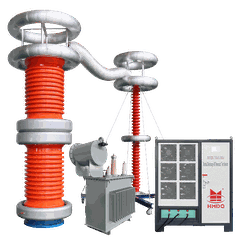

Hey there! As a supplier of Vehicle - Mounted AC Resonant Testers, I'm super excited to share with you how these nifty devices detect changes in AC resonant parameters.
First off, let's get a basic understanding of what an AC resonant tester does. An AC resonant tester is used to test high - voltage equipment like cables, transformers, and insulators. It creates a resonant circuit with the test object, and by analyzing the parameters of this resonant circuit, we can figure out the health of the equipment being tested.
The Vehicle - Mounted AC Resonant Tester is a mobile version of the traditional tester. It's great because it can be easily transported to different job sites, making it super convenient for on - site testing.
Now, let's dive into how it detects changes in AC resonant parameters.
1. Measuring Voltage and Current
One of the most fundamental ways the tester detects changes is by measuring voltage and current. The tester has built - in sensors that can accurately measure the voltage across the test object and the current flowing through it.
When the resonant parameters change, the relationship between voltage and current also changes. For example, in a resonant circuit, the impedance is at its minimum at the resonant frequency. So, if there's a change in the resonant frequency due to a fault or a change in the test object's properties, the impedance will change. This change in impedance will cause a change in the current flowing through the circuit for a given voltage.
The tester continuously monitors the voltage and current values. If it detects a significant deviation from the normal values, it can indicate a change in the resonant parameters. For instance, if the current suddenly increases while the voltage remains relatively stable, it could mean that the impedance has decreased, which might be due to a short - circuit or a breakdown in the insulation of the test object.
2. Frequency Sweeping
Another important method is frequency sweeping. The Vehicle - Mounted AC Resonant Tester can sweep through a range of frequencies to find the resonant frequency of the circuit.
It starts by applying a low - frequency signal to the test object and gradually increases the frequency. As it does this, it measures the voltage and current at each frequency. The resonant frequency is the frequency at which the voltage across the test object reaches its maximum value or the current reaches its maximum value (depending on the circuit configuration).
If there are changes in the resonant parameters, the resonant frequency will shift. For example, if the capacitance of the test object changes (maybe due to moisture ingress in a cable), the resonant frequency will change according to the formula for the resonant frequency of an LC circuit: (f = \frac{1}{2\pi\sqrt{LC}}), where (L) is the inductance and (C) is the capacitance.
By comparing the measured resonant frequency with the expected resonant frequency, the tester can detect changes in the AC resonant parameters. If the measured resonant frequency is different from the expected value, it's a sign that something has changed in the test object.
3. Power Factor Measurement
Power factor is another crucial parameter that the tester uses to detect changes. The power factor is the ratio of the real power (the power actually consumed by the test object) to the apparent power (the product of voltage and current).
In a healthy resonant circuit, the power factor is close to 1. However, if there are losses in the test object (such as due to insulation breakdown or dielectric losses), the power factor will decrease.
The tester measures the power factor by calculating the real power and the apparent power. If the power factor drops below a certain threshold, it indicates a change in the resonant parameters and a possible problem with the test object.
4. Phase Angle Detection
The phase angle between voltage and current is also an important indicator. In a purely resistive circuit, the voltage and current are in phase (phase angle = 0 degrees). But in a resonant circuit, the phase angle can vary depending on the frequency and the circuit components.
The tester measures the phase angle between the voltage and current signals. A change in the phase angle can indicate a change in the resonant parameters. For example, if the phase angle suddenly changes by a large amount, it could be due to a change in the inductance or capacitance of the test object.
Real - World Applications
Let's take a look at some real - world scenarios where the Vehicle - Mounted AC Resonant Tester's ability to detect changes in AC resonant parameters comes in handy.
Testing HV Cables
When testing HV cables, the tester can quickly detect any insulation problems. If there's a partial discharge in the cable, it will cause a change in the resonant parameters. The tester can detect these changes through the methods mentioned above, such as changes in voltage, current, power factor, and phase angle.


By using an HV Cable AC Resonant Tester, you can ensure that the cables are in good condition before they are put into service or during regular maintenance checks.
Testing Transformers
Transformers are critical components in power systems. The Vehicle - Mounted AC Resonant Tester can be used to test the insulation of transformers. A change in the resonant parameters could indicate a problem with the transformer's windings or insulation.
For example, if there's a short - circuit in the transformer windings, the impedance will change, and the tester can detect this through changes in voltage and current measurements.
Advantages of Our Vehicle - Mounted AC Resonant Tester
Our tester has several advantages over other models on the market. Firstly, it's highly accurate. The sensors used in our tester are of the highest quality, ensuring precise measurement of voltage, current, power factor, and phase angle.
Secondly, it's very user - friendly. The interface is intuitive, and it provides clear and easy - to - understand results. Even if you're not an expert in electrical testing, you can easily operate the tester and interpret the results.
Thirdly, it's mobile. As a vehicle - mounted tester, it can be taken to any location, which is a huge advantage for on - site testing.
Related Test Systems
We also offer other related test systems, such as the AC Resonant Test System with PD and the Inductive Resonant Test System. These systems can be used in conjunction with the Vehicle - Mounted AC Resonant Tester to provide a more comprehensive testing solution.
Contact Us for Purchase and Consultation
If you're interested in our Vehicle - Mounted AC Resonant Tester or any of our other products, we'd love to hear from you. Whether you have questions about how the tester works, need help with installation, or are ready to make a purchase, don't hesitate to get in touch. We're here to provide you with the best solutions for your high - voltage testing needs.
References
- Electrical Power Systems by J. Duncan Glover, Mulukutla S. Sarma, Thomas J. Overbye
- High - Voltage Engineering by M. S. Naidu, V. Kamaraju