

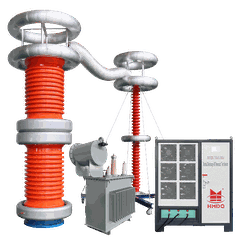

Hey there! As a supplier of Inductive Resonant Test Systems, I'm super stoked to chat about the cool applications of these systems in smart grid equipment testing. Let's dive right in!


1. Testing of Power Transformers
Power transformers are the heart of the smart grid. They step up or step down voltage levels to ensure efficient power transmission and distribution. An Inductive Resonant Test System Inductive Resonant Test System is a game - changer when it comes to testing these transformers.
During the manufacturing process, the system can be used to perform high - voltage withstand tests. By creating a resonant circuit with the transformer under test, we can generate the necessary high voltages with relatively low input power. This is a huge advantage as it reduces the size and cost of the testing equipment. For example, when testing a large - scale power transformer with a high voltage rating, the Inductive Resonant Test System can accurately simulate the actual operating conditions, allowing us to detect any insulation weaknesses or internal faults.
In the field, after installation and during regular maintenance, the system helps in diagnosing the health of the transformer. It can perform partial discharge tests, which are crucial for detecting early signs of insulation degradation. A small partial discharge in the transformer's insulation can lead to catastrophic failures over time. The Inductive Resonant Test System can precisely measure these partial discharges, enabling timely maintenance and preventing unexpected outages.
2. Cable Testing
Smart grids rely heavily on underground and overhead cables for power transmission. These cables need to be tested regularly to ensure their reliability. The Inductive Resonant Test System is well - suited for cable testing.
For new cables, before they are put into service, the system can conduct high - voltage AC withstand tests. Cables may have defects introduced during the manufacturing or installation process. By applying a high - voltage AC signal using the resonant test system, we can identify any potential weak points in the cable insulation. This helps in ensuring that only high - quality cables are used in the smart grid.
In the case of existing cables, the system can be used for diagnostic testing. Over time, cable insulation can degrade due to factors such as environmental stress, electrical stress, and mechanical stress. The Inductive Resonant Test System can perform dielectric loss factor measurements. A change in the dielectric loss factor indicates a change in the cable's insulation properties. By monitoring this factor over time, we can predict the remaining life of the cable and plan for replacement or repair. For instance, in an urban smart grid where replacing cables is a complex and costly process, early detection of cable degradation can save a lot of time and money.
3. Testing of Gas - Insulated Switchgear (GIS)
Gas - Insulated Switchgear is an important component of the smart grid, used for controlling, protecting, and isolating electrical equipment. The Inductive Resonant Test System plays a vital role in testing GIS.
During the factory acceptance test, the system can perform high - voltage tests on GIS units. GIS is designed to operate at high voltages, and it's essential to ensure that it can withstand these voltages without any breakdown. The resonant test system can generate the required high - voltage levels in a controlled manner, allowing for accurate testing of the GIS insulation.
In the field, after installation, the system can be used for maintenance testing. GIS may experience internal faults due to factors such as contamination, mechanical damage, or aging. The Inductive Resonant Test System can perform partial discharge detection on GIS. Detecting partial discharges in GIS is crucial as it can prevent major failures that could disrupt the power supply. For example, in a large industrial smart grid, a failure in the GIS can lead to significant production losses.
4. Testing of Surge Arresters
Surge arresters are used in the smart grid to protect electrical equipment from overvoltage surges caused by lightning or switching operations. The Inductive Resonant Test System can be used to test the performance of surge arresters.
During the manufacturing process, the system can perform high - current impulse tests on surge arresters. These tests simulate the actual surge conditions that the arrester will encounter in the smart grid. By using the resonant test system, we can accurately measure the arrester's response to high - current impulses, ensuring that it can effectively protect the connected equipment.
In the field, the system can be used for periodic testing of surge arresters. Over time, the performance of surge arresters can degrade due to repeated exposure to surges. The Inductive Resonant Test System can measure the arrester's leakage current and residual voltage. A change in these parameters indicates a change in the arrester's performance. By regularly testing surge arresters, we can ensure that they are always in good working condition and can provide reliable protection to the smart grid.
5. Integration with Variable Frequency Power Supply
The Inductive Resonant Test System can be integrated with a Variable Frequency Power Supply for enhanced performance. The variable frequency power supply allows us to adjust the frequency of the input signal to the resonant test system.
This is particularly useful when testing equipment with different resonant frequencies. For example, different types of power transformers, cables, and GIS may have different resonant frequencies depending on their design and parameters. By using a variable frequency power supply, we can easily tune the Inductive Resonant Test System to the resonant frequency of the equipment under test, ensuring accurate and efficient testing.
Moreover, the combination of the Inductive Resonant Test System and the variable frequency power supply can be used in a Container AC Resonant Test System Container AC Resonant Test System. This containerized solution is highly portable and can be easily transported to different testing sites. It provides a complete testing solution for smart grid equipment in various locations, whether it's a remote power plant or an urban substation.
Conclusion and Call to Action
As you can see, the Inductive Resonant Test System has a wide range of applications in smart grid equipment testing. It helps in ensuring the reliability, safety, and efficiency of the smart grid. Whether you're involved in the manufacturing, installation, or maintenance of smart grid equipment, having a high - quality Inductive Resonant Test System is essential.
If you're interested in learning more about our Inductive Resonant Test Systems or want to discuss your specific testing needs, feel free to reach out. We're here to provide you with the best testing solutions for your smart grid equipment.
References
- IEEE Standard for High - Voltage Testing Techniques
- IEC Standards for Electrical Equipment Testing
- Technical literature on smart grid components and testing methods