

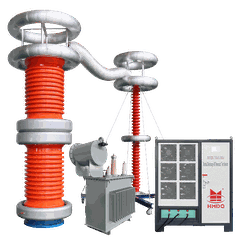


What are the technical specifications of Cascade Test Transformer?
As a dedicated supplier of high - voltage testing equipment, I'm often asked about the technical specifications of Cascade Test Transformers. These transformers play a crucial role in high - voltage testing scenarios, and understanding their technical details is essential for anyone involved in electrical testing, from engineers to technicians.
Basic Working Principle
Before delving into the technical specifications, it's important to understand how a Cascade Test Transformer works. Cascade Test Transformers are designed to generate high - voltage outputs for testing electrical equipment. They operate on the principle of electromagnetic induction, similar to regular transformers. However, they are configured in a cascade arrangement, which allows them to achieve much higher voltage levels than single - stage transformers.
In a cascade setup, multiple transformers are connected in series. The primary winding of the first transformer is connected to the power source. The secondary winding of the first transformer provides the input to the primary winding of the second transformer, and so on. This arrangement multiplies the voltage step - by - step, enabling the generation of extremely high voltages.
Key Technical Specifications
Voltage Rating
The voltage rating is one of the most critical specifications of a Cascade Test Transformer. It indicates the maximum voltage that the transformer can safely generate. Voltage ratings can range from a few kilovolts to several hundred kilovolts or even more, depending on the application. For example, in some industrial testing applications, Cascade Test Transformers with voltage ratings of 100 kV, 200 kV, or higher are commonly used. The choice of voltage rating depends on the type of equipment being tested and the required test voltage level. You can learn more about [Cascade Test Transformer]( /high - voltage - testing - equipment/ac - dc - hipot - tester/cascade - test - transformer.html) on our website.

Current Rating
The current rating of a Cascade Test Transformer specifies the maximum current that the transformer can supply at its rated voltage. This is an important parameter because it determines the power - handling capacity of the transformer. The current rating is usually expressed in amperes (A) or milliamperes (mA). For high - voltage testing, the current requirements are often relatively low, typically in the range of a few milliamperes to a few amperes. However, in some applications where larger loads need to be tested, higher current ratings may be required.
Frequency
The frequency of operation is another important specification. Most Cascade Test Transformers are designed to operate at a standard power frequency, which is typically 50 Hz or 60 Hz, depending on the region. However, in some specialized testing applications, such as testing of high - frequency electrical equipment, transformers with different frequency ratings may be required.
Turns Ratio
The turns ratio of a transformer is the ratio of the number of turns in the secondary winding to the number of turns in the primary winding. In a Cascade Test Transformer, the turns ratio of each stage is carefully designed to achieve the desired voltage multiplication. The overall turns ratio of the cascade arrangement determines the final output voltage of the transformer. A higher turns ratio results in a higher output voltage, but it also affects other performance parameters such as the impedance and the efficiency of the transformer.
Impedance
The impedance of a Cascade Test Transformer is an important factor that affects its performance. It is related to the resistance and reactance of the transformer windings. A low impedance transformer can supply a relatively large current at a given voltage, while a high impedance transformer limits the current flow. The impedance of the transformer should be carefully selected based on the requirements of the testing circuit. In some cases, a low - impedance transformer may be preferred to ensure accurate testing of low - impedance loads, while in other cases, a high - impedance transformer may be used to limit the short - circuit current.
Efficiency
Efficiency is a measure of how effectively a transformer converts electrical energy from the input side to the output side. It is expressed as a percentage and is calculated as the ratio of the output power to the input power. A high - efficiency Cascade Test Transformer minimizes power losses, which is important for reducing energy consumption and heat generation. Factors that affect the efficiency of a transformer include the core material, the winding resistance, and the design of the magnetic circuit.
Insulation Class
The insulation class of a Cascade Test Transformer indicates the maximum temperature that the insulation materials can withstand without significant degradation. Common insulation classes include A, E, B, F, and H, with class H being able to withstand the highest temperatures. The choice of insulation class depends on the operating environment and the expected temperature rise of the transformer. A higher insulation class provides greater reliability and longevity, especially in applications where the transformer may be subjected to high - temperature conditions.
Comparison with Other Testing Equipment
When considering high - voltage testing equipment, it's important to understand how Cascade Test Transformers compare with other types of testers. For example, the [Triple - Frequency Voltage Tester]( /high - voltage - testing - equipment/ac - dc - hipot - tester/triple - frequency - voltage - tester.html) is designed to generate triple - frequency voltages for specific testing purposes, such as testing the insulation of power transformers. While it has its own unique advantages, it may not be suitable for all types of high - voltage testing applications.

On the other hand, the [60kV/2mA DC Hipot Tester]( /high - voltage - testing - equipment/ac - dc - hipot - tester/60kv - 2ma - dc - hipot - tester.html) is used for direct - current high - potential testing. It can be used to test the insulation integrity of electrical equipment under DC conditions. In contrast, Cascade Test Transformers are mainly used for alternating - current high - voltage testing and can achieve much higher voltage levels compared to DC hipot testers in many cases.
Applications
Cascade Test Transformers have a wide range of applications in the electrical industry. They are commonly used for testing the insulation of high - voltage equipment such as power transformers, switchgear, cables, and insulators. By subjecting these components to high - voltage stress, potential insulation weaknesses can be detected before they cause failures in actual operation. They are also used in research and development laboratories for studying the behavior of electrical materials under high - voltage conditions.
Importance of Accurate Specifications
Accurate technical specifications are crucial for the proper selection and use of Cascade Test Transformers. If the voltage rating is too low, the transformer may not be able to generate the required test voltage, leading to inaccurate test results. On the other hand, if the voltage rating is too high, it may pose a safety risk and may also be more expensive than necessary. Similarly, the current rating, frequency, and other specifications need to be carefully considered to ensure that the transformer meets the specific requirements of the testing application.
Customization
As a supplier, we understand that different customers may have different requirements for Cascade Test Transformers. That's why we offer customization services. We can design and manufacture transformers with specific voltage ratings, current ratings, and other technical specifications to meet the unique needs of our customers. Whether you need a transformer for a small - scale laboratory test or a large - scale industrial application, we can provide a solution that fits your requirements.
Conclusion
In conclusion, Cascade Test Transformers are essential tools in high - voltage testing. Their technical specifications, including voltage rating, current rating, frequency, turns ratio, impedance, efficiency, and insulation class, play a crucial role in determining their performance and suitability for different applications. By understanding these specifications, customers can make informed decisions when selecting Cascade Test Transformers for their testing needs.

If you are interested in our Cascade Test Transformers or other high - voltage testing equipment, we invite you to contact us for further details and to discuss your specific requirements. Our team of experts is ready to assist you in finding the right solution for your high - voltage testing applications.
References
- Electrical Power Systems by John J. Grainger and William D. Stevenson
- High - Voltage Engineering by M. S. Naidu and V. Kamaraju
- Transformer Engineering: Design, Technology, and Diagnostics by George Karady and G. Venkata


