

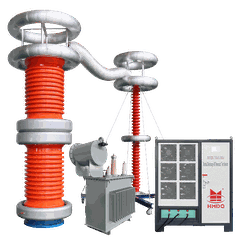

In the realm of electrical testing, the Inductive Resonant Test System stands as a cornerstone technology, playing a pivotal role in ensuring the safety and reliability of various electrical devices. As a leading supplier of Inductive Resonant Test Systems, we are often confronted with the question: What is the test accuracy of an Inductive Resonant Test System for different types of devices? This blog aims to delve into this question, exploring the factors that influence test accuracy and how our systems are optimized to deliver precise results across a diverse range of electrical equipment.
Understanding Inductive Resonant Test Systems
Before we discuss test accuracy, it's essential to understand the basic principles of an Inductive Resonant Test System. These systems operate on the principle of resonance, where an inductor and a capacitor are combined to create a resonant circuit. When the system is tuned to the resonant frequency of the device under test, it can efficiently generate high voltages with relatively low input power. This makes it an ideal solution for high-voltage testing, as it minimizes the power requirements and reduces the size and weight of the testing equipment.
The accuracy of an Inductive Resonant Test System is determined by several factors, including the quality of the components, the precision of the tuning mechanism, and the stability of the power supply. High-quality components, such as low-loss inductors and capacitors, are essential for minimizing energy losses and ensuring accurate measurements. The tuning mechanism must be able to precisely adjust the resonant frequency to match the characteristics of the device under test, and the power supply must be stable to maintain a consistent test environment.
Test Accuracy for Different Types of Devices
Power Transformers
Power transformers are one of the most critical components in an electrical power system, and their reliable operation is essential for maintaining the stability and efficiency of the grid. Inductive Resonant Test Systems are commonly used to perform high-voltage testing on power transformers, including withstand voltage tests and partial discharge tests.
The test accuracy for power transformers depends on several factors, such as the rated voltage, the winding configuration, and the insulation condition. Our Inductive Resonant Test Systems are designed to provide accurate measurements across a wide range of transformer ratings, with a measurement accuracy of up to ±1%. This high level of accuracy ensures that any potential insulation defects or weaknesses can be detected early, allowing for timely maintenance and repair.
Switchgear
Switchgear is used to control, protect, and isolate electrical circuits in a power system. Inductive Resonant Test Systems can be used to test the insulation integrity of switchgear, including circuit breakers, disconnect switches, and contactors.
The test accuracy for switchgear is influenced by factors such as the type of switchgear, the operating voltage, and the presence of any internal arcing or partial discharge. Our systems are equipped with advanced sensors and monitoring devices that can accurately detect and measure partial discharge activity, with a sensitivity of up to 1 pC. This allows for the early detection of insulation degradation and helps prevent catastrophic failures in the switchgear.
Cables
High-voltage cables are used to transmit electrical power over long distances, and their insulation integrity is crucial for ensuring the safe and reliable operation of the power system. Inductive Resonant Test Systems are widely used to test the insulation of high-voltage cables, including XLPE cables and PILC cables.
The test accuracy for cables depends on factors such as the cable length, the insulation thickness, and the presence of any moisture or contaminants. Our Inductive Resonant Test Systems are capable of accurately measuring the capacitance and dielectric loss of cables, which are important indicators of the insulation condition. With a measurement accuracy of up to ±0.5%, our systems can detect even minor changes in the cable insulation, allowing for proactive maintenance and replacement.
AC Resonant Test System for CVT
Capacitor Voltage Transformers (CVTs) are used to measure high voltages in a power system. An AC Resonant Test System specifically designed for CVTs can provide accurate testing of the insulation and performance of these devices.
The test accuracy for CVTs is affected by factors such as the rated voltage, the capacitance ratio, and the frequency response. Our AC Resonant Test System for CVT is optimized to provide precise measurements of the CVT's electrical parameters, with an accuracy of up to ±0.2%. This ensures that the CVT is operating within its specified tolerance and can provide accurate voltage measurements for the power system.
AC Resonant Test System with PD
Partial discharge (PD) is a critical indicator of insulation degradation in electrical devices, and detecting and measuring PD activity is essential for ensuring the reliability and safety of the equipment. Our AC Resonant Test System with PD is designed to provide accurate and sensitive PD measurements for a wide range of electrical devices.


The test accuracy for PD measurements depends on factors such as the sensitivity of the PD sensor, the signal processing algorithm, and the background noise level. Our system uses advanced PD sensors and signal processing techniques to minimize the background noise and provide accurate PD measurements with a sensitivity of up to 1 pC. This allows for the early detection of insulation defects and helps prevent equipment failures.
Vehicle-Mounted AC Resonant Tester
Vehicle-Mounted AC Resonant Testers are designed for on-site high-voltage testing, providing a convenient and portable solution for testing electrical equipment in the field. These testers can be used to test a variety of devices, including power transformers, switchgear, and cables.
The test accuracy for a Vehicle-Mounted AC Resonant Tester is similar to that of a stationary Inductive Resonant Test System, but it must also be able to withstand the vibrations and shocks associated with transportation. Our vehicle-mounted testers are built with rugged components and advanced shock-absorbing systems to ensure reliable operation in harsh environments. They also feature a compact and lightweight design, making them easy to transport and set up on-site.
Ensuring Test Accuracy
To ensure the highest level of test accuracy, our Inductive Resonant Test Systems undergo rigorous quality control procedures during the manufacturing process. Each system is tested and calibrated using traceable standards to ensure that it meets or exceeds the industry standards for accuracy and reliability.
In addition to the manufacturing process, we also provide comprehensive training and support to our customers to ensure that they are able to operate the testing equipment correctly and obtain accurate results. Our technical support team is available 24/7 to answer any questions and provide assistance with troubleshooting and maintenance.
Conclusion
The test accuracy of an Inductive Resonant Test System is crucial for ensuring the reliable operation of electrical devices. By understanding the factors that influence test accuracy and using high-quality components and advanced technology, our systems are able to provide accurate measurements across a wide range of devices, including power transformers, switchgear, cables, and CVTs.
If you are looking for a reliable and accurate Inductive Resonant Test System for your high-voltage testing needs, we invite you to contact us for more information. Our team of experts will be happy to discuss your requirements and provide you with a customized solution that meets your specific needs.
References
- IEEE Standard for High-Voltage Testing Techniques - Definitions and Requirements, IEEE Std 4-2013.
- IEC 60060-1:2010 High-voltage test techniques - Part 1: General definitions and test requirements.
- CIGRE Technical Brochure 496: Guide for the Use of Resonant Test Systems for High-Voltage Testing.