

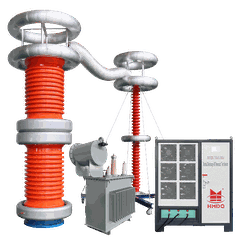


Product Overview & Applications
2.Transformer Manufacturing and Maintenance: Routine testing of power transformers, instrument transformers (Current Transformers - CTs, Voltage Transformers - VTs), and bushings.
3.Gas-Insulated Switchgear (GIS) Testing:Commissioning and maintenance of GIS systems, which are critical in substations.
4.Rotating Machine Manufacturing (Generators & Large Motors):Quality control during the manufacturing of high-voltage stator windings for generators and large industrial motors.
5.Component Manufacturing (Capacitors, Bushings):Testing individual high-voltage components that will be integrated into larger systems.
Product Features and Advantages
- The design concept, material selection and technological process of the HM-YDQ series
products are all new.
- Therefore, not only small size, light weight, beautiful appearance, and
the technical index also reached << jb3570-98 >> standard requirements.
- HM-YDQ series products adopt a new making technology, the dielectric insulation materials are completely
different from other products , so that the products achieve the effect of non partial discharge effect .
- Wiith compact size and light weight( 40%-65%lighterthan same oil immersed test transformerin same level).
- Insulation strength of gas-filled test transformer is obviously higher than the oil immersed test transformer, with minimal corona.
- PD level can be controlled within 3pC at rated output .
Operating Conditions
Temperature:-10°C to +40°C
Humidity:Low <70% RH), non-condensing
Altitude:< 1000 meters above sea level.
Site Condition:Indoors (preferred) or very calm outdoors. Must be clean, dry, dust-free, and free from vibration, corrosive gases, and strong air currents.
Electrical & Electromagnetic Conditions (Critical for PD Testing):Low Electrical Noise;Low Electrical Noise;Grounding (Earthing).
Personnel Conditions (Most Important):
Qualified Personnel:Operators must be trained and qualified high-voltage engineers or technicians with specific expertise in partial discharge measurement techniques.
Safety Knowledge:They must have an in-depth understanding of HV hazards, safe clearance distances, and the specific test procedures.
Additional Information
Pre-Operation & Setup Conditions (The Critical Checklist)
Before starting any test, these conditions must be met:
Inspect the Equipment Under Test (EUT): The EUT (cable, transformer, etc.) must be clean, dry, and visually inspected for damage.
Secure Grounding: Connect the test set and the EUT's ground terminal to the same high-quality earth ground.
Clear Safety Perimeter: Establish a clearly marked, secure safety zone around the entire test setup. Use barriers and warning signs. No unauthorized personnel should be inside this perimeter during testing.
Correct Connections: Use clean, dry, and dedicated high-voltage leads. All connections must be tight and secure. The test object should be placed on insulated supports if necessary.
Calibration: The PD measurement system (including the coupling capacitor and PD detector) should be calibrated as per the manufacturer's instructions to ensure accurate reading of the discharge magnitude.
Operational Modes:
Voltage Withstand Test: Applying a high voltage (100kV) for a set duration to check if the insulation can withstand the stress without breaking down.
PD Measurement Test: Gradually raising the voltage while monitoring for the inception of Partial Discharges. The voltage is then lowered to find the extinction voltage. This requires a separate PD detector.
Maintenance FAQ
Q: What do the "10kVA" and "100kV" specifications mean?
A: 100kV: This is the maximum voltage it can produce. It is used to test equipment rated for system voltages like 11kV, 33kV, etc.
10kVA: This is the power capacity. It indicates the set can supply enough current to properly test equipment with significant inherent capacitance (like long cables) without the voltage dropping.
Hot Tags: 10kva/100kv pd free hv test set, China 10kva/100kv pd free hv test set manufacturers, factory
Technical Specifications
1. The working condition should meet requirements as below for test transformer .
A. Environment temperature:-20℃ to +40℃
B. Relative humidity,should not more than85% at 25℃
C. The installation site shall be free from gas, steam, chemical dust, dirt and other
explosive media which seriously affect the insulation of the transformer.
D .When the test transformer is in use, its input voltage should be gradually
increased and enough protection resistance should be installed at the output end. It is strictly prohibited to break the equipment under high voltage. 2. Transformer Running time Continuous running time should not exceed half an hour , the interval time should be 5-10 time time of working time before make testing
1.No-load currents in various voltage classes of transformer 4~9%, impedance voltage
4~10%
2.HM-YDQ Test Transformer
|
Input voltage
(V)
|
200
|
200
|
400
|
400
|
400
|
400
|
400
|
|
Output voltage
(KV)
|
50
|
100
|
150
|
200
|
250
|
300
|
400
|
|
Partila discharge PC
|
≦5
|
≦5
|
≦5
|
≦5
|
≦10
|
≦10
|
≦10
|
|
Impedance voltage﹪
|
≦8
|
≦8
|
≦8
|
≦8
|
≦10
|
≦10
|
≦10
|
|
no-load current﹪
|
≦6
|
≦6
|
≦6
|
≦6
|
≦5
|
≦5
|
≦5
|
|
wave distortion ﹪
|
∠3
|
∠3
|
∠3
|
∠3
|
∠3
|
∠3
|
∠3
|


