

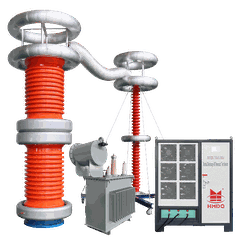

Hey there! As a supplier of AC Resonant Test Systems for CVT (Capacitor Voltage Transformer), I often get asked this question: Can an AC resonant test system for CVT detect internal faults of CVT? Well, let's dig into this topic and find out.
First off, let's understand what a CVT is. A Capacitor Voltage Transformer is an important piece of equipment in power systems. It's used to step down high - voltage for measurement, protection, and control purposes. Just like any other electrical equipment, CVTs can develop internal faults over time due to various reasons such as insulation degradation, mechanical stress, or over - voltage events.
Now, let's talk about the AC resonant test system for CVT. This system is designed to perform high - voltage tests on CVTs. It works on the principle of resonance, where the inductive reactance and capacitive reactance in the test circuit cancel each other out, allowing for efficient transfer of energy at a specific frequency.
One of the main advantages of using an AC resonant test system for CVT is its ability to simulate real - world operating conditions. When we apply an AC voltage at the rated frequency to the CVT using this test system, we can closely mimic the electrical stress that the CVT experiences during normal operation. This is crucial because many internal faults in CVTs are stress - related and may not be easily detectable under DC testing conditions.
For example, insulation defects in the CVT can be detected by monitoring the partial discharge (PD) activity during the AC resonant test. Partial discharges are small electrical discharges that occur within the insulation material when the electric field strength exceeds a certain threshold. These discharges can cause further degradation of the insulation over time and eventually lead to a complete failure of the CVT.
Our AC Resonant Test System with PD is specifically designed to detect and measure partial discharges in CVTs. By analyzing the PD patterns and magnitudes, we can identify potential insulation problems at an early stage. If we observe an abnormal increase in PD activity during the test, it could indicate the presence of an internal fault such as a void in the insulation, a delamination of the insulation layers, or a poor connection within the CVT.
Another way an AC resonant test system can detect internal faults is by measuring the electrical parameters of the CVT, such as capacitance and tan delta. The capacitance of a CVT is mainly determined by the geometry and dielectric properties of its capacitor elements. Any change in the capacitance value could suggest a physical change in the capacitor, such as a breakdown of the dielectric material or a short - circuit between the capacitor plates.
The tan delta, also known as the dissipation factor, is a measure of the energy loss in the insulation. An increase in the tan delta value indicates that more energy is being dissipated as heat within the insulation, which could be a sign of insulation degradation. Our Capacitor Divider Of Resonant Test Set is an essential component of the AC resonant test system that helps in accurate measurement of these electrical parameters.
Let's take a look at a real - life scenario. Suppose we are testing a CVT that has been in service for several years. During the AC resonant test, we notice that the PD activity has increased significantly compared to the previous test results. At the same time, the capacitance value has decreased slightly, and the tan delta has increased. These changes are strong indicators of an internal fault in the CVT. Further investigation may reveal that there is a small crack in the insulation of one of the capacitor elements, which is causing the partial discharges and the change in electrical parameters.
However, it's important to note that not all internal faults in CVTs can be detected by an AC resonant test system. Some mechanical faults, such as a broken support structure or a misaligned component, may not have a significant impact on the electrical parameters or PD activity during the test. In such cases, additional non - electrical testing methods, such as visual inspection or ultrasonic testing, may be required.
Also, the accuracy of fault detection depends on the quality and calibration of the test equipment. Our Variable Frequency AC Resonant Test System is carefully calibrated to ensure accurate and reliable test results. We use high - precision sensors and advanced signal processing techniques to minimize measurement errors and improve the sensitivity of the test system.
In conclusion, an AC resonant test system for CVT can be a powerful tool for detecting internal faults in CVTs. It can identify insulation defects, changes in electrical parameters, and other stress - related problems that may lead to the failure of the CVT. However, it should be used in conjunction with other testing methods for a comprehensive assessment of the CVT's condition.


If you're in the market for a reliable AC resonant test system for your CVTs, we'd love to have a chat with you. Whether you're a power utility, an electrical contractor, or a testing laboratory, our products can help you ensure the safety and reliability of your CVTs. Reach out to us to start a discussion about your specific requirements and how our test systems can meet them.
References
- Electrical Power Systems Testing Handbook
- IEEE Standards for High - Voltage Testing of Power Equipment