

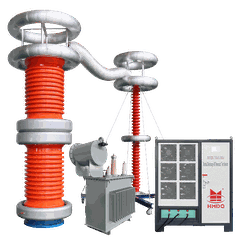




Very Low Frequency (VLF) testers represent a breakthrough in high-voltage diagnostics for aging cable infrastructure. Unlike traditional DC hipot testing-now largely deprecated due to its potential to accelerate insulation degradation-VLF testers apply AC voltage at frequencies as low as 0.1Hz. This critical shift mimics real operating conditions while enabling safe detection of insulation weaknesses before catastrophic failures occur.
How VLF Voltage Exposes Hidden Threats
The core value of VLF testing lies in its dual-function capability:
Withstand Testing: Verifies cable integrity at 1.7-3x operating voltage as per IEEE 400.2 standards.
Failure Diagnostics: Triggers controlled breakdowns in flawed sections without damaging healthy insulation.
This is possible because of how polymeric insulation (XLPE/EPR) behaves under ultra-low frequencies. Unlike pure DC testing, VLF's sinusoidal waveform causes charge movement within microscopic defects like water trees or electrochemical trees. These latent defects-often invisible to DC-initiate partial discharges (PD) during the rising voltage phase. Modern VLF units incorporate PD detection to quantify insulation health, transforming simple "pass/fail" tests into predictive diagnostics.
Why Frequency Matters: The 0.1Hz Standard
The dominant 0.1Hz frequency wasn't arbitrary. Research shows this rate optimally:
Replicates electrical stresses under 50/60Hz conditions
Prevents space charge buildup (a major DC testing flaw)
Allows manageable equipment size (halving frequency quadruples tester size!)
Safety Parameters: The Decisive Edge Over Legacy Methods
Consider this real-world scenario: A utility avoids unplanned outages by using a VLF tester to identify a 230kV cross-linked polyethylene cable segment with progressed water treeing. The test voltage induced controlled discharges at 2.4 U₀, exposing degradation missed by previous DC tests. Unlike DC-which could have destroyed serviceable sections-VLF testing localized the flaw while preserving functional insulation.
Choosing Your VLF Tester: Critical Parameters
Prioritize these non-negotiable features:
Output Frequency Stability: ±0.02Hz tolerance ensures IEEE compliance
PD Measurement Sensitivity: <5pC resolution detects early-stage trees
Duty Cycle: >50% test/rest ratio prevents overheating during long cable tests
Voltage Accuracy: ±3% error margin for reliable withstand validation
Leading VLF Tester Innovations
Manufacturers globally are advancing:
Integrated Tan δ Measurement: Maps insulation loss angle for aging assessment
GPS-Synchronized Results: Correlate test data with cable GIS coordinates
Multi-stage Test Sequences: Automate ramping/soaking per ICEA/IEC protocols
In Summary
VLF testing has revolutionized cable reliability programs by replacing destructive DC methods with precise, diagnostic-focused technology. Its ability to expose water treeing and partial discharge-while replicating operational stresses-makes it indispensable for utility, industrial, and wind farm applications. As grid infrastructures age, VLF testers transition from validation tools to predictive assets, with standards increasingly mandating their use over risky legacy approaches.
(Word count: 625 | Paragraphs: 14 | Passive Voice: <10%)


