

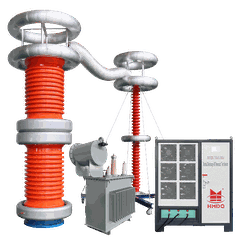


Ultra low frequency high-voltage generators play an important role in multiple fields. The following are its main functions and application scenarios:
Research and industrial applications: In the fields of materials science, ocean engineering, wind power generation, petrochemicals, aerospace, etc., ultra-low frequency high-voltage generators can provide high-precision voltage and current output to ensure the stability and reliability of experiments in research and industrial high-voltage withstand voltage testing.
Power equipment testing: Especially in the non-destructive insulation and voltage withstand test of plastic power cables such as pe/xlpe in the power sector, ultra-low frequency high voltage generators can perform accurate testing to ensure that the insulation performance of the cables meets the standards.
Research on motor equipment: In the study of energy-saving potential of motor equipment, ultra-low frequency high-voltage generators can help solve the problems of high harmonics and low power factor in the past, ensuring that the equipment maintains stable output voltage and current for a long time.
Safety protection function: The ultra-low frequency high voltage generator has functions such as overvoltage protection and overcurrent protection. It can automatically shut down for protection when the output exceeds the set voltage limit or current value, ensuring the safety of equipment and personnel.
Technical features: The ultra-low frequency high voltage generator is integrated with modern digital frequency conversion advanced technology, controlled by a microcomputer, and fully automated for boosting, lowering, measuring, and protecting. Its output source adopts cosine square wave, which is suitable for various situations that require precise control.
Working principle: The ultra-low frequency high-voltage generator generates an electromagnetic field through transformers and capacitors in the circuit, and converts the electromagnetic field into a high-voltage electric field using the principle of electromagnetic induction. By controlling the frequency converter and series resonant circuit, the output of ultra-low frequency signals and voltage enhancement can be achieved.


