


Can an Inductive Resonant Test System be used for high - voltage testing?
Hey there! I'm a supplier of Inductive Resonant Test Systems, and I often get asked this question: Can an Inductive Resonant Test System be used for high - voltage testing? Well, let's dig into it.
First off, what exactly is an Inductive Resonant Test System? It's a piece of equipment that uses the principle of resonance to generate high - voltage outputs. Resonance occurs when the inductive reactance and capacitive reactance in a circuit are equal, and this allows for efficient energy transfer.
When it comes to high - voltage testing, there are several requirements. We need to be able to generate high voltages safely and accurately, and we also need to ensure that the testing process is reliable. An Inductive Resonant Test System can actually meet these requirements quite well.
One of the key advantages of using an Inductive Resonant Test System for high - voltage testing is its efficiency. Since it operates at resonance, the power required to generate high voltages is significantly reduced compared to non - resonant systems. This means lower energy consumption and cost savings in the long run. For example, in large - scale high - voltage testing projects, these savings can add up to a substantial amount.
Another important aspect is safety. High - voltage testing is inherently dangerous, and we need to take every precaution to protect both the equipment and the operators. Inductive Resonant Test Systems are designed with safety features such as over - current protection, over - voltage protection, and short - circuit protection. These features ensure that the testing process is carried out safely, minimizing the risk of accidents.
Accuracy is also crucial in high - voltage testing. We need to be able to measure the voltage accurately to ensure that the equipment under test is operating within the specified limits. Inductive Resonant Test Systems are capable of providing highly accurate voltage outputs, thanks to their precise control over the resonant circuit. This allows for reliable testing results, which are essential for quality control and compliance with industry standards.


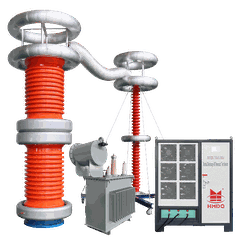
Now, let's talk about some of the components of an Inductive Resonant Test System that make it suitable for high - voltage testing. The [Inductance Adjustable AC Resonant Test System](/high - voltage - testing - equipment/ac - resonance - test - system/inductance - adjustable - ac - resonant - test - system.html) is a great example. This system allows for the adjustment of inductance, which is important for achieving resonance in different testing scenarios. By adjusting the inductance, we can ensure that the system operates at the optimal resonant frequency, resulting in efficient and accurate high - voltage generation.
The [Compensation Capacitor Of Resonant Test Set](/high - voltage - testing - equipment/ac - resonance - test - system/compensation - capacitor - of - resonant - test - set.html) is another important component. It helps to compensate for the capacitive load of the equipment under test, ensuring that the resonant circuit remains stable. This is particularly important when testing equipment with large capacitive loads, as it helps to maintain the resonance and generate the required high voltage.
The [AC Resonant Test Set](/high - voltage - testing - equipment/ac - resonance - test - system/ac - resonant - test - set.html) is the core of the Inductive Resonant Test System. It combines the inductance and capacitance components to create a resonant circuit that can generate high - voltage AC outputs. These test sets are available in different configurations and power ratings, allowing us to choose the most suitable one for our specific testing needs.
In real - world applications, Inductive Resonant Test Systems are widely used in various industries. For example, in the power generation industry, they are used to test the insulation of high - voltage cables, transformers, and switchgear. In the electrical equipment manufacturing industry, they are used for quality control testing of new products. In the research and development field, they are used to study the behavior of materials under high - voltage conditions.
However, like any technology, Inductive Resonant Test Systems also have some limitations. For instance, they are relatively complex to operate compared to some other types of high - voltage testing equipment. Operators need to have a good understanding of the resonant circuit theory and the operation of the system to ensure proper testing. Additionally, the initial cost of an Inductive Resonant Test System can be relatively high, although the long - term cost savings in energy consumption often offset this initial investment.
Despite these limitations, the benefits of using an Inductive Resonant Test System for high - voltage testing far outweigh the drawbacks. With its efficiency, safety, and accuracy, it has become an indispensable tool in the high - voltage testing industry.
If you're in the market for high - voltage testing equipment and are considering an Inductive Resonant Test System, I'd be more than happy to have a chat with you. Whether you have questions about the technical specifications, the pricing, or the application of the system, feel free to reach out. We can discuss your specific needs and find the best solution for your high - voltage testing requirements.
References
- Electrical Testing Handbook, McGraw - Hill
- High - Voltage Engineering Fundamentals, John Wiley & Sons


