

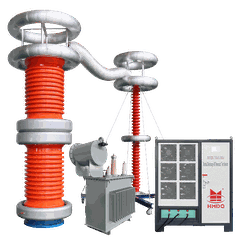


Wuhan Goldhome Hipot Electrical Co., Ltd. is one of the leading manufacturers and suppliers of 3-phase relay tester in China. With abundant experience, our factory offer high quality customized products made in China with competitive price. Welcome to contact us for quotation.
Product Overview & Application Scenarios
Product Overview
The 3 - Phase Relay Tester is a professional device designed for the testing and calibration of relay protection devices in power systems. Based on modern microelectronics technology and advanced testing concepts, it can simulate various power system faults and operating conditions. Widely used in testing, calibration, and research in the power industry, this device is an essential tool for power system maintenance and repair personnel due to its high precision, multifunctionality, and portability.
Application Scenarios
Power System Maintenance and Repair: Used for testing and calibrating various relay protection devices, such as current protection, voltage protection, and differential protection, to ensure they operate accurately during faults.
Power Equipment Commissioning: Validates the settings and operating characteristics of protection devices during the installation and commissioning stages of power equipment.
Research and Education: Provides an experimental platform for power system - related research projects and serves as a practical training device for power engineering education.
Fault Simulation and Analysis: Simulates various instantaneous and permanent faults to help analyze the behavior of protection devices and identify fault causes.
Automated Testing and Calibration: Connects with a computer to achieve automated testing processes, improving testing efficiency and accuracy.
Key Features & Advantages
Multifunctional Output
Standard 4 - phase voltage and 3 - phase current output can be flexibly combined to meet various protection testing requirements.
Each phase voltage can output up to 120V, and the combined 3 - phase current can output up to 120A, offering strong output capabilities.
The 4th phase voltage (Ux) is a multifunctional voltage option that can be set as 3U₀ or synchronization voltage, adapting to complex testing scenarios.
Convenient Operation
Standalone Operation: Equipped with a large LCD display and a rotary mouse controller, the intuitive Chinese interface allows for easy on - site testing without additional external devices.
Dual Operation Modes: With the Windows - based Chinese operation software, more complex automated testing can be achieved, supporting data storage, fault waveform plotting, and report printing.
High Precision and Reliability
AC output accuracy reaches 0.2 grade, and DC output accuracy reaches 0.5 grade, ensuring the accuracy of test results.
The device features rational heat dissipation design and multiple protection measures, with a fault self - diagnosis function for stable and reliable operation.
Rich Switching Interfaces
8 switching input channels and 4 pairs of relay outputs are provided, compatible with both open contacts and potential contacts, and can be expanded according to user needs.
High Cost - Performance Ratio
Combines the high performance of large testers with the portability of small testers, offering a reasonable price and excellent performance - to - price ratio.
Operating Conditions
Environmental Conditions
Temperature Range: - 10℃~+50℃
Relative Humidity: ≤90% (at 40℃)
Atmospheric Pressure: 80kPa~106kPa
Power Requirements
Input Voltage: AC 220V±10%
Frequency: 50Hz±0.5Hz
Power Consumption: ≤500W
Installation Conditions
The device should be placed in a well - ventilated area free from strong electromagnetic interference.
Avoid direct sunlight and prolonged exposure to damp environments.
Ensure proper grounding of the device to guarantee operational safety and testing accuracy.
Additional Information
Device Dimensions and Weight
Dimensions: 400mm×300mm×180mm (L×W×H)
Weight: Approximately 10kg, portable and easy for on - site operation.
Software Support
Windows - based Chinese operation software is provided, supporting automated testing, data storage, fault waveform plotting, and report printing.
The software supports online upgrades to meet evolving testing requirements.
After - Sales Service
Comprehensive after - sales service includes device installation, operation training, and technical support.
Free repairs during the warranty period, and paid repair services are available after the warranty period to ensure long - term stable operation of the device.
Maintenance & FAQs
Hot Tags: 3-phase relay tester, China 3-phase relay tester manufacturers, factory, 3-Phase Relay Tester
Technical Specifications
AC Current Output
Output Accuracy: 0.2 grade
Phase Current Output (RMS): 0~40A
Combined 3 - Phase Current Output (RMS): 0~120A
Phase Current Continuous Operating Value: 10A
Phase Current Maximum Output Power: 450VA
Combined 3 - Phase Current Maximum Output Power: 900VA
Combined 3 - Phase Current Maximum Operating Time: 10s
Frequency Range (Fundamental Wave): 0~1000Hz (Connected), 0~300Hz (Standalone)
Harmonic Order: 0~20 (Connected), 0~6 (Standalone)
DC Current Output
Output Accuracy: 0.5 grade
Current Output: 0~±10A (per phase), 0~±30A (combined)
Maximum Output Load Voltage: 20V
AC Voltage Output
Output Accuracy: 0.2 grade
Phase Voltage Output (RMS): 0~120V
Line Voltage Output (RMS): 0~240V
Phase/Line Voltage Output Power: 80VA/100VA
Frequency Range (Fundamental Wave): 0~1000Hz (Connected), 0~300Hz (Standalone)
Harmonic Order: 0~20 (Connected), 0~6 (Standalone)
DC Voltage Output
Output Accuracy: 0.5 grade
Phase Voltage Output Range: 0~±160V
Line Voltage Output Range: 0~±320V
Phase/Line Voltage Output Power: 70VA/140VA
Switching and Time Measurement
Switching Input: 8 channels, open contact 1~20mA, 24V; potential contact input range: "0" for 0~+6V, "1" for +11V~+250V
Switching Output: 4 pairs, DC: 220V/0.2A; AC: 220V/0.5A
Time Measurement Range: 0.1ms~9999s, Measurement Accuracy: 0.1ms


