

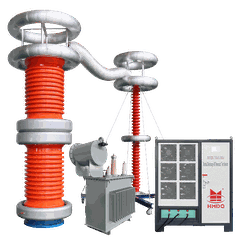



Demystifying the Core Technology: How a Zinc Oxide Arrester Tester Precisely Measures Resistive Current
Introduction
Zinc Oxide Surge Protectors (MOAs) are the silent guardians of the electrical grid, protecting valuable equipment from harmful voltage fluctuations. Their reliability is of utmost importance. A key indicator of their health is the resistive leakage current, a small component that signals insulation degradation. However, accurately measuring this current presents a significant technical challenge. This article addresses the fundamental technology that enables modern test equipment to overcome this challenge: the sophisticated method of separating resistive current from total leakage current.

Measurement Difficulty: Looking for a Needle in a Haystack
At normal operating voltage, a surge protector allows a small leakage current to flow. This current consists of two main components:
Capacitive Current: The larger component, which has a 90-degree phase difference with the voltage. This component is stable and is not a direct indicator of aging.
Resistive Current: The critical part that is in phase with the voltage. An increase in this component is a direct indication of moisture ingress, valve aging, or contamination.
The real challenge lies in the fact that resistive current is typically less than 10% of the total current. Advanced signal processing techniques are required to accurately extract this "needle" from the "haystack" of capacitive current.
Fundamental Technical Analysis: From Fundamental to Harmonic Analysis
The evolution of measurement methods has consistently revolved around the pursuit of precision. Currently, two primary fundamental approaches are employed:
1. Fundamental Frequency Method
This traditional approach assumes the grid voltage is a perfect sine wave. Testing equipment measures the phase angle difference between the voltage signal and total leakage current. Through trigonometric calculations, the resistive component is isolated based on this phase relationship.
Advantages: This method is relatively simple and requires minimal hardware.
Limitations: Its accuracy heavily depends on the purity of the grid voltage. In practical conditions where voltage harmonics are prevalent, the fundamental wave method may introduce significant errors, leading to misjudgments.
2. Harmonic Analysis Method (Advanced Approach)
Modern high-precision testers primarily employ harmonic analysis to achieve exceptional accuracy. This method identifies and accounts for harmonic distortion present in power grids.
Working Principle: The instrument performs Fast Fourier Transforms (FFT) on voltage and current waveforms separately via high-speed digital signal processing (DSP). This analysis decomposes the signal into fundamental frequency components (e.g., 50Hz/60Hz) and harmonic components (e.g., 3rd, 5th, 7th harmonics).
Core Principle: The correlation between voltage and current harmonics provides a more reliable approach for calculating true resistive current. By analyzing multiple frequency components, the tester effectively filters the impact of voltage distortion, enabling stable and precise resistive current measurement even in electrically noisy environments.
The adoption of harmonic analysis represents a significant leap in diagnostic technology, often backed by proprietary algorithms and patents, ensuring reliable data for condition-based maintenance strategies.
Why Precise Measurement Matters for Grid Safety
The ability to precisely measure the resistive current is not merely a technical feat; it is a critical practice for predictive maintenance. By tracking trends in resistive current values over time, maintenance teams can:
Identify early-stage insulation degradation long before a catastrophic failure occurs.
Schedule necessary repairs or replacements during planned outages, avoiding unplanned downtime.
Enhance the overall reliability and safety of the power transmission and distribution system.
This technological capability is particularly valued by utilities and industrial operators globally, including those in regions participating in international infrastructure initiatives and across Latin America, where grid stability is a top priority.
Conclusion
The zinc oxide arrester resistance current tester exemplifies how advanced electrical measurement technology directly enhances infrastructure resilience. This device transcends basic measurement capabilities, providing clear insights into the operational status of critical grid components through precise harmonic analysis. Its deep technical insights empower engineers with scientific decision-making capabilities, ensuring the sustained safe operation of global power systems. For high-voltage asset managers, deploying such advanced diagnostic tools has become an indispensable strategic initiative.


