

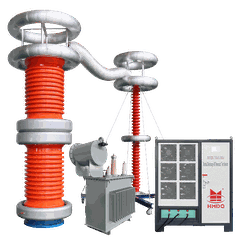




In the realm of power system maintenance and equipment validation, ensuring the integrity of high-voltage components like transformers, cables, and capacitors is non-negotiable. Enter the resonant test set-a specialized tool that has revolutionized how engineers and technicians perform insulation tests under extreme voltage conditions. But what makes this device so effective? Let's break down its working principle and uncover why it's become a cornerstone of modern electrical testing.
The Core Idea: Harnessing Resonance for Efficient High-Voltage Generation
At its heart, a resonant test set leverages the physics of resonance-a phenomenon where an electrical circuit oscillates at its natural frequency with maximum amplitude. Unlike traditional high-voltage test methods (like variable-frequency or direct current testers), which rely on brute-force power sources, resonant test sets use a clever combination of components to generate high voltages efficiently.
Here's the key players in the process:
•
Variable Inductor (Reactor): A coil that adjusts its inductance to match the system's requirements.
•
Capacitive Load (Test Object + Capacitor Bank): The equipment under test (e.g., a cable) acts as a capacitor, often paired with additional capacitors to fine-tune the total capacitance.
•
High-Frequency Power Supply: Delivers a low-voltage AC input, typically in the kHz range (commonly 20–300 kHz).
When these components work in harmony, they create a series resonant circuit. Here's the step-by-step magic:
1.
Frequency Matching: The power supply emits a signal, and the variable reactor is adjusted until its inductive reactance (X_L = 2πfL) equals the capacitive reactance of the load (X_C = 1/(2πfC)). At this point, the circuit resonates.
2.
Voltage Amplification: In resonance, the impedance of the circuit drops to near-zero (only the small resistance of the components remains). This allows the low-voltage input from the power supply to be amplified across the test object-often by 10–100x-reaching the desired high-voltage level (e.g., 100 kV to 500 kV).
3.
Steady-State Operation: Once resonant, the current in the circuit remains stable, and the test object is subjected to a clean, sinusoidal high voltage without excessive losses or distortion.
Why Resonance Matters: Efficiency Over Brute Force
Traditional high-voltage testers (like large step-up transformers) require massive iron cores and heavy copper windings to handle high currents. This makes them bulky, expensive to transport, and impractical for on-site testing-especially in remote or space-constrained areas like wind farms or urban substations.
Resonant test sets flip this script. By relying on resonance, they:
•
Reduce Size and Weight: The power supply operates at lower currents, eliminating the need for heavy transformers. A typical unit weighs under 100 kg, compared to several tons for conventional gear.
•
Minimize Power Consumption: Since energy is only supplied to compensate for circuit losses (not to drive the high voltage directly), efficiency skyrockets.
•
Limit Risk: Resonance ensures smooth voltage rise and fall, reducing the chance of sudden surges that could damage the test object.
Real-World Application: A Case Study in Simplicity
Imagine a utility company tasked with testing a 132 kV underground cable. Using a conventional transformer would require transporting a 2-ton machine to a remote site-an expensive and time-consuming logistical headache. Instead, the team deploys a resonant test set.
Within minutes, they connect the device to the cable, adjust the reactor to match the cable's capacitance, and activate the power supply. The circuit resonates at 30 kHz, amplifying the 10 kV input to 132 kV. The test runs smoothly, with real-time monitoring confirming the cable's insulation integrity. Afterward, the unit is packed into a compact case and driven back to base-no cranes, no extra crew, just results.
Final Thoughts: The Future of High-Voltage Testing
Resonant test sets are more than just tools-they're a testament to how understanding fundamental physics (like resonance) can solve real-world engineering challenges. By prioritizing efficiency, portability, and safety, they've become indispensable for utilities, manufacturers, and maintenance teams worldwide.
Whether you're validating a new transformer or troubleshooting an aging cable, mastering the resonant test set's working principle isn't just technical know-how-it's the key to reliable, future-proof power systems.


