

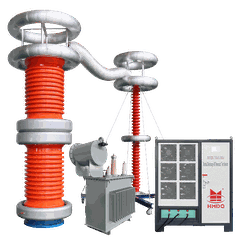



Series Resonance VS Parallel Resonance
Same:
Both series resonant and parallel resonant test systems are used to generate high AC voltages for conducting dielectric withstand and partial discharge tests on capacitive loads such as power cables, GIS, transformers, and generators. The core principle shared by both is to utilize adjustable reactors to achieve resonance with the capacitance of the test object at power frequency (50/60 Hz), thereby minimizing the input power requirements.

Difference:
Definition: A series resonant circuit consists of an inductor, a capacitor, and a resistor, where the inductor and capacitor are connected in series, while the resistor is either connected in series with the inductor or in parallel with the capacitor. A key characteristic of series resonant circuits is current sharing but voltage non-sharing, meaning the voltages across the inductor and capacitor are unequal.
A parallel resonant circuit consists of an inductor, a capacitor, and a resistor, where the inductor and capacitor are connected in parallel, while the resistor is either connected in parallel with the inductor or in series with the capacitor. The defining characteristic of a parallel resonant circuit is voltage sharing but not current sharing, meaning the currents flowing through the inductor and capacitor are unequal.
Current and voltage distribution: In series resonance, if the current is the same, the voltage is distributed proportionally; In parallel resonance, if the voltage is the same, the current is distributed proportionally.
Circuit characteristics: When in series resonance, the circuit exhibits pure resistance, with the minimum impedance and maximum current; When in parallel resonance, the terminal voltage of the circuit is in phase with the total current.
Resonance phenomenon: Series resonance can lead to an increase in voltage, while parallel resonance may lead to an increase in current.
Application:Series resonant circuits are commonly used in frequency selection circuits, filters, and other applications, while parallel resonant circuits are commonly used in frequency selection circuits, oscillators, and other applications.
Summary:
The working principles of these two resonant circuits are similar, but there are significant differences in current and voltage, and there are also significant differences in their applications. Deeply mastering these knowledge can also help us better understand resonance test.
Welcome to visit our website:www.goldhomehipot.com


