
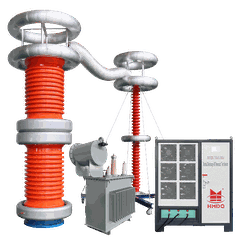


The main functions of the reactor in high-voltage testing equipment include the following aspects:
Limiting current flow: Reactors control the magnitude and direction of current by adjusting the size of inductance or capacitance, thereby protecting other components in the circuit from damage caused by overcurrent.
Adjusting power factor: Reactors can adjust the power factor of a circuit, improving its efficiency and stability.
Resonant voltage withstand test: In the ac voltage withstand test of power equipment, reactors are used to keep the circuit in a resonant state, thereby obtaining high voltage. The resonant frequency depends on the capacitance of the test sample and the inductance of the reactor.
Reactive power compensation: Reactors can be combined with capacitors to form lc resonant circuits, achieving reactive power compensation, reducing grid losses, and improving energy utilization efficiency.
Preventing self-excited magnetic resonance: In the power system, reactors can prevent self-excited magnetic resonance from occurring when the generator is running a long line, protecting system stability.
Types and characteristics of reactors:
Iron core reactor: High noise, poor linearity, easy to cause leakage and local overheating, suitable for indoor environments.
Dry type air core reactor: Good linearity, no noise, strong heat dissipation ability, suitable for indoor and outdoor environments.
Half core reactor: Combining the advantages of iron core reactor and air core reactor, it has low loss and good linearity.
Application areas:
Reactors are widely used in various power equipment and industrial production processes, such as transformers, motors, generators, capacitors, etc. In addition, it can also be used for reactive power compensation, harmonic control, and power quality improvement in the power system.


