

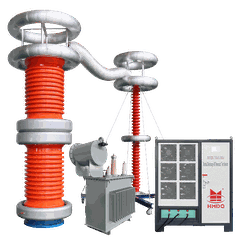


The main function of the reactor in power testing instruments is to keep the circuit in a resonant state, thereby obtaining high voltage. In the ac withstand voltage test of power equipment, especially the series resonant withstand voltage test, the reactor adjusts the reactance and inductance of the circuit to achieve resonance state, thereby obtaining high voltage. The resonant frequency depends on the capacitance of the test sample and the inductance of the reactor.
The specific role of reactors in power testing
Resonant regulation: The reactor adjusts the reactance and inductance of the circuit to achieve a resonant state. In the resonant state, the impedance of the circuit is minimized and the current is maximized, allowing for higher test voltage to be obtained at lower test power sources.
High voltage acquisition: In the resonant state, the reactor can help obtain high voltage, which is very important for the withstand voltage test of power equipment and can effectively detect the insulation performance of the equipment.
Types and characteristics of reactors
Iron core reactor: High noise, poor linearity, easy to cause leakage and local overheating, and prone to magnetic saturation, resulting in a sharp decrease in reactance value, weak ability to suppress harmonics, and low ability to resist short-circuit current.
Dry type air core reactor: Good linearity, no noise, strong overcurrent ability, strong heat dissipation ability, suitable for indoor and outdoor environments, but with a large volume and high losses.
Half core reactor: Combining the advantages of iron core reactor and air core reactor, it has good linearity and low noise, suitable for reactive power compensation and series resonance testing.


