

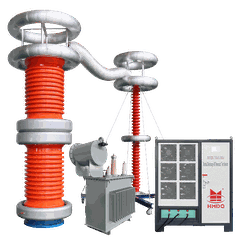



An AC resonance test system is a crucial piece of equipment in the field of high - voltage testing. As a supplier of AC resonance test systems, I am well - versed in how these systems work and their significance in ensuring the safety and reliability of electrical equipment.
Basic Principles of AC Resonance
To understand how an AC resonance test system works, we first need to grasp the concept of resonance. In an electrical circuit, resonance occurs when the inductive reactance ($X_L$) and the capacitive reactance ($X_C$) are equal, i.e., $X_L = X_C$. The inductive reactance is given by the formula $X_L=2\pi fL$, where $f$ is the frequency of the alternating current and $L$ is the inductance of the inductor in the circuit. The capacitive reactance is calculated as $X_C=\frac{1}{2\pi fC}$, where $C$ is the capacitance of the capacitor.
When $X_L = X_C$, the impedance ($Z$) of the circuit is at its minimum, and the current in the circuit reaches its maximum value. This phenomenon is used in AC resonance test systems to generate high - voltage outputs with relatively low input power.
Components of an AC Resonance Test System
An AC resonance test system typically consists of several key components:
- Variable - frequency power supply: This is the heart of the system. It can adjust the frequency of the output voltage to achieve resonance. By varying the frequency, the system can match the resonance conditions of different test objects, which may have different capacitances. For example, when testing a long cable, the capacitance is relatively large, and a different frequency may be required compared to testing a small transformer.
- Inductor: The inductor provides the inductive reactance in the circuit. It is designed to have a specific inductance value, which can be adjusted in some systems. The inductor stores energy in its magnetic field during the positive half - cycle of the AC voltage and releases it during the negative half - cycle.
- Capacitor: The capacitor is an essential part of the resonant circuit. It stores energy in its electric field. The capacitance of the capacitor is determined by the test object. For instance, if the test object is a high - voltage cable, the cable itself has a certain capacitance, which is included in the overall resonant circuit.
- Test object: This is the equipment or component that needs to be tested, such as transformers, cables, or switchgear. The test object is connected to the resonant circuit, and the high - voltage output of the system is applied to it to check for insulation integrity and other electrical properties.
Working Process of an AC Resonance Test System
- Initial setup: The test object is first connected to the AC resonance test system. The variable - frequency power supply is set to a low initial frequency. The system then starts to scan the frequency range to find the resonance point.
- Resonance search: The power supply gradually increases the frequency while monitoring the current in the circuit. As the frequency approaches the resonance frequency, the current starts to increase. When the inductive reactance equals the capacitive reactance, the current reaches its maximum value, indicating that the system has reached resonance.
- High - voltage generation: Once resonance is achieved, the system can generate a high - voltage output with a relatively low input power. The high - voltage is applied to the test object for a specified period to perform various tests, such as insulation resistance testing, partial discharge testing, etc.
- Monitoring and analysis: During the test, various parameters such as voltage, current, and partial discharge are continuously monitored. Any abnormal readings may indicate potential problems in the test object, such as insulation breakdown or internal defects.
Types of AC Resonance Test Systems
There are different types of AC resonance test systems available, each with its own features and applications:
- High Voltage AC Resonant Test System: This type of system is designed to generate high - voltage outputs for testing large - scale electrical equipment. It can be used for testing high - voltage cables, transformers, and other power grid components. You can learn more about our High Voltage AC Resonant Test System.
- Integrated Container AC Resonant Test System: This is a more compact and portable solution. It is housed in a container, which makes it easy to transport and use in different locations. It is suitable for on - site testing of electrical equipment. Check out our Integrated Container AC Resonant Test System.
- PD AC Resonant Test Set: This system is specifically designed for partial discharge testing. Partial discharge is a sign of potential insulation problems in electrical equipment. The PD AC Resonant Test Set can detect and measure partial discharges accurately. For more information, visit our PD AC Resonant Test Set.
Advantages of Using AC Resonance Test Systems
- Low power consumption: Since the system operates at resonance, it can generate high - voltage outputs with relatively low input power. This reduces the energy consumption and the size of the power supply required.
- Accurate testing: AC resonance test systems can provide accurate and reliable test results. They can detect various electrical defects in the test object, such as insulation breakdown, partial discharge, and dielectric loss.
- Safety: These systems are designed with safety features to protect the operators and the test object. For example, they have over - voltage and over - current protection devices to prevent damage to the equipment.
Applications of AC Resonance Test Systems
- Power grid equipment testing: AC resonance test systems are widely used in the power industry to test high - voltage cables, transformers, switchgear, and other power grid components. They help ensure the safety and reliability of the power grid.
- Manufacturing quality control: In the manufacturing process of electrical equipment, AC resonance test systems are used to test the products before they are shipped. This helps ensure that the products meet the required quality standards.
- Research and development: These systems are also used in research and development to study the electrical properties of new materials and components.
Why Choose Our AC Resonance Test Systems
As a supplier of AC resonance test systems, we offer several advantages:
- High - quality products: Our systems are designed and manufactured with the latest technology and high - quality components. They are reliable and accurate, ensuring the best test results.
- Customized solutions: We can provide customized AC resonance test systems according to the specific requirements of our customers. Whether it is a large - scale power grid project or a small - scale research project, we can offer the right solution.
- Excellent after - sales service: We have a professional after - sales service team that can provide technical support and maintenance services to our customers. We are committed to ensuring the long - term performance of our products.
If you are in need of an AC resonance test system for your electrical testing needs, we invite you to contact us for a detailed discussion. Our team of experts will be happy to assist you in choosing the right system and provide you with all the necessary information.


References
- Electrical Power Systems: A First Course by Ashfaq Husain
- High - Voltage Engineering: Fundamentals by E. Kuffel, W. S. Zaengl, and J. Kuffel


