

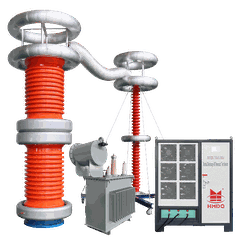


As a supplier of AC Resonant Test Sets, I've witnessed firsthand the critical role these systems play in electrical testing. In this blog, I'll delve into the concept of the stability of an AC Resonant Test Set, exploring its importance, factors affecting it, and how we ensure high - level stability in our products.

Understanding the Basics of an AC Resonant Test Set
An AC Resonant Test Set is a specialized piece of equipment used for conducting high - voltage tests on electrical components such as cables, transformers, and switchgear. The fundamental principle behind it is resonance. When the inductive reactance and capacitive reactance in the test circuit are equal, resonance occurs. At this point, the impedance of the circuit is minimized, and the voltage across the test object can reach a high value with relatively low input power.
The main components of an AC Resonant Test Set typically include a [Variable Frequency Power Supply](/high - voltage - testing - equipment/ac - resonance - test - system/variable - frequency - power - supply.html), an inductor, and a capacitor. The variable frequency power supply allows the operator to adjust the frequency of the input voltage to achieve resonance. The inductor and capacitor form the resonant circuit, and the test object is connected in parallel or series with this circuit.
The Significance of Stability in an AC Resonant Test Set
Stability is of utmost importance in an AC Resonant Test Set for several reasons. Firstly, accurate test results rely on stable operating conditions. In high - voltage testing, even small fluctuations in voltage, current, or frequency can lead to inaccurate measurements. For example, if the voltage across the test object is not stable, it may cause false indications of insulation breakdown or other faults, leading to incorrect conclusions about the condition of the electrical component.
Secondly, stability ensures the safety of the testing process. Unstable test sets can generate sudden voltage spikes or surges, which pose a significant risk to both the test equipment and the personnel operating it. A stable test set operates within a predictable range, reducing the likelihood of such dangerous events.
Finally, stability affects the efficiency of the testing process. A stable AC Resonant Test Set can maintain resonance for extended periods, allowing for continuous and uninterrupted testing. This reduces the time required for testing and increases the overall productivity of the testing facility.
Factors Affecting the Stability of an AC Resonant Test Set
1. Power Supply Stability
The [Variable Frequency Power Supply](/high - voltage - testing - equipment/ac - resonance - test - system/variable - frequency - power - supply.html) is the heart of the AC Resonant Test Set. Any instability in the power supply can directly impact the performance of the test set. Factors such as voltage regulation, frequency stability, and harmonic content in the power supply output can all affect the stability of the resonant circuit. A high - quality power supply with excellent voltage and frequency regulation capabilities is essential for maintaining the stability of the test set.
2. Component Quality
The quality of the inductor, capacitor, and other components in the test set also plays a crucial role in stability. Inductors with low resistance and high Q - factor (quality factor) can reduce power losses and improve the stability of the resonant circuit. Capacitors with stable capacitance values over a wide range of temperatures and frequencies are necessary to ensure consistent resonance characteristics. Poor - quality components may introduce additional impedance variations or electrical noise, leading to instability in the test set.
3. Load Variations
The test object itself can act as a load on the AC Resonant Test Set. Changes in the capacitance or impedance of the test object, such as those caused by temperature variations, moisture, or mechanical stress, can affect the resonance conditions. A stable test set should be able to adapt to these load variations and maintain resonance. Some advanced test sets are equipped with automatic tuning mechanisms that can adjust the frequency or other parameters in real - time to compensate for load changes.
4. Environmental Conditions
Environmental factors such as temperature, humidity, and electromagnetic interference (EMI) can also impact the stability of an AC Resonant Test Set. High temperatures can cause the resistance of components to increase, leading to power losses and instability. Humidity can affect the insulation properties of the test object and the components in the test set, potentially causing electrical leakage and other issues. EMI from nearby electrical equipment can introduce noise into the test circuit, disrupting the resonance and affecting the accuracy of the test results.

Ensuring Stability in Our AC Resonant Test Sets
As a supplier of [AC Resonant Test Sets](/high - voltage - testing - equipment/ac - resonance - test - system/ac - resonant - test - set.html), we take several measures to ensure the stability of our products.
1. High - Quality Components
We source only the highest - quality components for our test sets. Our inductors are designed with low - loss materials and precision winding techniques to achieve high Q - factors. The capacitors we use have excellent temperature and frequency stability, ensuring consistent performance under various operating conditions. By using high - quality components, we minimize the impact of component variations on the stability of the test set.
2. Advanced Power Supply Design
Our [Variable Frequency Power Supply](/high - voltage - testing - equipment/ac - resonance - test - system/variable - frequency - power - supply.html) is designed with advanced control algorithms and high - precision voltage and frequency regulation circuits. It can provide a stable output voltage and frequency, even under varying load conditions. The power supply also has built - in protection mechanisms to prevent over - voltage, over - current, and other abnormal conditions, further enhancing the stability and reliability of the test set.
3. Automatic Tuning and Compensation
Many of our AC Resonant Test Sets are equipped with automatic tuning and compensation features. These features allow the test set to continuously monitor the resonance conditions and adjust the frequency or other parameters in real - time to maintain resonance. For example, if the capacitance of the test object changes due to temperature variations, the automatic tuning system can adjust the frequency of the power supply to ensure that the resonant circuit remains in a stable state.
4. Environmental Protection
We design our test sets to be resistant to environmental factors. They are housed in rugged enclosures that provide protection against dust, moisture, and mechanical shock. Additionally, we incorporate EMI shielding techniques to reduce the impact of electromagnetic interference on the test set. This ensures that our test sets can operate stably in a wide range of environmental conditions.
Our Inductance Adjustable AC Resonant Test System
One of our flagship products is the [Inductance Adjustable AC Resonant Test System](/high - voltage - testing - equipment/ac - resonance - test - system/inductance - adjustable - ac - resonant - test - system.html). This system offers enhanced stability and flexibility for high - voltage testing. The adjustable inductance feature allows the operator to fine - tune the resonance conditions according to the specific requirements of the test object. This not only improves the accuracy of the test results but also ensures that the test set can maintain stability even when testing objects with different capacitance values.
Conclusion
The stability of an AC Resonant Test Set is crucial for accurate, safe, and efficient high - voltage testing. As a supplier, we are committed to providing our customers with test sets that offer the highest level of stability. By using high - quality components, advanced power supply design, automatic tuning and compensation features, and environmental protection measures, we ensure that our products can meet the demanding requirements of electrical testing applications.
If you are in need of a reliable AC Resonant Test Set for your electrical testing needs, we invite you to contact us for more information and to discuss your specific requirements. Our team of experts is ready to assist you in finding the right solution for your testing challenges.
References
- Grover, F. W. (1946). Inductance Calculations: Working Formulas and Tables. Dover Publications.
- Hayt, W. H., & Kemmerly, J. E. (2001). Engineering Circuit Analysis. McGraw - Hill.
- Sullivan, C. R. (2018). Power Electronics: Converters, Applications, and Design. Wiley.


