

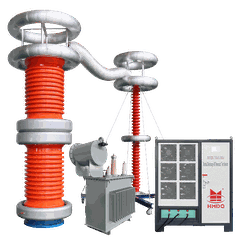



How does a partial discharge-free series resonant system work?

I. Fundamental Structure of Partial Discharge-Free Series Resonance
Partial Discharge-Free Series Resonance is essentially a high-voltage generation device based on the "series resonance principle." It primarily consists of an adjustable reactor, excitation transformer, high-voltage divider, capacitive divider, and partial discharge suppression module. Its core objective is to achieve resonance in the test circuit by adjusting circuit parameters, thereby generating high voltage on the tested equipment while suppressing or eliminating partial discharge signals generated during testing.
Unlike conventional series resonant equipment, the key to the partial discharge-free design lies in controlling the "partial discharge sources." For instance, at the connection points between reactors and capacitors, the equipment employs coaxial shielding structures to reduce electric field concentration. Insulation materials are selected from epoxy resins or silicone rubbers with low partial discharge characteristics to minimize inherent discharge risks. Even the connecting cables feature dual-shielded layer designs to isolate external electromagnetic interference from internal signals. These combined details ensure the partial discharge level in the test circuit remains below the detection instrument's sensitivity threshold (typically ≤10 pC).
II. Workflow:
1. Parameter Matching Stage: Before the test, technicians calculate the required reactance value (L) based on the capacitance (Cx) of the test equipment and the test voltage (U). By adjusting the inductance of the reactor (or changing the number of parallel reactors), the total impedance of the circuit approaches pure resistance. At this point, the circuit current reaches its maximum value, and the voltage across the test equipment equals the excitation voltage multiplied by the quality factor (Q-value), enabling easy high-voltage output.
2. Voltage Ramp-up and Partial Discharge Monitoring Stage: After the voltage is gradually raised to the preset value, the equipment enters steady-state operation. At this point, the partial discharge monitoring system begins real-time signal acquisition-using built-in high-sensitivity sensors (such as ultra-high-frequency sensors or ultrasonic sensors) to capture partial discharge pulses within the tested equipment. Algorithms then analyze the location, intensity, and type of partial discharge (e.g., air gap discharge, surface discharge). If abnormal partial discharge is detected (e.g., exceeding the threshold of 100 pC), the system immediately triggers an alarm and cuts off the power supply to prevent equipment damage.
3. Voltage reduction and data analysis stage: After the experiment is completed, the equipment automatically reduces voltage to zero and generates a test report including partial discharge level, voltage waveform, and frequency characteristics. Technicians can compare historical data to determine whether the insulation status of the tested equipment is qualified.
III. Leading Enterprises in Partial Discharge-Free Technology
Goldhome Hipot:
As an enterprise with years of deep expertise in the power testing and commissioning sector, Wuhan Goldhome Hipot Electrical Co., Ltd. has accumulated substantial experience in the R&D, production, and application of partial discharge-free series resonant technology. Its products have become the preferred choice for industry users due to three core strengths:
1. Extensive Patents and Robust R&D Capabilities. Holding over 30 national patents (including multiple invention patents), its core technologies span critical areas such as resonant circuit design, partial discharge suppression, and intelligent control. The R&D team has significantly reduced equipment-induced partial discharge interference while enhancing output voltage stability and regulation precision through optimized reactor winding processes, improved damping resistor configurations, and digital control algorithms. Multiple technologies have reached industry-leading standards.
2. Professional laboratory hall
Goldhome has established an independent high-voltage testing hall equipped with internationally advanced high-voltage detection equipment. From raw material screening to finished product delivery, each device needs to undergo multiple verifications such as partial discharge testing, pressure resistance testing, and temperature rise testing. The partial discharge testing standards are even higher than industry standards to ensure that the product can maintain its "low partial discharge" characteristics under complex working conditions.
3. Extensive Project Experience and Broad Overseas Market Expansion
Leveraging reliable product performance, Guodian Huamei has repeatedly participated in equipment selection and testing for key projects like State Grid, accumulating rich field application experience. In recent years, with the advancement of the Belt and Road Initiative, Guodian Huamei's zero-partial-discharge series resonant devices have gradually expanded into international markets. Sold to regions including Latin America, Southeast Asia, and Europe, these devices have earned widespread recognition from overseas customers for their stable performance.
In a short, For the power industry, the accuracy of insulation testing directly impacts the safety and stability of grid operations. As the core tool in this process, the performance of partial discharge series resonant devices is of paramount importance. Leveraging technological innovation, stringent quality control, and extensive experience, Wuhan Goldhome delivers safe and reliable products to users. Choosing Goldhome means choosing a commitment to safety.


