



Introduction
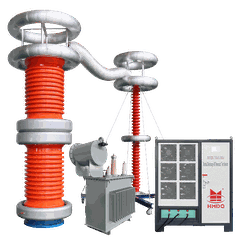
In high-voltage testing, the stability and safety of the power supply are of paramount importance. Among various techniques, non-partial discharge power supplies (VFD, Variable Frequency Drive) have emerged as a significant solution to reduce the risk of insulation degradation caused by partial discharges. These advanced systems are designed to provide clean and stable power while minimising harmful electrical events that jeopardise equipment integrity.
Core technology: Partial discharge suppression
Partial discharge (PD) occurs when local dielectric breakdowns occur in the insulation material without the electrodes being completely bridged. Although initially a minor phenomenon, repeated PD events lead to gradual deterioration of the insulation, resulting in premature failures and safety risks. Partial discharge-free VFD power supplies address this issue through several innovative methods:
•Optimised topology design: By improving circuit layouts and component selection, these power supplies reduce voltage fluctuations and transient oscillations during switching operations. This provides smoother output waveforms with minimal harmonic distortion.
•High-frequency soft switching: The use of soft switching techniques significantly reduces switching losses and electromagnetic interference (EMI). This technique enables voltage transitions to occur with reduced load on the insulation material.
•Improved electromagnetic shielding: advanced shielding materials and designs limit electromagnetic interference and prevent external disturbances from causing partial discharges in connected devices.
Partial discharge-free VFD power supplies are often used in situations requiring high reliability:
•High-voltage motor testing: ensures accurate performance evaluation without subjecting the insulation to additional stress.
•Testing the strength of power transformers: provides a stable voltage output to detect weak points in the insulation without causing damage during testing.
•Diagnostics of gas-insulated switchgear (GIS): enables accurate assessments of GIS integrity under controlled conditions.
The benefits extend beyond safety:
•Longer equipment life: by minimising partial discharges, these power supplies help preserve the life of both the test equipment and the devices being tested.
•Higher test accuracy: reduced electrical noise ensures that measurements reflect true performance rather than artefacts due to power supply issues.
•Energy efficiency: modern designs incorporate built-in energy-saving features, in line with global sustainability goals.
Conclusion
VFD power supplies without partial discharge represent a significant advancement in high-voltage testing technology. Their ability to suppress partial discharges not only enhances safety and reliability but also supports more accurate and efficient testing processes. As industrial sectors increasingly prioritize equipment durability and energy savings, the implementation of such innovative energy solutions becomes inevitable. For specialists seeking to enhance testing capabilities, examining these systems offers a pathway to achieve better results and reduce operational risks.


