





Introduction
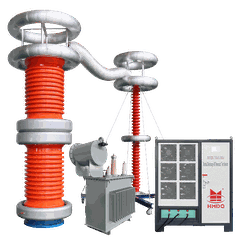
Capacitive voltage transformers (CVTs) play a fundamental role in high-voltage power measurement and protection systems, where measurement accuracy directly affects grid stability. Traditional testing methods often struggle with impedance matching challenges, which prolong setup time and compromise data reliability. Modern serial resonance testers overcome these limitations through intelligent automation and precision engineering, setting new standards in CVT calibration efficiency.
Key innovation: automatic impedance matching technology
An outstanding feature of advanced series resonance test systems is that they automatically synchronize with the capacitive properties of CVTs. This capability changes test procedures in three important ways:
1.Dynamic frequency adjustment
Unlike fixed-frequency systems, modern test systems use real-time algorithmic calculations to determine the exact resonance point (f₀=1/2π√LC). This eliminates manual estimates and ensures optimal energy transfer during testing, resulting in energy savings of up to 60% compared to traditional methods.
2.Harmonic suppression mechanism
By generating near-pure sinusoidal waveforms through LC resonance, these systems minimize harmonic distortion, which can corrupt CVT ratio error measurements. This is particularly important when testing CVTs installed in substation environments with electrical noise.
3.Safety integration
Automated impedance assignment prevents dangerous overvoltage conditions by keeping the tuned frequency within safe operating limits. The system continuously monitors parameters such as quality factor (Q factor) and immediately interrupts the tuned frequency when it detects abnormal conditions, in accordance with IEEE C57.13 safety protocols.
Technical advantages in field applications
Field technicians benefit from these technological advances through:
•Reduced installation time: automated configuration in 5 minutes versus manual calibration in over 30 minutes.
•Cross-platform compatibility: effective testing on different CVT designs (coupling capacitor/electromagnetic units).
•Data traceability: integrated recording of test parameters to document compliance.
Impact on the sector
This technology supports grid modernisation initiatives, enabling:
•Accurate calibration of CVTs for renewable energy integration projects.
•Reliable baseline data for preventive maintenance programmes.
•Standardised testing methodologies across international markets.
Conclusion
The evolution of series resonance test systems represents a significant step forward in high-voltage measurement technology. By leveraging adaptive impedance matching and intelligent control algorithms, these systems not only improve test accuracy but also contribute to broader network reliability efforts. As electrical systems continue to evolve, these innovations will remain indispensable for ensuring measurement integrity in critical infrastructure.
For specifications and technical assistance, consult accredited suppliers of high-voltage test equipment.


