

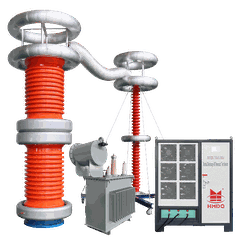



The Ultimate Checklist for Selecting a Lightning Impulse Voltage Generator
Lightning impulse Voltage test equipment serves as the core apparatus for insulation testing, grid connection certification, and fault analysis of power equipment. Its selection directly determines the reliability of test data, equipment safety, and long-term operational costs. This article distills key selection factors from a data-driven perspective and, leveraging the advantages of Goldhome's impulse equipment, provides selection guidance for industry clients.

I. Core Reasons for Selecting Lightning Impulse Test Equipment
- Mandatory Insulation Verification: Simulates natural lightning strikes and switching overvoltages to evaluate the insulation withstand capability of transformers, switches, cables, GIS, and other equipment. This is a mandatory test for factory acceptance and grid connection.
- Ensuring Grid Operational Safety: Proactively identifies insulation defects, reducing the risk of lightning breakdowns and tripping after commissioning, thereby minimizing power outages and operational maintenance losses.
- Compliance with Standards: Meets IEC 60060, GB/T 16927, and other standards, making it essential testing equipment for power research institutes, manufacturers, and grid operators.
- Supporting R&D and Quality Control: Provides quantitative data for new product iterations and process optimization, enhancing product reliability and market competitiveness.
II. Top Five Key Factors for Customer Selection
Parameter Matching
Voltage Rating: 200–480kV required for 10kV–110kV equipment; ≥480kV required for 220kV and above.
Energy Capacity: 5–10kJ for 10kV equipment; 7.5–30kJ for 35kV equipment; ≥50kJ for large-capacity transformers.
Waveform Standard: 1.2/50μs lightning wave, 250/2500μs operating wave, deviation ≤±3%.
Test Accuracy and Stability
Measurement Error: Peak voltage ≤±1%, waveform parameter deviation ≤±0.2%.
Continuous Operation: Supports 24-hour full-load testing with failure rate below 0.5%.
Safety and Reliability
Multi-level safety interlocks, automatic residual charge discharge, emergency shutdown, remote isolation control.
Insulation lifespan ≥10 years, annual maintenance cost below 5% of purchase price.
Intelligence and Usability
Automatic charging, synchronous triggering, data acquisition, report generation-one-click completion of entire workflow.
Strong anti-interference capability ensures undistorted data in complex field testing environments.
Brand and Service
Complete certifications, extensive project experience, rapid response, and comprehensive warranty/calibration systems.
III. Core Advantages of Goldhome Lightning Impulse Voltage Test Equipment
As a specialized manufacturer of high-voltage testing equipment, Goldhome's lightning impulse devices are industry-preferred for their high parameters, precision, and safety.
Leading Parameters: Peak values up to 1800kV/180kJ, voltage utilization factor ≥85% for lightning waves and ≥80% for operating waves. Low loop inductance ensures waveform accuracy under heavy loads.
Reliable Precision: Peak measurement error <1%, waveform deviation exceeds national standards. Data is traceable and suitable for certification testing.
Safety and Intelligence: Constant-current charging, automated control, and multi-level protection with remote operation capability minimize personnel and equipment risks.
Comprehensive Coverage: Full voltage range from 10kV to 1000kV, suitable for power research institutes, manufacturers, power grids, and renewable energy applications.
Service System: Integrated delivery, installation, commissioning, training, calibration, and after-sales support reduce customer operational costs.
IV. Summary
Lightning impulse device selection prioritizes parameter matching, precision compliance, and safety reliability. Choose brands with proven technology, comprehensive certifications, and robust service systems. Goldhome delivers stable, precise, and secure lightning impulse solutions through high-standard design, data-driven performance, and full-cycle service. We enhance power equipment testing quality and efficiency, supporting high-quality development in grid and equipment industries.


