

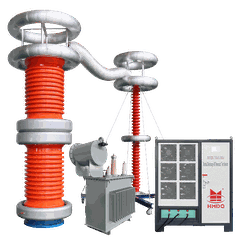


Lightning Impulse include full-wave and chopped wave types. Are there any other waveforms?

Analysis of the three primary waveforms in lightning impulse voltage testing is as follows:
1. Standard Lightning Full Wave
Definition: The standard lightning impulse voltage waveform simulates the typical voltage waveform of a direct lightning strike in nature.
Waveform Characteristics:
- Front time (rise time) T1 = 1.2 µs (±30%)
- Half-peak time (fall time) T2 = 50 µs (±20%)
- Commonly represented as a 1.2/50 µs surge wave
Diagram:
Voltage
| /\
| / \
| / \
| / \
|___/ \___________ Time
T1=1.2µs T2=50µs
Application: Evaluate the insulation performance of equipment when subjected to typical lightning overvoltages.
2. Lightning Chopped Waveform
Definition: A waveform where the full lightning wave is abruptly truncated near its peak, simulating voltage transients caused by insulation breakdown or protective gap operation.
Waveform Characteristics:
- Chopping Duration: 0.5–5 µs
- Voltage rapidly drops to zero after truncation
Schematic Diagram:
Voltage
| /\
| / \
| / \
| / \
|___/ |__________ Time
Cutoff Point
Application: Evaluates equipment's withstand capability under steep voltage cutoff, imposing more severe insulation stress.
3. Oscillating Lightning Wave (Shake Wave)
Definition: A lightning impulse wave containing high-frequency oscillations, simulating oscillations generated during wave propagation when equipment is connected via long cables or windings.
Waveform Characteristics:
- High-frequency oscillations superimposed on a standard lightning wave
- Oscillation frequency typically ranges from 0.1 to 1 MHz
Schematic:
Voltage
| /\/\
| / \/\ /
| / \/
| / \
|___/ \______ Time
Application: Evaluates the insulation performance of equipment with windings (e.g., transformers) under oscillating overvoltage conditions.


