

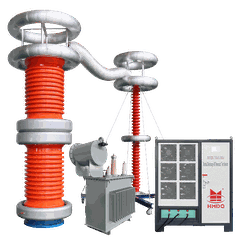



The important role of capacitive dividers in resonance testing systems

Introduction
Resonance testing is a fundamental procedure in high-voltage systems used to assess the integrity of insulation and the operational safety of electrical equipment such as transformers, cables and generators. At the heart of these tests is the capacitive voltage divider – a precision instrument that ensures accurate voltage measurement and system safety. Unlike resistive dividers, capacitive dividers have excellent characteristics in high-frequency environments, making them indispensable for resonance applications where precise impedance matching and minimal phase shift are required. This article discusses the functionality, advantages and technical nuances of capacitive dividers in resonance testing.
How capacitive voltage dividers improve resonance testing
Capacitive voltage dividers operate on the principle of capacitive impedance division, whereby two capacitors in series divide the high input voltage into a lower, measurable output voltage. Their design offers several key advantages for resonance testing:
1.High accuracy and frequency stability
Capacitive dividers maintain consistent performance over a wide frequency range, which is important for resonance testing that is often performed at varying frequencies (e.g., 30-300 Hz). Their low temperature coefficient and minimal power loss ensure that measurements are not affected by changes in the environment or prolonged use.
2.Impedance matching for resonance conditions
In resonance test systems, the divider must be matched to the reactive components in the test setup to achieve optimal energy transfer. Capacitive dividers offer accurate capacitive impedance, enabling seamless integration with inductive loads and facilitating stable resonance conditions without disruptive phase distortions.
3.Improved safety and isolation
With their high input impedance and robust isolation design, these distributors isolate the measurement circuits from high-voltage sources, protecting both users and downstream equipment. Advanced materials such as gas-filled capacitors or composite dielectric materials further reduce the risk of partial discharges or interference during testing.
4.Compact and lightweight design
Modern capacitive isolators use innovative materials and a compact design, making them portable and easy to use in field tests. This is particularly valuable for on-site diagnostics in substations or remote power generation facilities.
Applications in power systems
Capacitive dividers are commonly used in the following applications:
•Cable and transformer testing: Checking voltage and partial discharge resistance under resonance conditions.
•Frequency response analysis: Measuring harmonic distortion and system responses in AC resonance test systems.
•Renewable energy infrastructure: Testing solar and wind energy components, where fluctuating frequencies are common.
Their compatibility with international standards (e.g., IEC 60060) ensures reliability in global projects, including the expansion of energy infrastructure in regions covered by the Belt and Road Initiative and in Latin America.
Conclusion
Capacitive voltage dividers combine precision engineering with functional innovation, making them a cornerstone of modern resonance testing. Their ability to deliver accurate, safe, and frequency-stable measurements underscores their value in ensuring the reliability of high-voltage power supply systems. For engineers seeking to optimize resonance testing systems, selecting a high-quality capacitive divider is not just a technical decision, but a commitment to safety and accuracy.
Discover advanced testing solutions today to enhance your power supply diagnostics.


