

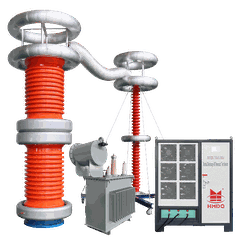




The important role of compensation capacitors in resonance testing systems
Resonance testing systems are widely used in high voltage testing, particularly to evaluate the insulation integrity of electrical power equipment such as transformers, cables, and GIS switchgear. At the heart of these systems are compensation capacitors – components that are often overlooked, but are essential for achieving accurate, efficient, and safe testing conditions. This article provides an in-depth examination of the primary functions, operating principles, and benefits of compensation capacitors in resonance testing setups.
How compensation capacitors work in resonance applications
Resonance test systems work by matching the inductive reactance (of the test object or reactor) with capacitive reactance to create series or parallel resonance conditions. Compensation capacitors have two main functions:
1.Reactive power compensation: They balance the inductive reactive power generated by the test object, reducing the load on the power source and minimizing energy losses.
2.Voltage stabilization: By carefully adjusting the resonance frequency, these capacitors help maintain a stable output voltage, which is important for accurate dielectric strength testing.
Without proper compensation, the system would require a larger power source, be subject to a higher risk of voltage fluctuations, and have difficulty achieving precise resonance for reliable results.
Key benefits of optimized compensation
•Increased efficiency: Compensation capacitors reduce energy requirements by up to 80% compared to conventional testing methods, thereby reducing operating costs.
•Increased accuracy: Stable resonance ensures uniform voltage influence, which is key to detecting insulation faults without overloading the equipment.
•Scalability: Capacitor banks can be configured modularly to accommodate different test voltages and capacities, making them adaptable to a variety of applications.
Applications in Modern High-voltage Testing
Compensation capacitors are essential in frequency-tuned resonance systems used for:
•Approval testing of power cables
•Insulation evaluation of transformers and reactors
•Commissioning of transformer stations on site
Advanced designs include dry or gas-insulated capacitors with characteristics such as low partial discharge levels and temperature stability, in accordance with international standards such as IEC 60270 and IEEE 400.
Innovation and Industry Trends
Recent technological advances have focused on compact, lightweight capacitors for integrated monitoring systems. These innovations support real-time diagnostics and automatic adjustment functions, effectively reducing setup time and minimising human error. Such technologies are particularly important for field testing in remote locations or within Belt and Road infrastructure projects, where reliability and portability are of utmost importance.
Conclusion
Compensation capacitors go beyond their role as auxiliary components and serve as key factors in achieving efficiency and precision in resonance testing. By understanding their function, technicians and engineers can optimise test configurations, ensure compliance with safety standards and extend the service life of critical power facilities. For professionals working with high-voltage testing, investing in well-designed compensation systems means increased productivity and reduced operational risks.


