


Why Use the 88-44 Series Resonance Tester? An Analysis of Its Primary Applications and Key Advantages
The 88-44 Variable-Frequency Series Resonance Tester (88kVA/44kV) is Goldhome Hipot's flagship model for small-to-medium-sized high-voltage withstand testing. Designed specifically for AC withstand testing of 10kV and 35kV power equipment, it is widely used in power engineering, substation maintenance, new energy projects, and industrial and mining power distribution systems. Compared to traditional power-frequency withstand voltage equipment, this model is compact, highly safe, and highly adaptable, making it the preferred choice for on-site testing by B2B buyers. Below, we provide a clear explanation of its value based on practical applications, actual performance, and key procurement challenges.
The core application of the 88-44 series resonant system is conducting AC withstand voltage tests on capacitive high-voltage equipment. First, it is used for 10kV high-voltage cable handover and preventive testing, capable of testing cables up to 1.8 km in length with a maximum test voltage of 44kV to identify potential issues such as insulation damage, moisture ingress, and joint defects; Second, it is used for **withstand voltage testing of 10kV/35kV switchgear, transformers, and isolating switches** to verify the insulation performance of porcelain insulators, arc-extinguishing chambers, and windings; third, it serves testing of **small distribution transformers, busbars, and bushings**, supporting project acceptance for urban distribution networks, photovoltaic power plants, and mining distribution systems. The equipment generates high voltage through frequency modulation to simulate actual operational overvoltages, accurately detecting early-stage insulation defects and proactively preventing operational failures.
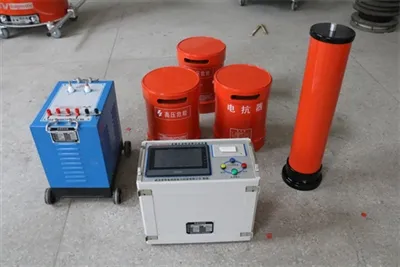
In terms of the performance metrics most critical to customers, the Goldhome Hipot delivers stable and reliable measured parameters. The output frequency is continuously adjustable from 30 to 300 Hz, with a voltage waveform distortion rate of <0.5% and a stable power factor (Q) of ≥35. Voltage ramp-up is smooth and shock-free; it can operate continuously for 40 minutes under rated conditions, with a voltage measurement accuracy of Class 0.5, and features automatic protection against overvoltage, overcurrent, and flashover. The reactor employs a fully sealed epoxy casting process, providing moisture and dust resistance. It can operate stably in environments ranging from -10°C to 45°C at altitudes up to 2,000 meters, making it suitable for high-temperature, dusty, and humid conditions overseas. The entire unit is modularly designed for easy disassembly and can be transported by a single person, making it ideal for outdoor, mountainous, and remote construction sites.
Addressing the three core concerns of B2B buyers-customization, cost control, and certification compliance-first is customization: voltage regulation ranges and equipment dimensions can be tailored to the buyer's country's voltage system (50/60 Hz) and on-site testing requirements. For example, a heat-dissipation enhanced version for high-temperature conditions in Africa or a moisture-proof upgraded version for humid environments in Southeast Asia can be provided without incurring additional customization costs. Second, regarding cost control, the equipment utilizes cost-effective core components, with a factory price of only 45% that of imported counterparts. It also features low power consumption, using only 20% of the electricity consumed by traditional line-frequency equipment during operation, leading to significant long-term savings on electricity bills. Additionally, the core components are highly interchangeable, keeping replacement costs low.
Third, certification and compliance: The equipment has obtained international certifications such as CE and ISO 9001. We can provide a complete set of English certification documents to meet the requirements for overseas project tenders and customs inspections, thereby preventing project delays caused by missing certifications.