

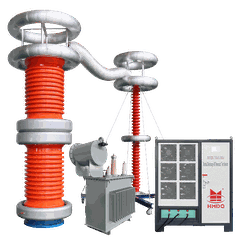



AC Variable-Frequency Series Resonance Test System: Four Key Advantages Empowering High-Voltage Withstand Testing
In power systems, AC withstand testing of high-voltage electrical equipment-such as cables, GIS, transformers, and generators-is critical for assessing insulation performance. However, as the capacitance of test specimens increases, traditional power-frequency test transformers (which are bulky, heavy, and difficult to transport on-site) struggle to meet the demands of flexible on-site testing. The AC Variable-Frequency Series Resonance Test System adjusts the power supply frequency to induce LC series resonance between the reactor's inductance (L) and the test specimen's capacitance (C). By utilizing the Q-times voltage generated by resonance to achieve efficient voltage boosting, it delivers four core advantages for high-voltage withstand testing.

I. Lightweight Design: Volume and Weight Reduced to 1/10 to 1/30
Traditional power-frequency withstand test units are large and heavy, making them difficult to transport on-site. Based on the principle of resonance, the variable-frequency series resonance test system requires the power supply to provide only the portion of active power consumed by the system (approximately 1/Q), eliminating the need for bulky, high-power voltage regulators and power-frequency test transformers. Compared to traditional test transformers, the volume and weight of the variable-frequency series resonance test system are approximately 1/10 to 1/30 of those of conventional test equipment, making it easy to move on-site and particularly suitable for field operations.
II. Sine Wave Output, Waveform Distortion Rate ≤ 1%
The voltage waveform distortion rate of traditional power-frequency transformers is typically 5%–10%, which can easily cause accidental breakdown of the test specimen's insulation due to harmonic peaks. The variable-frequency series resonance test system employs a resonant filter circuit that effectively reduces output voltage waveform distortion, producing a pure sine wave. This prevents accidental breakdown caused by harmonic peaks and provides more accurate test results for insulation evaluation. The HMCXZ series from Goldhome features an output voltage waveform distortion rate of ≤1% and an output frequency range of 30–300 Hz, meeting the requirements of standards such as IEC 60270 and GB/T 3048.
III. Dual Hardware and Software Protection: Automatic Detuning for Safety in Case of Faults
The variable-frequency series resonance test system integrates a comprehensive protection mechanism. When a weak point in the test specimen's insulation is punctured, the circuit immediately detunes, the high voltage disappears instantly, and the circuit current rapidly drops to 1/Q of the normal test current, effectively preventing the fault point from being damaged by large short-circuit currents. Additionally, the system features multiple protection functions, including overvoltage, overcurrent, zero-voltage start-up, and system detuning (flashover). Overvoltage and overcurrent protection thresholds can be adjusted according to user requirements. When a flashover occurs, the flashover protection activates and records the flashover voltage value for test analysis. The resonant frequency-converted power supply is also equipped with overheat protection, with a response time of less than 1 microsecond, ensuring fast and highly reliable protection. Goldhome products offer comprehensive and reliable protection against overvoltage, overcurrent, discharge, overheating, and zero-voltage startup.
IV. Multi-Purpose Unit Suitable for On-Site Testing of Various High-Voltage Equipment
The variable-frequency series resonance test system offers exceptional versatility. The reactors are designed as multiple separate units, allowing them to be connected in series to meet high-voltage, low-current testing requirements, or in parallel to handle high-current applications. A single system covers AC withstand voltage testing for a wide range of test objects, including cables, GIS switches, generators, and transformers. This system is primarily designed and manufactured for AC withstand voltage testing of cross-linked cables and power system components (such as hydroelectric generators, main transformers, busbars, and GIS) operating at voltage levels ranging from 6 kV to 500 kV and above. It is an ideal choice for high-voltage testing departments at the provincial, municipal, and county levels, as well as for power installation, maintenance, and testing engineering units.
Goldhome: A Technology Pioneer in the Field of Variable-Frequency Series Resonance
Goldhome Hipot established in 2008 and located in the Wuhan Economic and Technological Development Zone, is a national-level high-tech enterprise integrating R&D, production, and sales. It has been honored with the titles of Wuhan "Science and Technology Little Giant" Enterprise and "Gazelle Enterprise." The company operates a modern production base spanning over 10,000 square meters. Its core products include variable-frequency series resonance test sets, GIS partial discharge-free test systems, power frequency withstand voltage test sets, and fully automatic insulation tool test sets. These products are exported to more than 30 countries and regions across Europe, America, Africa, the Middle East, and Southeast Asia.


