

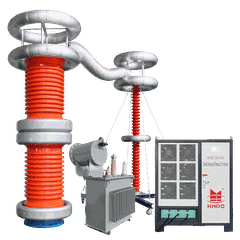


Goldhome Hipot Advances Grid Reliability with Wireless High Voltage Phase Transmitter Technology
In the constantly evolving field of network management, precise phase verification is crucial for preventing outages and ensuring operational safety. The innovative wireless high-voltage phase transmitter developed by Wuhan Jinjiabao High Voltage Electrical Co., Ltd. is specifically designed to meet the demands of modern power systems. This device effectively reduces risks and increases operational efficiency by allowing technicians to perform phase matching and synchronization checks without physically touching high-voltage components.
Specifically designed for transmission lines, substations, and industrial distribution networks, this wireless high-voltage phase transmitter facilitates real-time phase angle comparison at multiple network points using secure wireless communication and robust signal processing technology. This feature is particularly critical in maintenance, commissioning, or network expansion projects where phase errors could lead to equipment damage or safety incidents.

Core Functions and Supporting Components
Core Functions: Primarily detects whether high-voltage lines are energized while accurately capturing critical electrical parameters such as phase and frequency. Subsequently, it transmits the digitized signals wirelessly to the receiving host via radio frequency technology, providing data support for phase difference calculation and phase-matching/non-matching determination. Some transmitters also feature low-voltage voltage detection capabilities, adapting to multi-voltage scenarios.
Components and Specifications: This device is not standalone. It typically operates in pairs with a receiver unit to form a complete phase-comparison system. It must be used with an epoxy resin insulated operating rod to ensure safety during high-voltage operations. The transmitter incorporates a compact rechargeable lithium battery, such as the common 10440 lithium battery (450mAh capacity). Its operating power consumption is typically below 0.1W, with leakage current less than 10uA, ensuring both endurance and compliance with high-voltage safety standards. Its line-of-sight transmission range reaches hundreds of meters, with mainstream models achieving a maximum transmission distance of approximately 200 meters when paired with the receiver host, meeting the demands of most outdoor high-voltage work scenarios.
Key Features
- Superior Safety Performance: Eliminates the need for connection cables found in traditional wired phase comparators, preventing operators from being close to high-voltage line cores. When used with insulated working rods, it significantly reduces the risk of electric shock. Signals can pass through barriers such as walls and partitions, operating without restrictions from terrain or facility structures.
- Wide Compatibility: Supports a wide voltage range covering main current systems from 220V to 220kV and above AC transmission lines. Meets phase matching requirements in various scenarios, including substations, transmission lines, and renewable energy plants.
- Stable Data Transmission: Its electromagnetic interference-resistant wireless transmission design and precise signal encoding technology minimize interference from other equipment in high-voltage environments. While phase difference measurement error is typically ≤5°, frequency measurement accuracy reaches ±0.1Hz, providing reliable detection data.
Typical Application Scenarios
- Grid Connection and Maintenance: Prior to connecting new and existing busbars during substation expansion, use the corresponding phase verification system to check phase consistency between busbars. After repairing high-voltage line faults, collect signals via transmitters to verify phases, preventing short circuits during reclosing. For example, prior to connecting new and existing busbars at a 220kV substation, the transmitter separately detects phase data for the A-A', B-B', and C-C' phases on both sides.
- Industrial and Renewable Energy Generation: Before starting high-voltage motors at large enterprises like steel mills and chemical plants, the system verifies three-phase power sequence to prevent motor reverse rotation and equipment damage. Before connecting inverters from photovoltaic power stations or wind farms to the grid, it verifies the phase at the grid connection point to ensure phase matching with the grid, preventing inrush currents during grid connection.
- Temporary Power Supply Verification: During emergency repairs, when connecting temporary generators or mobile power supply vehicles to the grid, it rapidly acquires phase signals to verify phase alignment between the temporary power source and the grid, preventing equipment failures caused by phase conflicts.
The adoption of wireless high-voltage phase measurement tools signifies the industry's progress toward digital transformation and enhanced safety protocols. Goldhome Hipot continues to invest in R&D, continuously optimizing the performance and functionality of these devices to meet global standards for electrical testing and verification.


