



The Crucial Role of Partial Discharge Induced Resonance Testing
In the field of high-voltage equipment testing, partial discharge induced resonance testing represents an advanced method for evaluating insulation quality. This technique combines the principles of partial discharge detection and resonant frequency testing to establish a comprehensive assessment system for high-voltage equipment.
The primary function of this test is to identify insulation faults within capacitive loads-such as power cables, transformers, and generators-by applying a resonant frequency matched to the object's natural frequency. Compared to traditional testing methods, this resonant approach enables efficient testing of large-capacity equipment with reduced energy consumption. The resonant state allows the test system to apply the required high voltage levels with minimal energy expenditure.
Partial Discharge (PD)-Induced Resonance Testing is a comprehensive non-destructive testing method that integrates a power-frequency series resonance test system with a partial discharge measurement system. Its core function is to precisely detect localized insulation faults in high-voltage (HV) and extra-high-voltage (EHV) electrical equipment under simulated operating voltage conditions, while simultaneously evaluating the insulation's withstand voltage strength and the severity of potential faults.
Evaluating insulation integrity by combining dielectric strength with partial discharge performance
Unlike standalone dielectric strength tests (which only detect breakdown) or standalone partial discharge tests (which may use non-standard voltage sources), this combined test serves a dual purpose:
Verification of dielectric strength reliability: Confirming that the test object can withstand the specified test voltage for a specified duration (e.g., 1 minute, 10 minutes) without insulation breakdown or discharge.
Quantifying the severity of partial discharge: Measurement of key partial discharge parameters (discharge initiation voltage [DIV], discharge extinction voltage [DEV], maximum discharge intensity, discharge repetition frequency) to assess damage risk levels. According to IEC 60270 standards, for example, new high-voltage transformers typically require a partial discharge intensity of ≤10 pC at rated voltage to be considered compliant.
Correlation between voltage and discharge voltages: Analyze the variation in discharge activity as the test voltage increases (e.g., if the discharge intensity increases exponentially with voltage) to evaluate the potential lifetime of insulating materials.
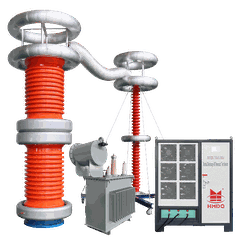
The resonance test setup usually includes a variable frequency power supply, an excitation transformer, and a resonance circuit. When the system reaches the resonant frequency, it creates the conditions necessary to induce partial discharge in existing insulation defects. Special partial discharge detection devices monitor and record the discharge patterns, providing important data on the condition of the insulation.
This test method offers many operational advantages, such as the ability to test equipment under actual operating conditions, improved sensitivity in measuring partial discharge, and reduced physical stress on the insulation system during testing. The frequency coordination approach also helps to distinguish between different types of partial discharge sources and provides more detailed diagnostic information for maintenance decision-making.


