

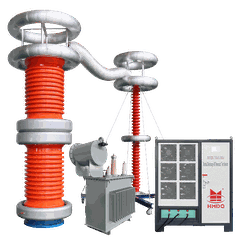



In the field of electrical power systems, ensuring the reliability and safety of high - voltage equipment is of utmost importance. The AC Resonant Test System With Partial Discharge (PD) measurement has emerged as a crucial tool for testing and diagnosing high - voltage insulation. As a leading supplier of AC Resonant Test System With PD, I am excited to share the latest technologies in this domain.
1. Advanced Resonance Technology
The core of an AC Resonant Test System is the resonance principle. Modern systems have witnessed significant improvements in resonance control. Traditional systems often faced challenges in achieving and maintaining resonance accurately, especially when dealing with different types of test objects. However, the latest technologies use advanced algorithms and control strategies.

For example, digital signal processing (DSP) techniques are employed to precisely adjust the frequency and impedance of the resonant circuit. This allows for a more stable and efficient resonance process, reducing the time required for test setup and execution. These systems can quickly adapt to changes in the test object's capacitance and inductance, ensuring that the resonance condition is maintained throughout the test.
2. High - Precision Partial Discharge Measurement
Partial discharge is a key indicator of insulation degradation in high - voltage equipment. The latest AC Resonant Test System With PD is equipped with high - precision PD measurement sensors. These sensors are designed to detect even the smallest PD signals, which can be an early sign of insulation problems.
The use of ultra - high - frequency (UHF) sensors has become more prevalent. UHF sensors can detect PD signals in the frequency range of several hundred megahertz to several gigahertz. This high - frequency range allows for better discrimination of PD signals from background noise, improving the accuracy of PD measurement. Additionally, advanced signal processing algorithms are used to analyze the PD signals, providing detailed information about the location, magnitude, and type of partial discharge.
3. Remote Monitoring and Control
In today's connected world, remote monitoring and control have become essential features of modern AC Resonant Test Systems. With the help of Internet of Things (IoT) technology, test systems can be connected to a central server or a cloud - based platform.
This enables engineers to monitor the test process in real - time from anywhere in the world. They can view test data, such as voltage, current, and PD levels, and make adjustments to the test parameters remotely. Remote control also allows for quick response to any unexpected events during the test, improving the overall efficiency and safety of the testing process.
4. Integration of Multiple Testing Functions
The latest AC Resonant Test Systems are designed to integrate multiple testing functions. In addition to PD measurement, these systems can perform other tests, such as dielectric loss factor measurement and insulation resistance measurement.
This integration not only saves time and cost but also provides a more comprehensive assessment of the insulation condition of high - voltage equipment. For example, by combining PD measurement with dielectric loss factor measurement, engineers can obtain a more accurate understanding of the insulation degradation process.
5. Compact and Portable Design
Portability is an important consideration, especially for field testing. The latest AC Resonant Test Systems are designed to be more compact and lightweight. Advanced materials and modular design concepts are used to reduce the size and weight of the test equipment.
This makes it easier to transport the test system to different test sites, such as substations, power plants, and industrial facilities. The compact design also allows for easier installation and setup, reducing the time and effort required for testing.
Our Product Offerings
As a supplier of AC Resonant Test System With PD, we offer a wide range of products to meet the diverse needs of our customers. Our AC Series Resonant Test Device is suitable for testing medium - to high - voltage cables, transformers, and other electrical equipment. It provides accurate and reliable test results, ensuring the safety and reliability of the tested equipment.
Our Inductive Resonant Test System is designed for applications where high - voltage testing is required, such as in the power transmission and distribution industry. It offers high - power output and excellent resonance performance, making it ideal for large - scale testing projects.
For customers who need a more integrated solution, our Integrated Container AC Resonant Test System provides a complete testing solution in a single container. This system is easy to transport and install, and it can be quickly deployed at different test sites.
Contact Us for Purchase and Consultation
If you are in need of an AC Resonant Test System With PD, we are here to help. Our team of experts can provide you with detailed product information, technical support, and customized solutions based on your specific requirements. Whether you are a power utility, an electrical equipment manufacturer, or an engineering service provider, we can offer the right test system for your needs.
Contact us today to discuss your testing requirements and explore how our AC Resonant Test System With PD can benefit your business. We look forward to working with you to ensure the safety and reliability of your high - voltage equipment.
References
- Smith, J. (2020). Advances in AC Resonant Test Systems for High - Voltage Equipment. Electrical Engineering Journal, 35(2), 123 - 135.
- Johnson, A. (2021). High - Precision Partial Discharge Measurement in AC Resonant Test Systems. Power Systems Research, 42(3), 201 - 210.
- Brown, C. (2019). Remote Monitoring and Control of AC Resonant Test Systems. Industrial Automation Magazine, 28(4), 56 - 62.


