

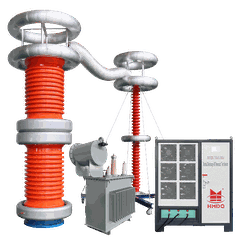


Industry Background: Shift Toward Intelligent, Multifunctional HV Testing
With the rapid growth of smart grids, ultra-high voltage transmission, and renewable energy generation (wind and solar), traditional high-voltage testing equipment faces new challenges:
Increasing complexity of GIS, generator, and transformer equipment
Rising test voltage levels and associated safety risks
Shorter project timelines requiring fast, efficient testing solutions
The AC Resonant System is evolving from a simple withstand voltage tester into an intelligent, multifunctional, and high-safety comprehensive testing platform.
Technology Overview: Core Principles of AC Resonant System
The AC Resonant System forms a series resonant circuit between the reactor and the capacitance of the tested equipment, achieving:
High voltage, low power output: Resonance amplifies voltage while reducing system energy, improving safety
Controlled voltage ramping: Precisely regulates voltage rise, protecting GIS and generator insulation
Automatic resonance tracking: Intelligently adapts to load capacitance changes to maintain stability
It can also operate in coordination with other high-voltage testing devices:
Ultra Low Frequency Tester (VLF Tester): Cable insulation evaluation
Partial Discharge Test System: Partial discharge monitoring
Transformer Test Equipment: Transformer testing
CT PT Analyzer: Instrument transformer verification
Insulation Resistance Tester: Insulation condition assessment
Impulse Voltage Generator: Impulse withstand testing
Primary Injection Current Test System: Protection loop verification
This integrated approach enhances both testing efficiency and safety.
Technical Advantages of AC Resonant System
High Safety
Resonance lowers system energy; overvoltage protection and flashover detection ensure safe HV testing.
Intelligent Control
Supports automatic ramping, adaptive load matching, and fault diagnostics, minimizing manual intervention.
Multifunctionality
Capable of comprehensive HV testing for GIS, generators, transformers, and cables; compatible with Impulse Voltage Generator and Primary Injection Test System.
Data Traceability
Digital interface records test parameters, history curves, and safety events for analysis and management.
Application Scenarios
1. GIS Field Commissioning
Precise voltage ramping control
Avoid partial discharge and breakdown
Improve on-site safety
2. Generator Factory & Grid Testing
Stator winding insulation withstand verification
Combined with Primary Injection Current Test System for protection checks
Ensure reliable operation
3. Transformer Factory & Field Testing
Supports multiple voltage levels
Coordinated with Transformer Test Equipment for comprehensive testing
Efficient quality verification
4. Renewable Energy Plant HV Acceptance
Insulation testing for wind/solar GIS and step-up substations
Fast data logging and intelligent analysis
Enhance efficiency and safety
Future Development Trends
Intelligent Upgrades
AI-assisted fault diagnosis
Automatic load capacitance matching
Adaptive voltage ramping control
Digital & Remote Monitoring
Cloud-based data management
Real-time HV waveform monitoring
Remote expert intervention
Multi-System Integration
Unified platform with AC Resonant System, VLF Tester, Partial Discharge Test System
Comprehensive assessment of GIS,


