

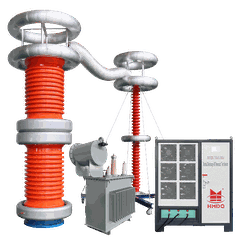


Industry Background: Importance of High-Voltage Test Safety
In GIS (Gas Insulated Switchgear), generator stator windings, and high-voltage substation equipment testing, voltage levels can reach 110kV, 220kV, or even above 500kV.
At such energy levels, any control failure may result in:
Insulation breakdown of equipment
Damage to testing systems
Personnel safety risks
Project delays and financial losses
Therefore, the AC Resonant System must provide not only high-voltage output capability but also a complete safety protection architecture.
Working Principle and Safety Mechanism of AC Resonant System
Resonance-Based Low Energy High Voltage Principle
The AC Resonant System forms a resonant circuit between the reactor and the capacitance of the tested object:
Only loss power is supplied at resonance
Voltage is amplified by the resonant circuit
Source-side current is significantly reduced
This "high voltage with low energy input" characteristic inherently improves safety.
Core Safety Protection Functions
Modern AC Resonant Systems typically include:
1. Overvoltage Protection
When output voltage exceeds the threshold:
Automatic reduction of excitation
Rapid shutdown of voltage rise
Prevention of GIS or generator insulation breakdown
2. Overcurrent Protection
Prevents:
Short-circuit discharge
Partial breakdown propagation
Reactor overload
3. Zero-Start Interlock Protection
Ensures:
Voltage regulator starts from zero position
Prevents accidental high-voltage application
4. Flashover Detection
In case of discharge:
Immediate detection of current surge
Automatic voltage reduction
Data recording for analysis
Safety Applications in GIS Testing and Generator Testing
GIS Testing Safety Control
In GIS systems:
SF₆ insulation structure is highly sensitive
Partial discharge must be strictly controlled
Voltage ramping must be smooth
AC Resonant System provides controlled voltage rise, reducing internal electrical stress.
Generator Testing Safety Protection
In Generator Testing:
Large stator capacitance
Complex insulation structure
High voltage levels
Key safety mechanisms include:
Step-by-step voltage ramping
Automatic resonance tracking
Fast fault interruption
Coordination with Other High-Voltage Testing Systems
In integrated testing environments, AC Resonant System is used together with:
Ultra Low Frequency Tester (VLF Tester) for cable insulation evaluation
Partial Discharge Test System for discharge detection
Transformer Test Equipment for transformer testing
CT PT Analyzer for instrument transformer verification
Insulation Resistance Tester for insulation condition assessment
Impulse Voltage Generator for lightning impulse testing
Primary Injection Current Test System for protection system verification
This integrated ecosystem significantly enhances overall testing safety.
Application Scenarios from a Safety Perspective
1. GIS Substation Commissioning
Reduce partial discharge risk
Prevent gas insulation failure
Improve field testing safety
2. Generator Factory Acceptance Testing (FAT)
Avoid stator insulation damage
Controlled step voltage application
3. Renewable Energy Grid Integration
Wind and solar station insulation verification
Controlled voltage stability testing
4. Maintenance and Inspection of HV Equipment
Safe offline insulation assessment
Prevent in-service failure risks
Industry Trends: Intelligent Safety Systems
AI-Based Protection Systems
Intelligent overvoltage detection
Automatic fault recognition
Adaptive voltage control
Digital Safety Monitoring
Real-time waveform monitoring
Cloud-based safety logging
Remote expert diagnostics
Integrated Safety Platforms
Future systems will unify GIS, generator, and transformer testing into a single safety management platform with:
Multi-device coordinated protection
Full-process risk control
Standardized test workflows
Conclusion
The AC Resonant System is not only a high-voltage testing device but also a critical safety control platform in GIS Testing and Generator Testing applications.
Through resonance-based low-energy design, overvoltage protection, flashover detection, and intelligent control systems, it ensures high reliability and operational safety during high-voltage testing.
As smart grid and ultra-high voltage systems continue to evolve, safety technologies in AC Resonant Systems will move toward greater intelligence, automation, and digital integration, making them indispensable in modern high-voltage testing engineering.


