

Industry Background: Importance of Transformer-Generator Coupling Testing
In power plants, hydroelectric stations, gas-fired facilities, and renewable energy projects, generators and step-up transformers operate as an integrated system. Before commissioning, comprehensive high-voltage testing is required to verify insulation integrity and operational reliability.
As generating capacities continue to increase, conventional power-frequency testing faces several challenges:
Large power supply requirements
Difficult transportation and field deployment
High energy consumption
Reduced testing efficiency
As a result, the AC Resonant System has become a preferred solution for combined generator and transformer high-voltage testing.
Working Principle of AC Resonant System for Transformer-Generator Testing
Series Resonance Testing Technology
The AC Resonant System creates a resonant circuit between the reactor and the capacitance of the equipment under test.
At resonance:
Inductive reactance equals capacitive reactance
Input power demand is minimized
Stable high-voltage output is achieved
Output waveform remains nearly sinusoidal
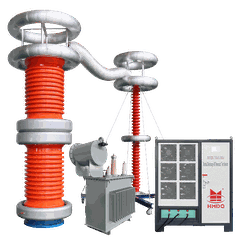
Main components include:
Variable-frequency power supply
Excitation transformer
Resonant reactor
Capacitive voltage divider
Control and protection unit
The technology is particularly suitable for generator stator windings and large power transformers with significant capacitive loads.
Technical Advantages of AC Resonant System in Transformer Testing and Generator Testing
Ideal for Large Equipment Testing
Generators and transformers exhibit substantial capacitance to ground.
Using an AC Resonant System provides:
Reduced power source requirements
Easier achievement of test voltage levels
Lower overall testing costs
High-Quality Voltage Output
Benefits include:
Low waveform distortion
Stable voltage regulation
Accurate measurement results
Compliance with IEC and IEEE standards
Comprehensive Safety Protection
Modern systems typically include:
Overvoltage protection
Overcurrent protection
Breakdown protection
Zero-start interlock
Automatic shutdown functions
These features improve testing safety and equipment protection.
Industrial Applications and Case Studies
Case 1: Thermal Power Plant Commissioning
During commissioning of a 600 MW generating unit:
AC withstand testing was performed on generator stator windings
Insulation verification was conducted on the main transformer
Final acceptance testing was completed before energization
The AC Resonant System significantly reduced power supply requirements on site.
Case 2: Hydropower Generator Refurbishment
In a large hydroelectric upgrade project:
Stator insulation performance was evaluated
Aging-related defects were identified
Long-term operational reliability was assessed
Partial discharge monitoring was integrated to enhance diagnostic accuracy.
Case 3: Renewable Energy Grid Connection Projects
During wind and solar substation commissioning:
Generator output equipment was tested
Step-up transformer insulation testing was completed
Grid-connection reliability was verified
This approach helped shorten project commissioning schedules.
Case 4: Factory Acceptance Testing (FAT)
Manufacturers utilize AC Resonant Systems for:
Generator factory testing
Transformer acceptance testing
Type test verification
This ensures compliance with international testing standards.
Industry Trends and Future Development
Intelligent Automatic Tuning
Modern systems increasingly support:
Automatic resonance tracking
Automatic voltage ramping
Automated testing procedures
Intelligent fault diagnostics
These capabilities improve efficiency and consistency.
Digital Testing Platforms
Future systems are expected to provide:
Cloud-based data storage
Automatic report generation
Historical trend analysis
Remote expert diagnostics
Integrated High-Voltage Testing Ecosystems
In modern power plants and substations, the AC Resonant System is increasingly integrated with complementary testing technologies, including:
Ultra Low Frequency Tester (VLF Tester) for cable insulation assessment;
Partial Discharge Test System for defect detection and discharge analysis;
Transformer Test Equipment for transformer performance verification;
CT PT Analyzer for instrument transformer testing;
Insulation Resistance Tester for insulation resistance measurements;
Impulse Voltage Generator for lightning impulse and switching impulse testing;
Primary Injection Current Test System for protection relay and switchgear verification.
This integrated testing strategy is becoming the preferred approach for large-scale electrical infrastructure projects.
Conclusion
As power generation capacity, renewable energy deployment, and transmission voltage levels continue to increase, the AC Resonant System has become an essential solution for Transformer Testing and Generator Testing applications.
Compared with conventional power-frequency methods, resonant testing offers lower power requirements, higher efficiency, and superior voltage waveform quality. These advantages make it particularly suitable for transformer-generator coupling tests, factory acceptance testing, and commissioning projects.
With ongoing advancements in intelligent diagnostics, digital platforms, and integrated testing ecosystems, AC Resonant Systems will continue to play a critical role in power equipment reliability, acceptance testing, and lifecycle asset management.