

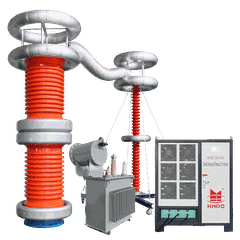


AC High Voltage Resonant Test System (Variable Frequency): Why Utilities Choose Resonance Testing for High-Capacitance Equipment
When Conventional High-Voltage Testing Becomes Impractical

Testing modern high-voltage equipment is no longer just about generating higher voltage. As cable lengths increase, GIS installations become more compact, and power transformers grow in capacity, the test object's capacitance also increases. This means a conventional power-frequency test source may require significantly higher input power to complete the same withstand test.
A Variable Frequency AC High Voltage Resonant Test System solves this challenge by using electrical resonance instead of relying solely on a larger power source. By matching the reactor to the capacitance of the equipment under test, the system can generate the required AC test voltage with a more efficient use of input power.
For this reason, variable-frequency resonant testing has become a widely used solution for commissioning, maintenance, and factory testing of high-capacitance electrical equipment.
Why Variable Frequency Makes the Difference
The key advantage of the system is not simply that it produces high voltage-it adjusts frequency to achieve resonance with the connected test object.
Instead of treating every cable or transformer as a fixed electrical load, the system searches for the appropriate operating point where inductive and capacitive reactance balance each other.
This approach offers several practical advantages:
Lower input power requirements for large-capacitance loads
Stable AC test voltage during the specified test period
Flexible testing across different equipment capacitances
Modular reactor combinations for different voltage configurations
Reduced equipment size compared with some conventional high-power AC sources
The exact performance depends on the system configuration, reactor combination, and the electrical characteristics of the connected test object.
Typical Equipment Tested

High-Voltage Power Cables
Long transmission cables present significant capacitive loads, making them one of the most common applications for resonant testing.
Typical applications include:
XLPE cable commissioning
Cable maintenance testing
Acceptance testing after installation
Underground transmission cable projects
GIS and Gas-Insulated Equipment
Gas-insulated switchgear requires controlled high-voltage testing during factory production and field commissioning.
Resonant systems can be configured for GIS testing where the required voltage level, test duration, and measurement arrangement match the project requirements.
Power Transformers
Power transformers often require AC dielectric testing during manufacturing and maintenance.
Depending on the required test procedure, resonant systems can support suitable AC withstand testing configurations when properly matched to the transformer's electrical characteristics.
Rotating Machines
Large generators and motors may also benefit from resonant AC testing when their insulation systems require the specified AC test voltage under controlled conditions.
What Makes a Good Resonant Test System?
Buyers often compare maximum voltage first. In practice, the more important question is whether the system can match the intended test object efficiently.
Variable Frequency Control
The controller should provide stable frequency adjustment throughout the required operating range.
A stable control system helps maintain resonance as operating conditions change during testing.
Modular Reactor Design
A modular reactor arrangement allows engineers to configure different voltage and load combinations without replacing the entire system.
This flexibility is particularly valuable for testing multiple equipment types within the same laboratory or maintenance department.
Accurate Voltage Measurement
A capacitive voltage divider and digital measurement system help verify that the specified test voltage is maintained throughout the test period.
Integrated Protection
High-voltage testing requires protective functions such as:
Overvoltage protection
Overcurrent protection
Emergency stop
Grounding procedures
Automatic voltage reduction after testing
These protections work together with approved operating procedures rather than replacing them.
Choosing the Right Configuration
Before requesting a quotation, engineers should define the actual testing requirements instead of focusing only on voltage ratings.
|
Procurement Item |
Why It Matters |
|---|---|
|
Maximum required AC test voltage |
Determines insulation and reactor configuration |
|
Test object capacitance |
Critical for resonance matching |
|
Equipment type |
Cable, GIS, transformer, motor, or reactor |
|
Test duration |
Affects operating requirements |
|
Frequency adjustment capability |
Determines matching flexibility |
|
Measurement and reporting |
Supports documentation requirements |
|
Site power supply |
Determines input configuration |
Providing these details early allows the supplier to recommend a suitable reactor combination and system configuration.
Typical Testing Workflow
A resonant test is typically organized around five main stages:
Connect the test object and verify grounding.
Configure the required test parameters.
Adjust frequency until the resonant operating point is reached.
Apply and maintain the specified AC test voltage for the required duration.
Reduce voltage, discharge the circuit safely, and record the test results.
The exact sequence depends on the equipment being tested and the applicable testing procedure.
Common Questions Buyers Ask
Why is variable frequency better than fixed-frequency testing?
Variable frequency allows the system to match different capacitive loads rather than requiring a single fixed operating point.
Can one system test both cables and transformers?
Potentially yes, provided the reactor configuration, voltage capability, and measurement arrangement are suitable for both applications.
Does resonance reduce testing accuracy?
No. The purpose of resonance is to establish the required AC test voltage more efficiently. Voltage measurement accuracy depends on the measurement system, calibration, and test configuration.
What information is needed for a quotation?
Prepare the following information:
Equipment type
Rated voltage
Estimated capacitance
Required AC test voltage
Test duration
Site power supply
Applicable testing standard
Why Goldhome Variable Frequency Resonant Test Systems
Goldhome develops Variable Frequency AC High Voltage Resonant Test Systems for power utilities, transformer manufacturers, electrical laboratories, EPC contractors, and industrial maintenance organizations.
Each system can be configured according to project requirements, including suitable reactor combinations, control systems, voltage measurement arrangements, and testing accessories for different high-voltage applications.
Website: https://www.goldhomehipot.com
Contact: +86 18971538425


