

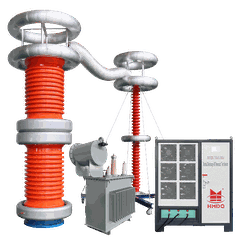



AC Resonant Test System in Renewable Microgrids: Practical Insulation Testing Applications
1. Industry Background: Rapid Microgrid Growth Drives New Testing Demands
As the global energy mix accelerates its transition toward cleaner and lower-carbon sources, the installed capacity of renewable energy generation-particularly solar PV and wind power-continues to grow rapidly. Microgrids, as emerging power networks that integrate distributed energy resources, energy storage systems, and local loads, are becoming key enablers for the efficient utilization of renewable energy. Whether in remote standalone microgrids or grid-connected systems serving industrial parks, islands, or military bases, the safe and reliable operation of these systems depends on rigorous insulation testing of electrical equipment.
However, the equipment composition of microgrids differs significantly from conventional power systems, presenting new challenges for high-voltage insulation testing:
Diverse equipment types: Microgrids encompass a wide range of electrical equipment-PV inverters, wind turbine converters, energy storage power conversion systems (PCS), step-up transformers, medium-voltage switchgear, and power cables-each with different test voltage requirements and procedures.
Constrained site conditions: Microgrid projects are often located in remote areas or space-constrained industrial parks, making the transport of large test equipment difficult and placing higher demands on portability and on-site adaptability.
Waveform quality sensitivity of new energy equipment: Power electronic devices such as PV inverters and wind converters are sensitive to voltage waveform distortion. Excessively distorted voltage can damage power components such as IGBTs.
Urgent need for preventive testing: Microgrids typically serve critical power supply roles. Once equipment is taken offline due to insulation failure, the impact can ripple across the entire microgrid system.
Against this backdrop, the AC Resonant Test System, with its outstanding advantages of lightweight design, low power supply requirements, and excellent waveform quality, is emerging as the ideal choice for insulation withstand voltage testing of microgrid electrical equipment.
2. Technical Principle: How Series Resonance Adapts to Microgrid Testing Scenarios
The core principle of the AC Resonant Test System is variable-frequency resonance technology. The system consists of a variable-frequency control power supply, excitation transformer, high-voltage reactors, and a capacitive voltage divider. By adjusting the output frequency of the variable-frequency power supply, when the frequency matches the natural frequency of the LC circuit formed by the test object's capacitance and the reactor's inductance, series resonance occurs, generating a test voltage far higher than the input voltage across the test object.
In the resonant state, the system demonstrates technical characteristics that are exceptionally well-suited to microgrid field testing:
Minimal power supply capacity requirements: The power supply only needs to provide the active power consumed by the system. The required test power is only 1/Q of the test capacity (Q is the quality factor, typically 20-40). This is particularly important for microgrid sites with limited power supply capacity.
Lightweight equipment: System weight and volume are generally 1/10 to 1/30 of conventional test equipment, enabling single-person transport and assembly-especially suitable for space-constrained microgrid project sites.
Pure sinusoidal output waveform: The resonant power supply inherently possesses filtering characteristics, producing a pure sinusoidal output voltage with waveform distortion ≤1%, effectively preventing false breakdowns caused by harmonic spikes.
Inherent safety protection: When breakdown occurs in the test object, the circuit immediately de-tunes and the high voltage automatically disappears. The short-circuit current is only 1/Q of the normal test current, eliminating the risk of burning fault points due to excessive short-circuit current.
These technical characteristics enable the AC Resonant Test System to effectively meet the diverse insulation testing requirements of microgrids.
3. Core Advantages of the AC Resonant Test System in Microgrids
The AC Resonant Test System offers the following core advantages when applied to insulation testing of microgrid electrical equipment:
1. Multi-purpose versatility covering diverse equipment
By changing reactor combinations or adjusting resonance parameters, a single AC Resonant Test System can cover AC withstand voltage testing for a wide range of microgrid equipment-PV inverters, wind turbine converters, energy storage PCS, step-up transformers, medium-voltage switchgear, and power cables. This flexibility is invaluable for microgrid projects with diverse equipment types.
2. Low partial discharge capability for new energy equipment
Equipment such as PV inverters and wind converters have strict requirements for partial discharge levels. Series resonant devices utilizing partial discharge-free reactor technology can achieve PD levels ≤5pC, meeting the testing standards for precision power electronic equipment.
3. Intelligent automatic tuning reducing operational complexity
Modern series resonant devices feature high-precision frequency tuning algorithms that automatically perform 20-300Hz full-band frequency scanning, precisely lock onto the resonance point, and smoothly ramp up voltage. This significantly lowers the technical expertise required of on-site operators and reduces human error.
4. Green and energy-efficient, aligned with new energy philosophy
Series resonant systems consume minimal power and produce no harmonic pollution during testing. This green testing approach is highly consistent with the environmental philosophy of renewable energy microgrids.
4. Typical Application Scenarios
Scenario 1: PV Inverter Insulation Withstand Voltage Testing
PV inverters are the core equipment of solar microgrids, operating under prolonged exposure to outdoor high temperatures, strong electromagnetic interference, and voltage fluctuations. Insulation testing of inverters is a mandatory pre-grid-connection requirement.
Using the AC Resonant Test System for AC withstand voltage testing of PV inverters effectively verifies the withstand voltage capability of both the AC and DC side insulation systems without damaging power components such as IGBTs. The pure sinusoidal voltage output of the resonant system avoids the additional damage that harmonic spikes from power-frequency test transformers could cause to inverters.
Scenario 2: Energy Storage System Insulation Testing
Energy storage systems are critical for peak shaving, power smoothing, and islanded operation in microgrids. Insulation withstand voltage testing of energy storage PCS and battery systems is an essential measure for ensuring safe energy storage operation.
The AC Resonant Test System can perform AC withstand voltage tests on energy storage PCS, verifying that insulation performance meets standard requirements. The system's low power capacity requirements enable smooth testing at energy storage sites with limited power supply availability.
Scenario 3: Wind Converter and Pad-Mounted Transformer Testing
In wind farm microgrids, the testing environment for turbine base converters and pad-mounted transformers is often challenging, demanding higher protection levels and portability from test equipment. The lightweight design of the AC Resonant Test System enables easy transport to confined spaces such as turbine bases for AC withstand voltage testing of converters and transformers.
Scenario 4: Microgrid Power Cable AC Withstand Voltage Testing
Medium-voltage power cables within microgrids connect distributed generation sources, energy storage systems, and various loads-they are the "blood vessels" of the microgrid. AC withstand voltage testing of cables is a standard procedure before commissioning and after maintenance. The AC Resonant Test System, utilizing resonance principles, completes cable withstand voltage testing with a small-capacity power supply-an ideal solution for microgrid cable testing.
Scenario 5: Microgrid Step-Up Transformer and GIS Switchgear Testing
Grid-connected microgrids typically require step-up transformers to connect to the distribution network. The insulation performance of transformers and GIS switchgear directly affects the safe connection between the microgrid and the main grid. The AC Resonant Test System can perform AC withstand voltage tests on transformers, GIS, and other equipment, verifying insulation reliability at rated voltages.
5. Industry Trends: The Future of Microgrid Testing Technology
As renewable energy microgrids continue to scale up, the application of the AC Resonant Test System in the microgrid sector is exhibiting the following trends:
Expanding test objects. The application scope is extending from traditional transformers, cables, and GIS toward new energy equipment such as PV inverters, wind converters, and energy storage PCS-continuously broadening the application scenarios of series resonant technology.
Gradually improving testing standards. Domestic and international standards organizations are developing and refining insulation testing standards specific to microgrid equipment, providing technical benchmarks for the standardized application of series resonant test systems.
Intelligent equipment upgrades. Next-generation series resonant devices integrate automatic tuning, data logging, remote diagnostics, and other features, substantially improving the efficiency and reliability of on-site microgrid testing.
Integrated testing solutions. Series resonant test systems are being deeply integrated with partial discharge detection, dielectric loss measurement, insulation resistance testing, and other diagnostic methods to form comprehensive insulation assessment solutions tailored to microgrids.
6. Conclusion
As a critical component of the new power system, renewable energy microgrids depend on scientific and standardized insulation withstand voltage testing for the safe and reliable operation of their electrical equipment. The AC Resonant Test System, with its outstanding advantages of lightweight design, low power supply requirements, pure sinusoidal output, and inherent safety protection, is perfectly suited to the diverse testing scenarios and site conditions of microgrids. Whether for PV inverters, energy storage PCS, power cables, or step-up transformers, the AC Resonant Test System delivers efficient, safe, and precise insulation withstand voltage testing solutions-safeguarding the stable operation of microgrids.


