

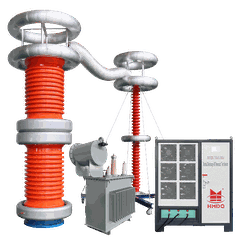



Troubleshooting Guide: Why Your AC Resonant Test System Cannot Find the Resonance Point?
Electrical engineers and field technicians frequently encounter a frustrating issue during high-voltage withstand tests: the Aesonant test system cannot find the resonance poiC rnt. When this happens, the system fails to boost the voltage to the required test levels, halting your project. In this comprehensive troubleshooting guide, we break down the exact physics behind this failure and provide a step-by-step checklist to get your high-voltage testing back on track.
Table of Contents
The Physics of Resonance: How Does it Work?
Top 5 Reasons Your AC Resonant Test System Fails to Find Resonance
Step-by-Step On-Site Troubleshooting Checklist
Industry Standards for High-Voltage Resonant Testing (IEC/IEEE)
Summary & Free Technical Support
1. The Physics of Resonance: How Does it Work?
To understand why a system fails to tune, we must first look at the core formula of an AC resonant test system. The system achieves a resonant state when the inductive reactance (\(X_{L}\)) of the high-voltage reactor equals the capacitive reactance (\(X_{C}\)) of the test object (such as XLPE cables, GIS, or power transformers).
The fundamental resonant frequency formula is:
\(f=\frac{1}{2\pi \sqrt{LC}}\)
Where:
f = Resonant frequency (typically regulated between 20Hz and 300Hz for power grids)
L = Inductance of the resonant reactors (Henry, H)
C = Capacitance of the test sample + voltage divider (Farad, F)
If the combination of your system's inductance (L) and the sample's capacitance (C) results in a frequency (f) that falls outside the tuning frequency range of your variable frequency power source, the system will never find the resonance point.
2. Top 5 Reasons Your AC Resonant Test System Fails to Find Resonance
Based on decades of field test data, 95% of tuning failures are caused by one of the following five factors:
Mismatch of Total Capacitance (C): The test object is either too short (capacitance is too low) or too long (空气/电缆 capacitance is too high) for the current reactor configuration.
Incorrect Reactor Configuration: The reactors are improperly connected. Forgetting to switch from series to parallel (or vice versa) alters the total inductance (L).
Poor or Improper Grounding: High-voltage testing requires a single-point, low-resistance ground. Loop currents or floating ground points drastically reduce the system's Quality Factor (Q).
High Corona Discharge or Corona Loss: At high voltages, sharp metal edges on connections cause air ionization. This acts as a heavy resistive load, damping the resonance.
Component Damage: A faulty excitation transformer, a cracked capacitive voltage divider, or internal insulation breakdown within the reactor.
3. Step-by-Step On-Site Troubleshooting Checklist
If your variable frequency power source sweeps from 20Hz to 300Hz and shows a flat line instead of a sharp resonant peak, follow these precise diagnostic steps:
[H3] Step 1: Verify the Reactor Configuration
Check your test object's nameplate or datasheet for its capacitance value (C). Use the resonant formula to see if your reactor configuration (L) matches it.
For small capacitance samples (e.g., short GIS, Bushings): Connect reactors in Series to increase total inductance.
For large capacitance samples (e.g., long XLPE Cables): Connect reactors in Parallel to handle higher current and decrease total inductance.
Step 2: Inspect and Tighten All Ground Connections
Ensure that the variable frequency power source, excitation transformer, reactors, and the test object are connected to the same ground grid point. Avoid daisy-chaining ground wires. The ground resistance must be less than 0.5 ohms.
[H3] Step 3: Add a Compensating Capacitor
If the test sample's capacitance is extremely small, the resonant frequency will exceed 300Hz. In this scenario, connect a compensating capacitor in parallel with the test sample to artificially increase the total capacitance (C) and bring the frequency back into the 20Hz–300Hz sweep window.
Step 4: Eliminate Corona Discharge
Ensure all high-voltage connections utilize proper corona rings (grading rings). Wrap any exposed sharp metal bolt threads or alligator clips with shielding tape or aluminum foil to smooth out the electric field.
4. Industry Standards for High-Voltage Resonant Testing
When troubleshooting or setting up your test loop, always refer to international testing guidelines to ensure compliance:
IEC 60840 & IEC 62067: Governs AC voltage withstand tests on extruded insulation power cables (30 kV up to 500 kV).
IEC 62271-203: Specifies high-voltage AC test procedures for Gas-Insulated Switchgear (GIS).
IEEE Std C57.12.00: Outlines standard criteria for liquid-immersed power transformers.
5. Summary & Free Technical Support
An AC resonant test system is a highly efficient tool for high-voltage dielectric testing, but it demands precise mathematical alignment between the system inductance and the load capacitance. When it cannot find the resonance point, checking your reactor configuration, adding a compensating capacitor, and perfecting your grounding will solve the issue in most field environments.
Need On-Site Support? Email us your test object specs (Cable length, GIS type) for a free kVA capacity calculation and customized solutions!


