

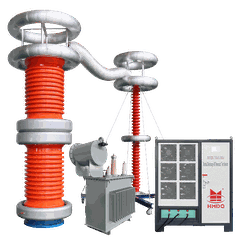



AC Resonant Test System for Industrial Motor Testing: Applications and Case Studies
1. Industry Background: The Challenges of Industrial Motor Insulation Testing
High-voltage motors (6kV, 10kV, and above) are critical power equipment in modern industrial production, widely deployed in power plants, petrochemical facilities, metallurgical mines, rail transportation, and other key sectors. The reliability of motor stator winding insulation directly impacts equipment safety and service life. AC withstand voltage testing, as an essential method for evaluating motor insulation performance, effectively identifies potential defects in winding insulation and is a mandatory procedure for factory acceptance, pre-commissioning handover tests, and routine preventive maintenance.
However, insulation withstand voltage testing of industrial motors presents a unique set of technical challenges:
Large capacitance, demanding power supply requirements. The ground capacitance of high-voltage motor stator windings typically ranges from hundreds of picofarads to several nanofarads. At power frequency, the capacitive reactance is substantial, and traditional power-frequency test transformers require enormous power supply capacity to meet testing demands.
Constrained site conditions, difficult equipment transport. Large motors are often installed in factory buildings or power plant sites, requiring test equipment to be transported to the work location. Traditional test transformer assemblies are bulky and extremely heavy, creating numerous difficulties for on-site testing.
High requirements for test waveform quality. Motor insulation is sensitive to voltage waveform distortion. Excessively distorted voltage can cause additional damage to insulation and compromise test result accuracy.
Against this backdrop, the AC Resonant Test System, with its unique technical advantages, is becoming the mainstream solution for industrial motor insulation withstand voltage testing.
2. Technical Principle: How Series Resonance Meets Motor Testing Requirements
The core principle of applying the AC Resonant Test System to industrial motor testing is to use inductance (reactors) and the equivalent capacitance of the motor stator winding under test to form a series resonance at a specific frequency, thereby generating the required test high voltage on the test object.
The system primarily consists of a variable-frequency control power supply, an excitation transformer, high-voltage reactors, and a capacitive voltage divider. The working process is as follows:
The variable-frequency power supply converts the 380V or 220V power-frequency input into an adjustable-frequency and adjustable-voltage excitation source. This is stepped up by the excitation transformer and fed into the high-voltage series resonant circuit formed by the reactor (L) and the motor stator winding capacitance (Cx) under test. By adjusting the output frequency of the variable-frequency power supply, when the frequency satisfies the formula f = 1/(2π√(LCx)), the circuit reaches resonance.
In the resonant state, the system demonstrates exceptional electrical characteristics:
Voltage multiplication effect: With a relatively small excitation voltage, a resonant voltage tens of times higher than the input can be generated across the test object (Q is the quality factor, typically between 20 and 40).
Significantly reduced power supply capacity: The resonant excitation power supply only needs 1/Q of the test capacity, substantially lowering requirements for on-site power supply conditions.
Pure sine wave output: The resonant reactor and test object capacitance form an effective filtering circuit, producing output voltage with extremely low waveform distortion.
Inherent safety protection: When breakdown occurs in the test object, resonance conditions are immediately disrupted and the high voltage automatically decreases, preventing fault escalation.
3. Technical Advantages of the AC Resonant Test System for Motor Testing
Compared with traditional power-frequency test transformers, the AC Resonant Test System offers the following outstanding advantages for industrial motor insulation withstand voltage testing:
1. Lightweight design for easy on-site transport
Traditional power-frequency test transformers can weigh hundreds of kilograms or even several tons per unit, requiring multiple personnel and lifting equipment for transport. In contrast, series resonant systems feature modular design with reactors configured in multiple separate units, significantly reducing individual component weight. The resonant excitation power supply only requires 1/Q of the test capacity, reducing system weight and volume to approximately 1/10 of conventional test equipment-particularly suitable for indoor and outdoor mobile operations in power plants and industrial facilities.
2. Low input power supply requirements
Traditional power-frequency withstand voltage testing requires power input comparable to the test capacity, while the AC Resonant Test System only needs to compensate for minimal active losses such as line resistance and thermal losses. Taking a 10kV/8800kW motor as an example, with a test voltage of 16kV, the required power supply capacity is far lower than conventional solutions.
3. High test safety
Series resonance has the inherent characteristic of "de-tuning equals voltage reduction." When insulation weakness in the motor is punctured, the circuit immediately de-tunes and the loop current rapidly drops to 1/Q of the normal test current. This feature not only protects the test object from excessive damage but also ensures operator safety.
4. Excellent voltage waveform quality
In the series resonant state, the reactor and test object capacitance form a natural filtering network, producing a pure sinusoidal output voltage with extremely low harmonic content-fully meeting the waveform quality requirements of motor insulation testing.
5. Wide applicability
By configuring different reactor combinations, a single AC Resonant Test System can cover testing requirements for motors of different voltage classes and capacities. From 6kV low-voltage motors to 20kV and above large generator units, flexible adaptation is achievable.
4. Typical Application Case Studies
Case Study 1: 10kV/8800kW Motor AC Withstand Voltage Test
A project utilized a DAXZ-216kVA/162kV variable-frequency series resonant test device to conduct an AC withstand voltage test on a 10kV/8800kW motor. The test voltage was 16kV, with an operating frequency range of 30-300Hz. The device had a rated capacity of 216kVA, output voltage waveform distortion ≤1%, and quality factor Q≥30. During the test, the system automatically completed tuning and voltage regulation, successfully passing the withstand voltage test.
Case Study 2: 10kV/13500kW Motor AC Withstand Voltage Test
Another project employed a DAXZ-216kVA/54kV/27kV/108kV variable-frequency series resonant test device for AC withstand voltage testing on a 10kV/13500kW motor. The test frequency was 45-65Hz with a test voltage of 16kV. This solution also accommodated testing requirements for other equipment such as 35kV PTs, demonstrating the flexible multi-purpose configuration capability of the series resonant system.
Case Study 3: 300MW Turbine Generator Stator Winding Withstand Voltage Test
In March 2010, a power plant used a frequency-modulated series resonant test device to conduct an AC withstand voltage test on a QFSN-300-2 type 300MW turbine generator. The generator had a rated stator voltage of 20kV, with a measured phase-to-ground capacitance of 0.3008μF. The series resonant device effectively overcame the challenges of bulky traditional power-frequency test equipment and insufficient power supply capacity, successfully completing the test.
Case Study 4: Hydrogenerator Insulation Testing
In the insulation testing of Three Gorges 700MW hydrogenerators, technicians combined a series resonant device with a dielectric loss tester for stator winding dielectric loss and capacitance measurement. This method was successfully validated on large hydrogenerators, demonstrating the broad application prospects of series resonant technology in ultra-large motor testing.
5. Industry Trends: The Evolution of Motor Insulation Testing Technology
As industrial motors continue to advance toward larger capacity and higher voltage, motor insulation testing technology is exhibiting the following trends:
Increasingly stringent testing standards. Domestic and international standards such as GB/T 1032, IEC 60034-1, and IEEE 43are establishing increasingly explicit requirements for motor insulation test voltages and procedures. Test voltages are typically 1.5 to 2.0 times the rated voltage.
Growing demand for on-site testing. With the widespread adoption of condition-based maintenance philosophies, an increasing number of motors require insulation testing at installation sites or in operational locations. The lightweight design and low power supply requirements of the AC Resonant Test System align perfectly with this trend.
Integration of multiple testing technologies. Pure AC withstand voltage testing is gradually being combined with partial discharge detection, dielectric loss measurement, insulation resistance testing, and other diagnostic methods to form comprehensive insulation assessment systems.
Digitalization and intelligence. Next-generation series resonant test systems integrate automatic tuning, data logging, remote diagnostics, and other features, substantially improving the efficiency and reliability of on-site testing.
6. Conclusion
The AC Resonant Test System, with its outstanding advantages of lightweight design, low power supply requirements, excellent waveform quality, and inherent safety protection, has become the ideal choice for industrial motor stator winding insulation withstand voltage testing. From 10kV medium and small motors to 300MW large generator units, from factory acceptance to on-site preventive maintenance, series resonant technology is providing a solid technical foundation for the safe and reliable operation of industrial motors.
For engineers and technicians engaged in motor insulation testing, a thorough understanding of the AC Resonant Test System's working principles and configuration methods, as well as mastery of test parameter selection for typical motors, is the key to ensuring test quality and safety.


