

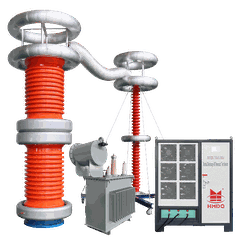



Cylindrical AC test transformers: Technical perfection in high-voltage testing

High voltage testing requires equipment that is designed with precision to guarantee both safety and accuracy. Among the various models available, cylindrical AC test transformers have become the preferred solution thanks to their unique structural advantages and reliable performance, especially in demanding electrical testing scenarios.
Structural advantages of cylindrical design
The cylindrical configuration is not just an aesthetic choice, but a calculated technical decision. This geometry offers three fundamental advantages:
1.Better distribution of the electric field
The absence of sharp edges minimises field concentration points, allowing for a more uniform distribution of stress on insulating materials. This feature is especially valuable when testing equipment such as cables or shunts, where field uniformity directly affects measurement accuracy.
2.Greater mechanical stability
Axial symmetry allows for even weight distribution, making these transformers extremely resistant to vibration and mechanical stress during transport or operation. This resistance ensures stable performance in field testing environments.
3.Optimised thermal management
The cylindrical form factor provides a higher surface-to-volume ratio compared to rectangular designs, significantly improving heat dissipation capacity during prolonged testing. This thermal performance contributes to longer service life and reduced heat loss.
Critical applications in power supply systems
These transformers are widely used for:
- Routine voltage withstand tests for switchgear and transformers.
- Insulation diagnostic tests for rotating machines.
- Type tests for high-voltage components in accordance with IEC standards.
- Research and development applications in high-voltage laboratories.
Technical considerations for selection
When evaluating cylindrical test transformers, professionals should consider the following:
- Nominal voltage compatibility with test requirements.
- Cooling method (oil-immersed designs and dry-type designs).
- Need for portable or stationary configuration.
- Compatibility with existing test consoles and measurement systems.
Innovations in cylindrical transformer technology
Modern versions include advanced features such as:
- Coils with stepped design to reduce resistance
- Multilayer electrostatic barrier
- Integrated partial discharge measurement functions
- Smart monitoring interfaces for real-time parameter monitoring
These innovations reflect the industry's ongoing pursuit of greater accuracy and operational safety, while maintaining the original advantages of the cylindrical design philosophy.
Conclusion
Cylindrical AC test transformers represent a mature but constantly evolving technology in the field of high-voltage testing. Their geometric advantages offer tangible benefits to test engineers seeking reliable, accurate, and durable test solutions. As power delivery systems evolve with ever-higher voltages and smarter grids, the fundamental principles of these transformers continue to provide a solid foundation for testing electrical insulation and installations.


