

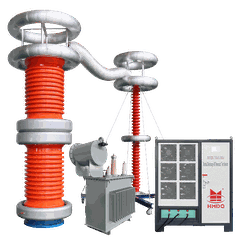




In the field of electrical equipment insulation testing, the DC high-voltage generator serves as a core tool for verifying the insulation performance of equipment such as cables, surge arresters, and transformers. The scientific soundness of its operating principles directly impacts the accuracy of test data and the safe operation of equipment. Leveraging years of expertise in high-voltage testing technology, Wuhan Goldhome Hipot Electric Co., Ltd. has developed its HMZGF series of DC high-voltage generators. Centered on high-frequency pulse width modulation (PWM) technology, closed-loop feedback control, and multiple safety protections, these generators provide stable and reliable DC high-voltage testing solutions for power users worldwide. This article offers an in-depth analysis of the operating principles of Goldhome DC high-voltage generators.
Voltage Generation Principle: High-Frequency Inversion and Voltage-Doubling Rectification
The core operating principle of Goldhome's DC high-voltage generators is based on the combination of high-frequency inversion technology and voltage-doubling rectification circuits. The equipment first rectifies and filters the input 220V AC power supply, converting it into smooth DC power. Subsequently, using high-frequency pulse width modulation (PWM) technology, the DC power is inverted into a high-frequency AC square-wave signal. This design significantly improves power conversion efficiency while substantially reducing the size and weight of the transformer.
The high-frequency AC signal is stepped up by a high-frequency high-voltage transformer and fed into a multi-stage voltage-doubling rectifier circuit. The voltage-doubling circuit employs a cascaded structure of capacitors and diodes, utilizing the energy storage properties of capacitors and the unidirectional conductivity of diodes to progressively add voltage in each half-cycle. Goldhome's voltage-doubling cylinder features a fully solid-state encapsulation using DuPont materials, overcoming the inconveniences of traditional gas-filled or oil-filled equipment and resulting in a compact design and easy maintenance.
Closed-Loop Control and Voltage Stabilization Principle
Goldhome DC high-voltage generators employ an advanced closed-loop feedback control system to ensure high output voltage stability and a low ripple coefficient. The equipment features a built-in high-precision voltage sampling circuit that continuously monitors the actual voltage at the high-voltage output terminal and feeds the sampled signal back to the control circuit. The control circuit compares the feedback value with the setpoint and precisely regulates the output power of the high-frequency inverter circuit by adjusting the duty cycle of the PWM signal.
This closed-loop control mechanism gives Goldhome equipment the significant advantages of high voltage stability and a low ripple coefficient, with a ripple coefficient better than 0.5% and voltage regulation accuracy within 0.1%. Even when the input voltage fluctuates by ±10%, the output voltage fluctuation can still be controlled within 0.5%, ensuring a stable and reliable testing process.
Leakage Current Measurement Principle
During DC withstand voltage testing, Goldhome equipment uses a high-precision microcurrent sampling circuit to monitor the leakage current of the test object in real time. A precision sampling resistor is connected in series at the low end of the high-voltage circuit to convert the current signal into a voltage signal, which is then amplified, filtered, and sent to the ADC for digital processing.
Goldhome's current measurement resolution reaches 1 μA for the control cabinet and 0.1 μA for surge current, with a measurement accuracy of 0.5%. To address the specific testing requirements of zinc oxide surge arresters, the equipment also features a 0.75-times voltage latch function, which automatically measures and locks the leakage current value after the voltage is reduced, enabling one-button synchronized testing of the U1mA reference voltage and 0.75U1mA leakage current.


